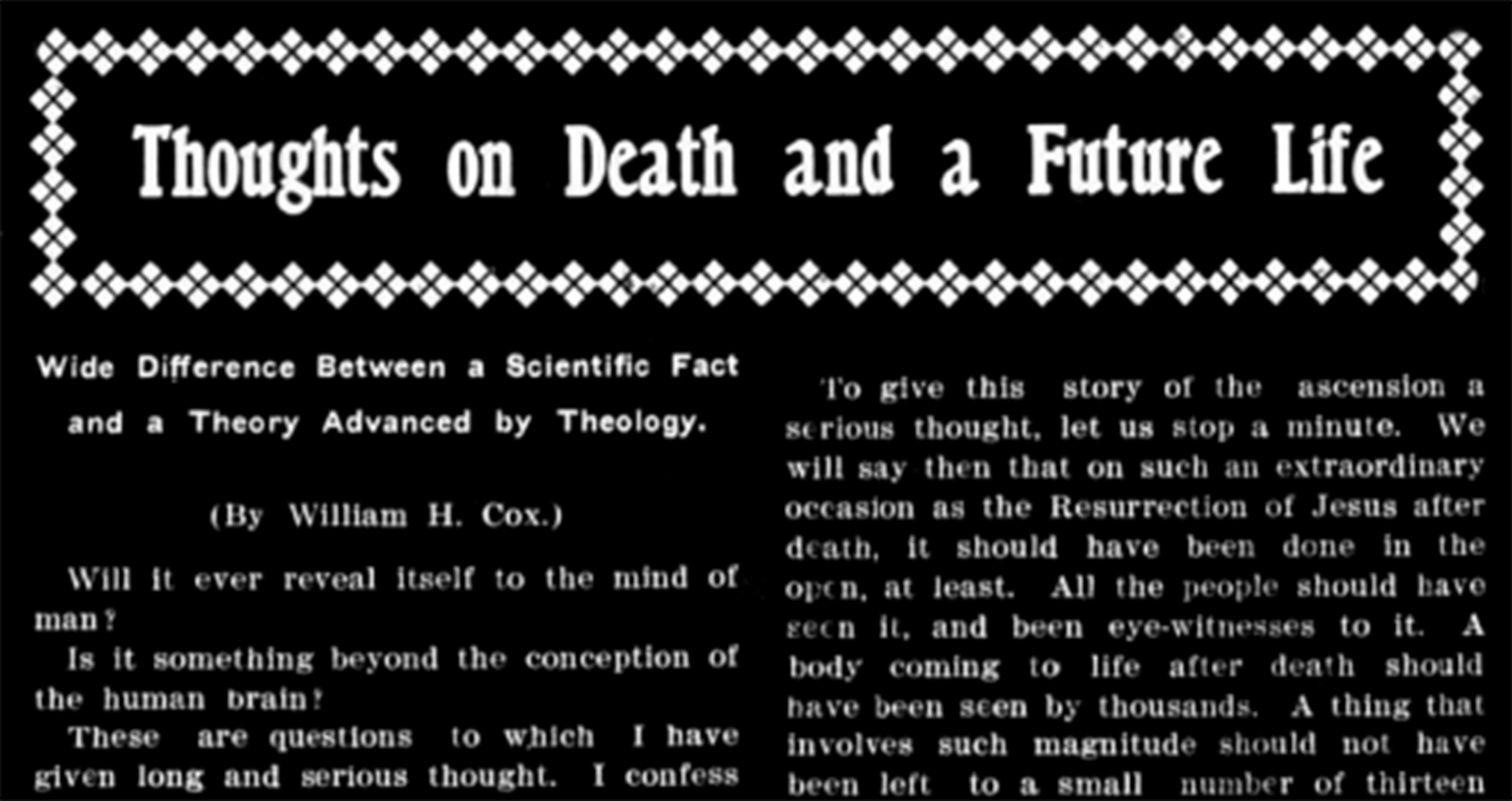
Thoughts on Death & a Future Life – William H. Cox, 4/12/1908
Republished from the free-thought publication the Blue Grass Blade
Will it ever reveal itself to the mind of man? Is it something beyond the conception of the human brain?
These are questions to which I have given long and serious thought. I confess I do not know, and I do
not think any other man does know. We all see death and have no positive proof of any life beyond death.
Then death seems to me to end all. Of the millions upon millions of the human family that have preceded
us in death, not a single one of them has come back to confirm life after death. There are some people
who believe there is life after death—that is, that the spirit lives beyond the death of the body—and they,
to confirm their theory, cite the “Resurrection of Jesus” after death. They think they know exactly what
death is, but they only give us a superstitious theory to substantiate their claim of life after death. There
is a vast difference between a theory and a living fact or truth. I cannot accept their theory as real truth,
and the difference between a theological fact, so called, and a demonstrated scientific fact is as wide as
the North and South Pole, or as the rising and setting of the sun, or as between day and night. In other
words, it does not harmonize with the best thoughts of the human family. On the other hand, a scientific
fact is something which can always be demonstrated to be absolutely correct. This, then, is the difference
between a fact and a theory. The theologians give us nothing but a theory to support their belief. Theologically,
the story may be right, but scientifically it is not. There are thousands upon thousands of good men and women
in this world of ours who reject the whole story, and some always will. To some people, the account of the
ascension may not be clear enough, and to others it may border too much on sleight of hand, or legerdemain,
to suit them. From my own point of view, I reject it both ways. We have long since ceased to look to theology
for any truth. We now look to science for all truth, just as a child looks to its parents for its support.
All truth worth recording we owe to science, and right here I wish to say that all scientists worthy of the name
reject theology. If we are to give this story of the ascension serious thought, let us stop a minute. We will say,
then, that on such an extraordinary occasion as the resurrection of Jesus after death, it should have been
done in the open, at least. All the people should have seen it and been eyewitnesses to it. A body coming
to life after death should have been seen by thousands. A thing that involves such magnitude should not
have been left to a small number of thirteen people—Mary Magdalene and the other Mary, and eleven of
his own disciples. I have the same right to doubt it as the apostles of his own choice did in that time, and I
frankly declare that the whole story is written in such a childish way that I cannot harmonize it with reason.
I was forced by my own reason to abandon it long ago, and I look upon it now as an ancient history written
by and for an ignorant people, and it should have no place in modern literature. Let us dig a little deeper
under their temple. The first thing we see is a robber. We go a little further and see this robber’s name on
the roster, recorded as a full-fledged member, with his dues paid ahead. He is the most influential member
of his church. He is capable of offering up the loudest and most sincere prayer to his omnipotent God. Now
stop again. Is it an uncommon thing in this age to see where some great financier has gone wrong and
robbed the whole community, stolen the very bread from the washerwoman and her helpless children,
taken the last cent from the poor mechanic who has toiled unceasingly to accumulate enough to secure
his beloved family a home? In many cases of this kind, it has driven men to commit suicide. Then this
family, who was the joy and life of this poor man, has been cast adrift in this cold world and left to subsist
the best they can on sweet charity.
Then stop preaching this old dogma, and tell man that this is the only life worthy of serious thought. Begin
in his infancy and teach him that there is nothing more noble than truth and justice, morality and reason,
charity and love. Teach him that these things are the paramount issues of his mission in this life. Teach
him that all other life depends, to a large degree, on his cultivation of those principles in his moral, mental,
and physical self. Let the church stop giving passports into this supposed kingdom of heaven. This, and
this alone, has been the cause of more war, murder, bloodshed, and strife than any other one thing that
was ever conceived by the brain of man. In this enlightened age, when we look back over the dark, gloomy,
and bloody past, it is enough to cause a thrill of horror to see the countless millions of human beings that
have been sacrificed in the cause of this Christian God. My Christian friends, you cannot do without war.
It has been associated with you ever since you showed any signs of strength, and as long as you have
any strength you cannot let go of it. War has gone hand in hand with you from Genesis to Revelation. My
Christian friend, can you tell why so many of the best and most highly educated people of the past and
present have disbelieved your theory of God and the future? Here are a few reasons I give you why a
freethinker cannot accept your dogma: They cannot harmonize an omnipresent God with disaster on land
and water. They cannot harmonize a God of love and mercy with war and murder. They cannot harmonize
a God of infinite wisdom with ignorance and vice. They cannot harmonize a God with famine and flood.
They cannot harmonize the birth and resurrection of Jesus with reason, nor do they believe that Jesus
ever did rise from the dead, or that saints ever arose from their tombs and walked into the city. It may
have been customary in that early age for the dead to get up from their graves and make a parade, but
this does not hold good here in this twentieth century. And now to my friends, ministers of the gospel: you
have been preaching this holy Bible doctrine for the last nineteen hundred years. Has there been a single
one of you in all this time that has saved a single human soul and sent it into the kingdom of your God?
What! Did you say “yes”? Then, if you have any particular regard for me, will you not send me this party’s
particular address so that I can get into communication with him, that he may confirm your word?