Methods of Torture – Unknown, 12/11/1887
We combined some smaller sections into larger paragraphs
The term “torture” is derived from the Latin word torquere, which means to twist or bend. As used in this
article, the term applies to torture inflicted in obedience to the mandate of the monarch or of the authorities
of the state. Torture administered by individuals in their private capacity, therefore, will not be touched upon.
In the sense in which the word is employed here, torture was used by the state mainly to extract from the
persons tortured an avowal of guilt, a revelation of accomplices, or testimony in general, says a writer in
the St. Louis Globe-Democrat. Torture, for one or another of the purposes named, was in vogue from a very
early age. It was in such general vogue among the Greeks several centuries before the beginning of the
Christian era that it became incorporated in their legal procedure and grew to be a regular feature of the
administration of their laws. Torture was one of the legacies which the Greeks bequeathed to their Roman
conquerors. Under the rule of these world-subjugators, the uses of torture were extended and the implements
by which it was inflicted increased. Among the Greeks, torture could be administered to slaves only. Immunity
from torture was one of the most precious privileges of the free Hellenic citizen in the days of Grecian greatness.
An exception was made, however, in the case of persons suspected of crime against the state. To discover
guilt in offenses of that character, torture was sometimes inflicted on persons without distinction of social
status or rank. Under Roman rule, the free citizen did not enjoy the exemption from torture which was
extended to him by the Greeks. By decrees of Nero, Domitian, and other despots, it was often inflicted
for offenses purely imaginary. It was inflicted even on persons of high rank and on both sexes.
THE PURPOSES OF TORTURE
A word may be necessary here in explanation of the full purpose of torture. It was, as already intimated, inflicted
with the object of discovering crime, whether committed by the person tortured or by his accomplices. Sometimes,
however, it had another purpose. In cases of religious persecutions, it was employed to compel heretics to retract
or unbelievers to subscribe to the tenets of some particular faith. There were two grades of torture inflicted, the
distinction being in their relative severity. One form was termed the “question ordinary,” and the other the “question
extraordinary.” The first involved a comparatively mild use of the instruments of torture. The second, however,
included the extremest severity compatible with the preservation of life. There was a distinction also made in
the “threats of torture.” There was what was called “verbal territion,” in which the executioner described the
torture, and the “real territion,” when the victim was put upon the rack but the torture not administered. There
was also a distinction regarding the time of the application of torture. For example, it was called in one phase
the “question preparatory,” and in another the “question preliminary.” In the first case it was for the purpose of
compelling the suspected person to confess that he himself was guilty, and in the second it was employed to
induce him to reveal his confederates.
SPREAD OF THE SYSTEM OF TORTURE
The adoption of the system of torture by Rome, and its extension during the empire to all the countries dominated
by that nation, gave it a firm foothold throughout Europe and part of Asia. In the Middle Ages it was a feature of
the examination of persons in every part of the world in which the Code of Justinian formed the basis of law. There
is some doubt as to whether torture formed any part of the common law of England. Many British writers contend
that it did not. However, the dispute on this subject seems to be upon a mere abstraction, for there was a system
of procedure in law in England which was, in all essential respects, torture. This was known as peine forte et dure,
French words denoting harsh and severe punishment. If a prisoner indicted for any capital offense refused to
answer the charge preferred against him, and so prevented his trial from taking place, he was condemned to
the punishment of peine forte et dure. The prisoner was laid on his back, nearly naked, in a dungeon, with heavy
weights put upon his breast. While subjected to this ordeal, he received a small allowance of water one day and
a small portion of the coarsest and hardest bread the next day. These rations were alternated until the victim
either consented to plead or died. This was the form which the punishment of peine forte et dure took when first
introduced. Subsequently, however, the system was changed so that it became a death penalty. A person refusing
to answer to an indictment could not secure a release by consenting to plead; the punishment was continued
until death.
THE ERA OF TORTURE
Torture was recognized, either by law or custom, in the principal European countries for many centuries. It
probably assumed more phases in Germany than in any other part of the world during the latter portion of the
Middle Ages. A complete set of the implements of torture is still displayed in the town house of Ratisbon, in
Bavaria. Torture was not formally abolished in Germany until about the beginning of the present century.
Practically, however, it had gone out of use half a century earlier, although it was employed to some extent
when Howard, the English philanthropist and prison reformer, visited Germany in 1770. It was abolished in
France during the Revolution, though it had already gone into disuse thanks to the efforts of Voltaire, Rousseau,
Beccaria, and others. Russia abolished it in 1801. In Austria it was suspended about the middle of the last
century, although instances are on record in which it was inflicted up to near the beginning of the present
century. The punishment of peine forte et dure was abolished by law in England in 1772, during the reign of
George III. It had been employed from time to time since the days of Edward I in the thirteenth century. The
last time it was judicially resorted to, however, was in 1640. Torture was in vogue in Scotland until after the
Restoration, but was abolished early in the reign of Queen Anne.
TORTURE IN THE AMERICAN COLONIES
Torture, in the sense in which the word is generally employed, was seldom used in the American colonies. It was
frequently used as a punishment for necromancy, sorcery, or witchcraft. In that connection it was a death penalty
and not torture proper. There are very few cases on record in which it was used in this country to compel confession
or to reveal accomplices, and not many instances in which it was employed to induce the retraction of religious
views opposed to the general belief of the community. Stories are told of its having been resorted to occasionally
by the Spaniards during their dominance in the southern portion of the country, especially in Florida. One well-
authenticated case of peine forte et dure occurred during the witch trials in Massachusetts. Giles Corey, husband
of a woman accused of witchcraft, refused to answer questions at his trial. Neither threats nor blandishments
could induce him to speak. The court ordered the torture. Though over eighty years old and in feeble
health, the pressure of the heavy weights upon his breast rendered him only more obdurate. The
punishment continued until his death.
TORTURE UNDER ECCLESIASTICAL DIRECTION
The most cruel and barbarous cases of torture on record were those inflicted by church authorities. During the
days of the Inquisition, nearly all devices which fanaticism, ignorance, and ingenuity could devise were employed
either to extirpate heretics or to bring them under spiritual control. The number of persons put to death in Spain,
Germany, the Netherlands, France, Italy, and other countries under the decrees of the Inquisition is believed to
number in the millions. Torture was not inflicted under ecclesiastical direction prior to 1252, when Pope Innocent
IV called upon secular powers to torture those accused of heresy.
VARIOUS INSTRUMENTS OF TORTURE
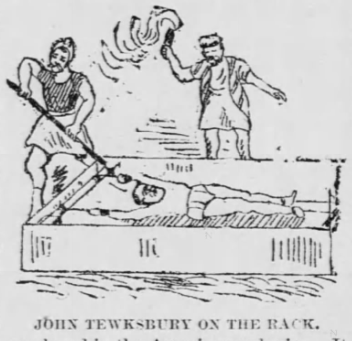
The most commonly used instrument of torture was the rack. It consisted of an oblong frame laid horizontally,
upon which the victim was stretched. Rollers at each end were turned by levers, tightening ropes bound to
the wrists and ankles. By this means joints were often dislocated. Variants included racks fitted with spikes,
or vertical racks where victims were hoisted and dropped suddenly, producing violent shock. The boot was
widely used in continental Europe, particularly in France and Spain. It consisted of an iron casing into which
the leg was inserted, wedges or screws being driven to crush the flesh and bones. In many cases the leg
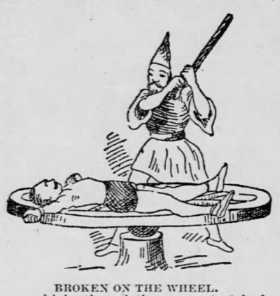
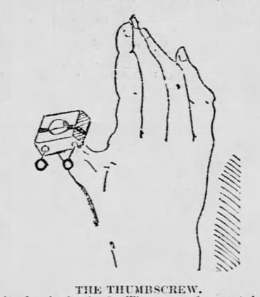
was permanently destroyed. Other instruments included the scavenger’s daughter, thumbscrew, pincers,
manacles, and the wheel. Torture also included confinement in the “little ease,” pulling out hair, tearing off
nails, prolonged water torture, and burning skewers inserted beneath the nails.
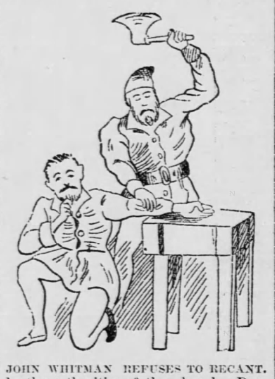
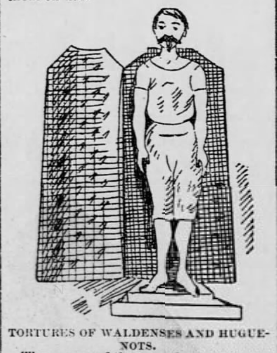
TORTURES OF WALDENSES AND HUGUENOTS & WAS GALILEO’S TORTURE PHYSICAL?
The number of notable individuals subjected to torture is countless. Particularly infamous are the persecutions
of the Waldenses and Huguenots. John Milton memorialized the suffering of the former in his famous sonnet
beginning: Avenge, O Lord, thy slaughtered saints, whose bones Lie scattered on the Alpine mountains cold…
Whether Galileo suffered physical torture remains disputed. Records confirm severe moral torture and threats
of physical punishment should he refuse to recant his support of the Copernican system. At age seventy, clad
in sackcloth, he publicly and humiliatingly recanted before the Roman court. Tradition claims he murmured, “E
pur si muove” (“And yet it moves”), though this cannot be verified. What is undisputed is that Galileo endured
profound moral suffering and the constant threat of physical torture.
Select Pictures from the article: