Mastering the Water, Rice, Etc – The Khmer Rouge, 1977
Republished from Democratic Kampuchea is Moving Forward
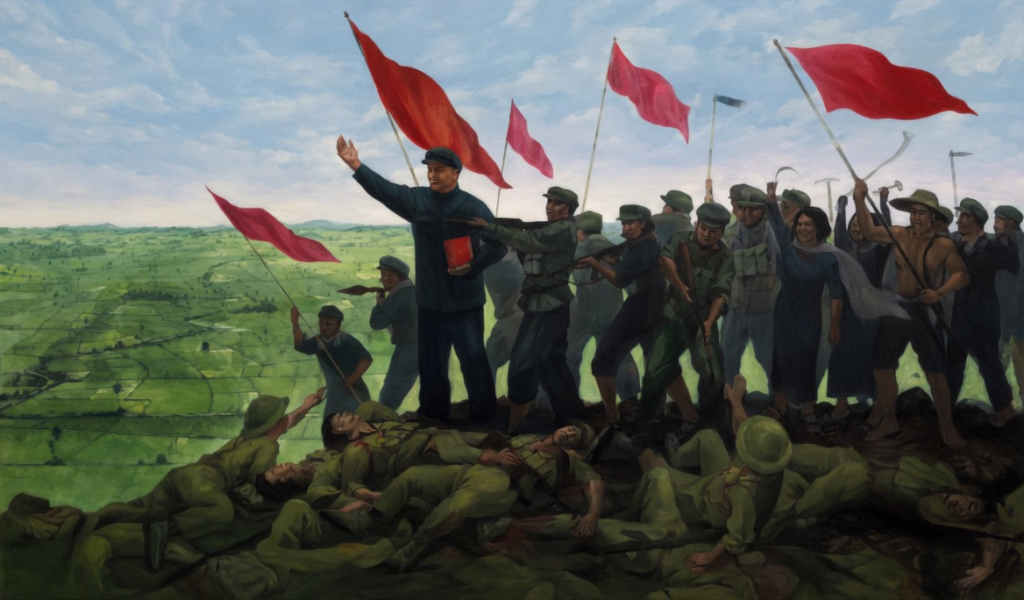
Everywhere in the country — in the countryside, in the factories, and in the units of the Revolutionary Army
— joy, enthusiasm, and emulation prevail. The trade-union workers, the cooperative peasants, the men and
women fighters, and the cadres of the Revolutionary Army mobilize all their physical, moral, and intellectual
forces. They put forward their creative spirit and ingenuity, their combativeness and revolutionary heroism,
in conformity with the principles of independence, sovereignty, and self-reliance, in order to successfully fulfill
their revolutionary tasks of national defense and construction. Being masters of the destiny of their country,
with determination and revolutionary optimism, they have transformed nature with their own hands to build a
new, prosperous, and healthy society. In this society, happiness, equality, justice, and genuine democracy
prevail. There are neither rich nor poor, neither an exploiting class nor an exploited class. All the people live
in harmony, in great national unity, and are closely united together to participate in production, to defend, and
to build up the country. Tens of thousands, twenty thousand, thirty thousand people are working at each constr
-uction site to build reservoirs, canals, dikes, and more. The work is advancing rapidly. The rural areas of
Democratic Kampuchea are undergoing profound changes. The mobilization of this powerful collective force
has been possible thanks to the ardent patriotism and the close unity of all the worker-peasant people and the
Revolutionary Army under the leadership of the Revolutionary Organization. It has also been made possible
by the establishment of trade unions and agricultural production cooperatives throughout the country, which
are imbued with a lofty community spirit. In the difficult situation left behind by the devastating war of aggression,
when the people lacked everything, this collective force has overcome all difficulties and obstacles and won
great victories in all fields — political, defense, economic, cultural, social, and others.
These victories would not have been possible without the many acts of self-sacrifice and heroism displayed
by the revolutionary mass movement. These victories have rapidly improved the living conditions of the worker
-peasant people and the Revolutionary Army, who now enjoy the full fruits of their efforts. Their pride and
attachment to the Revolutionary Power and the communal regime of the new society have been further
strengthened. They are more determined than ever to defend their Motherland and the gains of the Revolution,
and to redouble their efforts in rapidly building the new society. Taking agriculture as the fundamental factor
and industry as an important factor, on the basis of the principles of independence, sovereignty, and self-reliance
— such is the line defined by the Revolutionary Organization of Democratic Kampuchea for the construction
of an independent national economy. In Democratic Kampuchea, an agricultural country, agriculture is the main
source of capital accumulation for the progressive construction of light and heavy industry. In the present phase
of national construction, everything, including industry, is placed at the service of the development and modern
-ization of agriculture, and particularly rice cultivation. For this purpose, mastery of water is a vital necessity.
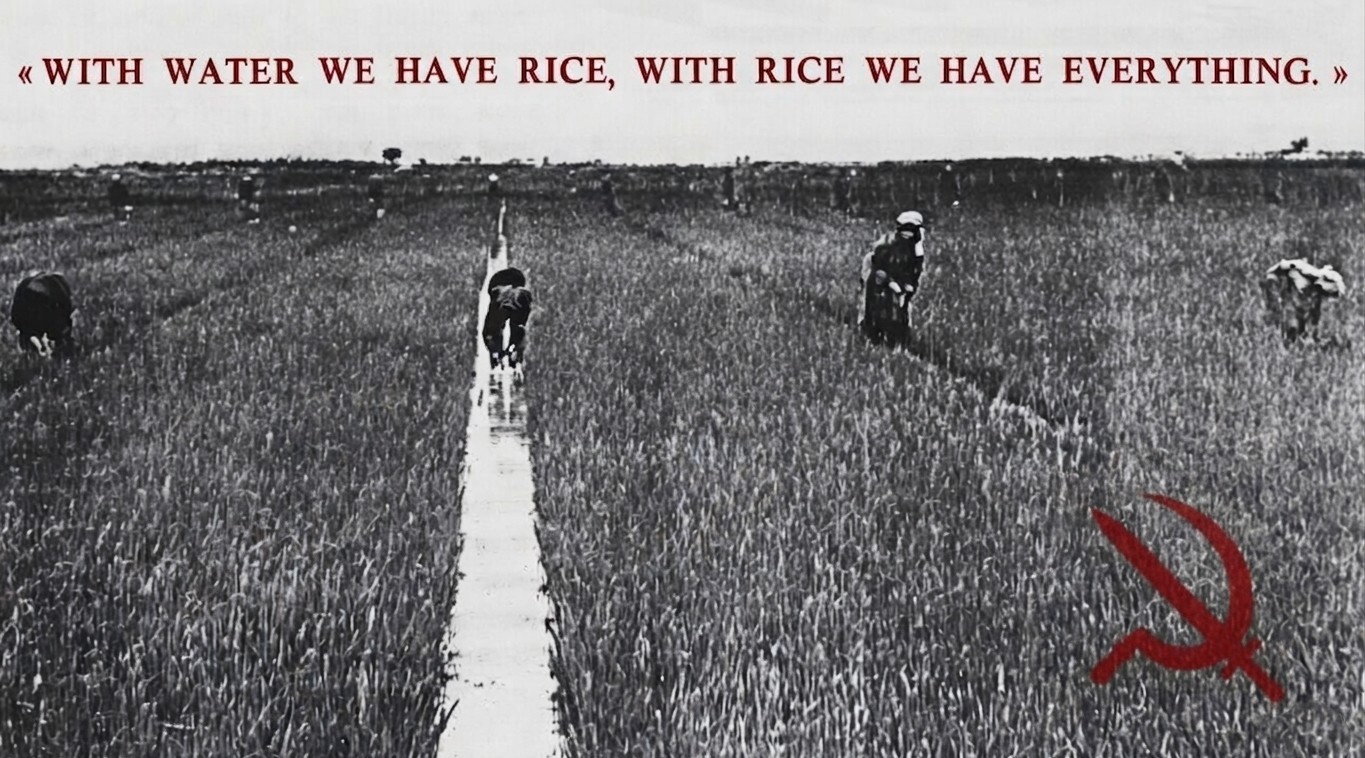
Under the slogan “With water we have rice, with rice we have everything,” the agricultural production cooperatives
have mobilized their forces to transform the rice fields into checkerboard patterns and to develop irrigation systems.
They have carried out major hydraulic works that now irrigate vast areas of land, both in the dry season and the
rainy season, thus enabling two rice crops a year on all fertile soils. Before the Revolution, during the dry and hot
season (March to mid-May), the rural areas were arid. Now they are covered with hundreds of thousands of
hectares of dry-season rice cultivation. Water is flowing abundantly.
And where there is water, the scenery is fresh, life is pleasant, spirits are high, and culture flourishes. Never
before has the countryside known such radical changes. The sight of rice fields arranged in checkerboards,
along with networks of irrigation canals, dikes, and reservoirs appearing everywhere in the countryside, shows
that, thanks to the cooperatives, the peasants have gained great mastery over water and have reached a
high level of political consciousness. This strengthens the confidence of the worker-peasant people in the
radiant future of their Motherland and in their own future. Before the Revolution, agriculture — and especially
rice cultivation — was very backward. Poor peasants individually farmed small plots of land, paying a rent of
about 50 percent of the crop, and were crushed by usury at a rate of 12 percent per month. Landowners and
capitalists each seized hundreds of hectares of land and possessed agricultural machinery. Yet for everyone,
crops depended mainly on weather conditions. Furthermore, fertilizers and insecticides imported from foreign
countries were extremely expensive and were hardly used. On May 20, 1973, in the midst of the war of aggression
by the US imperialists — who had mobilized all their air forces in the Pacific and Southeast Asia against Kampuchea
— the first cooperatives were established. During the people’s and national liberation war, these cooperatives
served as solid bases for both the front and the rear. At the front, they were an inexhaustible source of supplies,
of men and women fighters, and of moral and material support. At the rear, they abolished all feudal and capitalist
relations of production, mobilized all forces and means of production, and solved all supply problems in full
independence and sovereignty. At present, agricultural production cooperatives exist throughout the country.
They serve simultaneously as the basic units of people’s power and of agricultural production. Parallel to the
movement of hydraulic works for mastering water, these cooperatives are vigorously advancing and sustaining
a powerful movement to produce fertilizers and insecticides using resources that are abundantly available
everywhere in the country. The most commonly used fertilizers are natural ones made from fertilizing plants
(such as eupatorium, etc.), manure, compost, mud, silt, and others.
Every year, each cooperative prepares tens of thousands of tons of fertilizer in order to improve the soil at
an average rate of 10 tons per hectare. The insecticides are prepared from three poisonous plants and are
very effective: they destroy insects and also have a fertilizing effect on the crops. Each cooperative has its
own workshop for preparing insecticides. Moreover, great care is given to seed selection. Before harvesting,
the best plants with the largest grains are selected and kept as seed stock. Finally, the agricultural production
cooperatives have continuously discovered and developed more modern tools and agricultural machinery
better suited to the needs of developing production. They have progressively equipped themselves with motor
pumps, planting machines, threshing machines, winnowing machines, and more. Besides all these agricultural
techniques, the cooperatives attach particular importance to the organization, distribution, and efficient use
of labor power, draft animals, machinery, and tools. A great impetus has thus been given to rice production
in all areas. At present, there is no dead season in the countryside. In 1975, the cooperatives obtained a suf
-ficient crop to cover the needs of national consumption. In 1976, the crop was better than in 1975. It was
enough to feed the entire population and produced a surplus for export. In 1977, just two years after liberation,
Kampuchea once again exported rice. All these rapid results have been achieved in the difficult conditions
left by the devastating war of aggression, when the agricultural production cooperatives lacked everything
and the worker-peasant people had nothing but their bare hands. But the just and far-sighted leadership of
the Revolutionary Organization, the collective strength of the worker-peasant people and the Revolutionary
Army, their high political consciousness, their determination to struggle, their communal spirit and way of life,
their self-sacrifice and endurance in the face of all difficulties, and finally their creative spirit in the service
of the Revolution and the Motherland — these have been the decisive factors. These results have further
strengthened the confidence of the worker-peasant people and the Revolutionary Army in their ability to
build the country and in the line of the Revolutionary Organization, which consists in transforming backward
agriculture into modern agriculture while remaining independent, sovereign, and self-reliant.