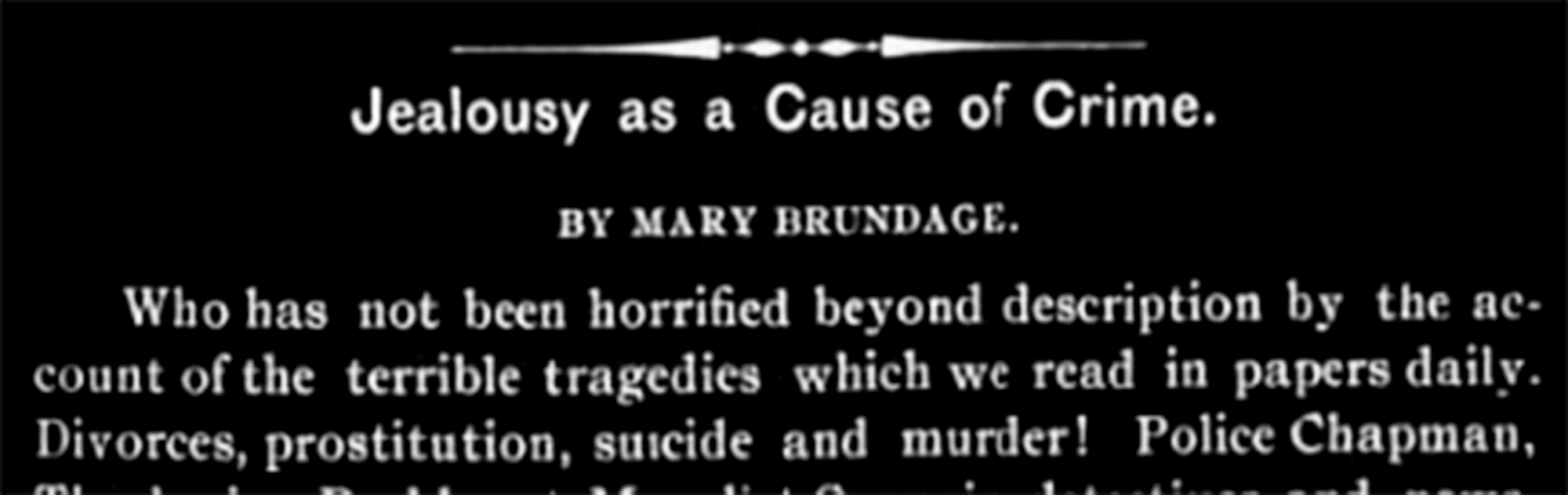
Jealousy as a Cause of Crime – Mary Brundage, 5/13/1899
Republished from our predecessor publication Lucifer the Light Bearer
Who has not been horrified beyond description by the accounts of the terrible tragedies which we read in
the papers daily—divorces, prostitution, suicide, and murder? Police, Chapman, theologian Parkhurst, moralist
Grannis, detectives, and newspapers are all busy trying to find a remedy for the social evils that beset us.
Neither divorce, nor consecrated marriage permitting no divorce, reduces inharmonies in family life in general.
Arrest and punishment of solicitors on the street do not stop prostitution. Clearing the “Bowery” only transfers
the evils to another location. Laws against attempted suicide furnish no incentive to live when the real desire
for death comes, and electrocution has not terrors enough to stay the hand of the murderer. No one seems
to expect to cure the evil. Mrs. Grannis thinks not one man in ten outside the church is virtuous. She does not
tell the people the proportion in the churches. Grant thinks even Christianity helps only the few, and proposes
to keep the evil stream within a certain channel by the wall of segregation. Detectives hunt up culprits and the
law shuts them up, and no one seems able to assign a cause for such evils. What is the reason for persons
acting so badly? When I read of the Guldensuppe murder, I asked, “How could they cut a man up so, even if in
a passion they killed him?” A friend replied: “Jealousy could do it; ninety per cent of all murders are caused by
jealousy.” I believe that is the cause of all the troubles mentioned. Humanity has come to look upon love as a
commodity, one and indivisible. The person who loves is held to be able to limit that love, or, if not, he or she is
very immoral. Hence, at the first intimation that any love is expressed for another, there is the terrible fear of loss
and the suffering of envy an uncultured person feels when he sees a superior do something he would like to do
and cannot do. I am well aware that society does not want to look at the question in this way; it wants to see it in
the accustomed way, the old-fashioned way.
For generations, laws and customs have tried to enforce the ideas of conventional morality now upheld; they have
never succeeded. Love will risk being murdered rather than go unexpressed, and the owner of another’s love will
risk electrocution rather than yield its property rights. There is one solution to this trouble, and that is education. Love
is appreciative of those attributes and things in life that make us most happy. We appreciate one person’s music
without expecting to be blamed if another musician touches chords that thrill us as well. We admire the oratory of
a Phillips without censure because we also love the speech of a Beecher. We cannot choose whether a white, a
red, or a yellow rose is sweetest. In everything in life except love of individuals, we think a person more cultivated
who understands and loves many things than one who knows but one thing. A real, true appreciation of this fact
will make any one of us understand that love for another does not weaken love for one. A woman or a man must be
a great egotist who thinks himself or herself capable of supplying another person’s wants to the extent that no one else
is loved. When I look around me and see women who are my superiors—some in beauty, some in one accomplishment,
some in another, some in education, etc.—I feel that I could not love a man who had so little appreciation of these
qualities that he did not see and love them, or who was hypocritical enough to deny it. When a man I love tells me of
his love for others and what he loves in them, I can believe him when he says he loves me. The man who loves me
best, and whom I love best, is the one whose nature I harmonize with in most ways. But because I love him in many
ways, is that any reason why I should withhold my love, in some one way, from the person who has one superior claim,
or that I should be jealous because my lover finds a counterpart in some other person in something I have not?
Not at all. I certainly should not prohibit him from something because I cannot supply it. Then, if he loves me for my
gentleness, affection, and intellect, how can he help loving the same things in others? There is no ground for jealousy
in natural appreciation. It is in our notions, our habit of ownership of the property and person of the one we love. We
talk a gospel of love, but enact and enforce a policy of hatred. It is legal and moral to express hatred for your neighbors,
but illegal and immoral to express love, especially if you are really sincere in it. An understanding of the question is
the only thing that will do away with jealousy and its consequent crimes. When we are not forced by society to lie
about love, when we can acknowledge we love as many as we do love without being considered wicked, deceit and
treachery will have no place, and then all can love and be loved. No woman will need to solicit a man on the street,
no man will be so depraved as to have no choice and accept such a woman; prostitution will die a natural death. The
time spent by intriguing wives and husbands to prevent an expression of love can be put to self-improvement and
make them worthy of love. No one will murder another for jealousy, and Parkhurst, Chapman, and Grannis can enjoy
their own lives instead of trying to regulate the lives of others. This is no visionary theory; it is in practice and eminently
successful with many persons now.