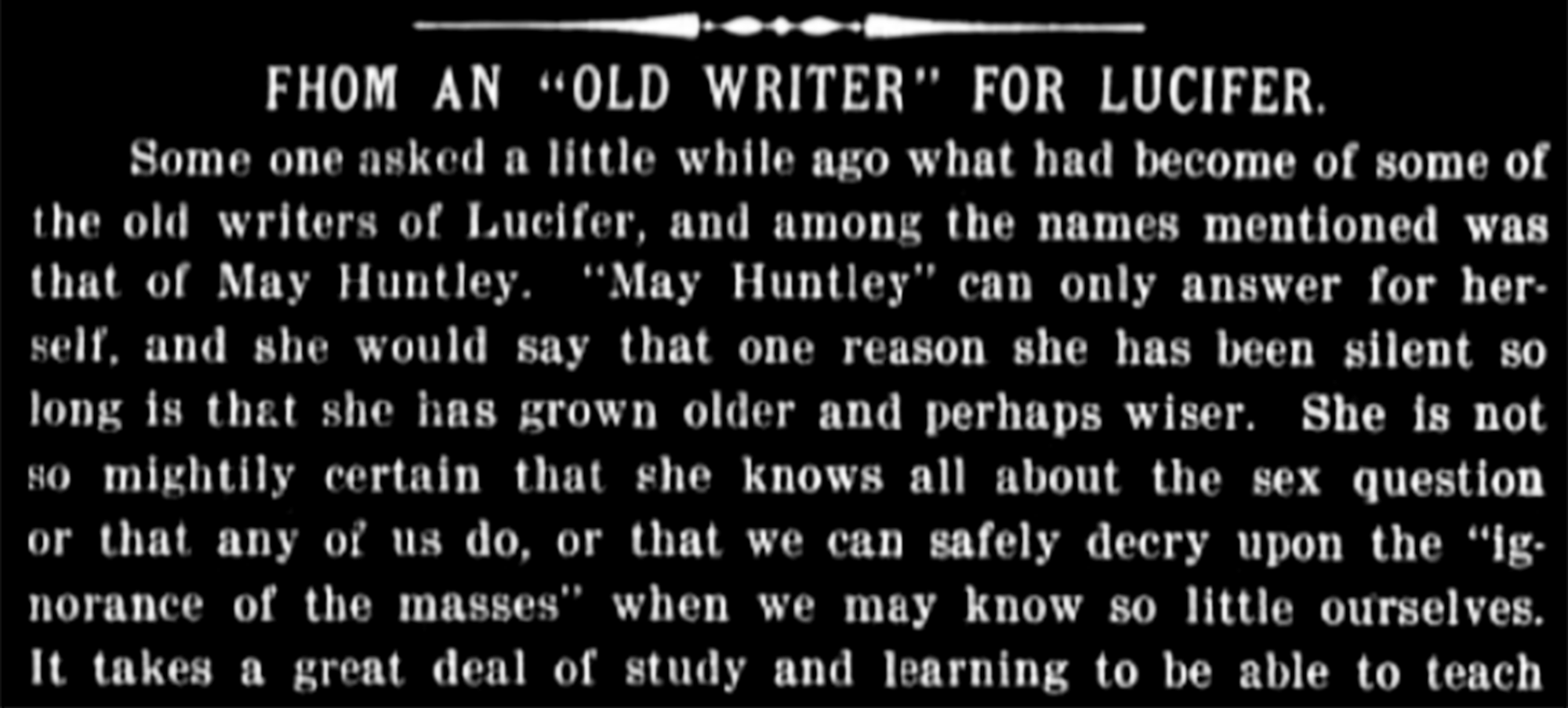
From An “Old Writer” for Lucifer – May Huntley, 8/18/1904
Republished from our predecessor publication Lucifer the Lighter Bearer
Someone asked a little while ago what had become of some of the old writers of Lucifer, and among the names mentioned
was that of May Huntley. “May Huntley” can only answer for herself, and she would say that one reason she has been silent
so long is that she has grown older and perhaps wiser. She is not so mightily certain that she knows all about the sex
question, or that any of us do, or that we can safely decry the “ignorance of the masses” when we may know so little
ourselves. It takes a great deal of study and learning to be able to teach others; and we may do more mischief than
good by teaching some things that are not so. “May Huntley” has never doubted for one instant the desirability of liberty
—that one great blessing that comes second only to life itself. We can accomplish nothing, we cannot grow, we cannot
develop our own real lives, without liberty. We must not be fettered by crystallized institutions, by legally established
authority, by outside constraints of any kind, if we would truly live. But while appreciating liberty more and more with
each succeeding year, I also appreciate that perfect and beautiful mastery of self which should go with it in order to
bring ourselves up to the very best of which we are capable. Liberty and knowledge should go together; certainly the
way to gain the latter is to possess the former, but one needs to be careful what one does with liberty when one does
not know. I have seen so much sorrow, misery, and loneliness come from seizing liberty simply as a sensuous power
to satiate every appetite, every passion, every impulse, and desire that springs up in the human breast without due
consideration, that I have become wary of preaching liberty until a sense of responsibility and self-control is well
established within the individual. I read, with interest, Mr. R. B. Kerr’s article in No. 1017. I am aware that Mr. Kerr is
a more learned, more scientific writer than I; but at the same time, I take the liberty to express an opinion contrary to
his. It seems to me that he writes as though “gratification” were the most important thing in the world, and he is more
anxious that “natural satisfaction whenever it is wanted” should be easy than he is that women should be free. He
thinks if “cheap and plentiful checks” prevailed, all would be well and everybody would be happy.
But the “free woman” may not mean “natural satisfaction whenever it is wanted” after all. The “free woman” may be a
wise, well-poised, self-controlled being who may not think best to yield to every passing passion or desire or impulse.
None of us can be so sure that celibacy is the “evil,” the curse, that he seems to think it. There may be other methods
for the expression of sex forces than the procreative act. Creative energy may be exerted in many different ways and
still result in happiness and great good. We do not know that it is so necessary that men and women exchange magnetism
by physical sexual connection. I know plenty of healthy, wholesome, high-minded, cheerful people in this world who are
celibates. I know many other people who, early in life, decided that to be a happy and well-rounded character one must
indulge every impulse of appetite and passion, and that as no one had a right to deny them the opportunity, they must
be gratified. No consideration of anyone else’s welfare or peace, no thought of future health and comfort, no foresight
as to consequences, were allowed to interfere with the present delight in “doing as one pleased.” And in old age they
found only lonely misery, disappointment, the destruction of all the ties that make old age sweet and peaceful; only sorrow
and ruin. I have known of several cases of a young married woman whose bonds chafed too severely, and I have myself
helped her to a sense of her own individuality and to her right to herself. But these women became dazzled with the
prospect of “doing exactly as they pleased.” Throwing aside all legal or religious constraint, they forgot that they then
needed all the more the guidance of a wise, self-possessed, calm, and dignified mind; everything was thrown to the
winds, and impulse, passion, and whim ruled. These women have not found happiness, or health, or development, or
sanity. They are far less at peace than the poor, faithful, ignorant wife who has simply followed her idea of “duty.” Not
that I think the martyr wife is an ideal personage, either. But the free, well-balanced, sane, self-mastered woman who
knows exactly what she is about and does it is the creature I hope to see develop in the future.
Some libertarians are in favor of allowing—yes, encouraging—the greatest liberty to their young children in matters of
sex relations. What does a young girl of fifteen know of the consequences of her acts? You may teach her, of course,
by words, but there are some things that cannot be learned except by observation or experience. She has little idea
of the future, little idea that life is long and earnest and serious. She learns to play at love, to dally with this one and
that, to trifle her soul’s best treasures away. When she is of mature age and begins to realize what existence means,
she finds she has wasted her gifts and her chances. She is not capable of loving, as a woman should, a steady,
strong, devoted, and manly man; she is not really fit to be the lover of such a man—not because of the conventional
idea that she is no longer “virtuous,” but because she has really destroyed those qualities which make her desirable
as a companion for an earnest, sensible, good-hearted man. I do not believe in outside restraints for a sane, responsible
person. But I do believe some restraint is necessary for children to prevent them from running into the fire or into
ruin. I would not even set “Mrs. Grundy” on the track of grown women. I have no more use for “Mrs. Grundy” than
has Mr. Kerr, but I would remind him that she is, after all, a creature of economic conditions; her power would be
very small if she could not deprive people of a chance to make a living, or of occupying the position in the economic
world they would like. I would place no obstacle in the way of any person to prevent them from doing as they pleased,
but I would, if I could, teach them to know whether they were doing as they pleased or not. I would teach them to
study the laws of cause and effect, to look into the consequences of actions and to weigh results, then to decide,
and to decide firmly, what their lives should be. I would not have them be mere driftwood on the current of circumstances,
to be hurried hither and yon as impulse and passion seized them. If a woman looks well into the probable consequences
of a life of varied physical love relations and makes up her mind that she will be happier, better, and greater in following
that kind of a life, I respect her decision and herself and would wish her good speed. But if she is ignorant; if she allows
herself to drift, to be coaxed or swayed into conditions she does not really understand; if she is imbued merely with
a desire to be “free” without any idea of responsibility, I can only pity her and regret that she is so “free.”
I wish women to be free, but I also want them to be wise. If a well-poised, firm, self-controlled woman wishes to sacrifice
herself and her love nature for the sake of superior children, that is her business. And this brings us to another of Mr.
Kerr’s hobbies. It is a very “nice” question, this “scientific” breeding of children. The human race are not cattle and
cannot be managed in the same way. How will Mr. Kerr, or any other advocate of human stirpiculture, control the
bearing of future generations without setting up a despotism more rigid and exacting than any we have ever known?
No doubt every good woman wants her child to be healthy, strong, intellectual, and good; but will she be willing to
sacrifice her finer feelings, her love, her lover (for he may not always be a superior animal), for the sake of bearing
a child by a “scientifically” fit man? And would any lover of liberty expect to force her to do so? It is a favorite fad of some
“reformers” to establish a bureau of matrimony before which all who wish to marry or unite sexually shall appear for
examination. Ella Wheeler Wilcox advocates this idea, and many other apparently sane persons. Could mating be
prevented by such means, and if it could, would any libertarian like to see such a despotism established?