A Dispute on Tritogenism – Tritogen, (Benjamin R. Tucker, 1880’s)
Republished from our predecessor publication Lucifer the Light Bearer
This is all of the anarchist Benjamin Tucker’s contributions to Lucifer.
Against Liberal Superstition – Tritogen, 2/26/1886
The disposition of LUCIFER’s editors and contributors generally is so fair, and their sympathy so wide and
generous, that it makes me sad to see you all involved in confusion, using words which have lost their meaning
when we reject the moral government of the universe, and placing your hopes on a disinterested choice to
act for the good of others. Nature’s strong current is self-satisfaction and self-advancement. Right and duty
are now visionary, sentimental abstractions, of feeble effort for good, of deterrent effect as to the use of
means for securing release from oppression. Actuality is contrasted with that which we can think, but the
conceivable (called the possible) is in fact impossible if not actual. If you will quit your point of view, and
each one say, “I owe no duty or allegiance to any idea or to any person or thing; I have no claim upon the
world or natural society but for what I can take and hold,” I think you will sooner rid yourselves of much
oppression. When I rejected belief in God, I rejected that slandering humbug, moral obligation, which today
unnerves the hands of ten thousand subject people where it brings one earnest pleader to their side, to
plead in vain to their oppressors for concessions. “Justice, Humanity, Liberty” are a deputy trinity. Fooling
with such phantoms, you remain the laughing-stock of human sharks. “Ought-to-be” is as vain as “might
-have-been.” With your “devotion” to a cause, you only continue in a sublimated form the religious idea, like
Christianity—the domination of one ideal or another over the individual. Oppressors will really tremble when
numerous people begin simply to accept all actions as equally natural, but take whatever measures are
practicable to remove what is obnoxious. They are amused while we argue about “justice” and “injustice,”
calculating that we shall hesitate lest we be “unjust.” Natural society is like any other growth—for me, an
object to be exploited. I just laugh at the idea that I owe it my “duty.” I will make use of it. But come and
make a compact by which we can aid each other, and we shall then have an interest in each other. Then
we can give meanings to words. An obligation means something when there is a person or number of
persons in mutual contract (where power exists on both sides).
The Christian has a distinct meaning for “duty” and “right,” because he believes in a god who gives the command.
The state has a distinct meaning for duty and right because it has law and penalties. The Liberal has a sort of duty
and right in the air, as it were—a mere phantom. By voluntary association we can establish relations which will
enable us to use the words without talking nonsense. Power is the condition without which “duty” is the most barren
of idealities. Men will and must behave themselves when they meet real individuals. If you tell the poor slaves
that if they love their slavery and fear to strike for freedom they are just where pitiless nature puts them and “serves
them right,” they will sooner shake off the shackles than if you boo-hoo about the matter. You yourselves are idea
-ridden. A phantom deputy or substitute god in humanity rides you. If ever you shake it off, the world will be yours
as individuals to the extent that you can take it, and you will pay no more attention to alleged moral laws or duties
in nature, but will make such associations on such terms as you please and can. You will not worship or reverence,
but use them for your individual purposes and make self-satisfaction, or your will, your purpose in action.
Unknown – Unknown, 1886
While we cannot agree with “Tritogen” that “right and duty are now visionary, sentimental abstractions,” nor that
“moral obligation is a slandering humbug,” nor that “Justice, Humanity and Liberty” are “phantoms,” etc., we freely
admit that there is much in the article “Against Liberal Superstition” that deserves the attention of the Liberal thinker
and worker. Speaking for one, I can say with Tritogen that “I owe no allegiance to any idea or to any person or thing,”
but when I of my own volition become a husband or father, it seems to me that thenceforth I owe certain duties to
my wife and child. If I understand Tritogen correctly, he would ignore that element in the human, commonly called
“conscience”—traces of which we find in the so-called lower animals—which I regard quite as legitimately the
product of natural evolution as I do the intellect or the habit of walking erect, that distinguishes the human. While
I look upon society at large as a strictly and simply natural growth, as a tree or a coal bank, I cannot, with Tritogen,
look upon that society as an “object to be exploited” with the same freedom that I would exploit the tree or the
coal bank. On first reading, it would appear that our friend Tritogen would have Liberals imitate nature on the purely
physical plane. “Nature’s strong current is self-satisfaction and self-advancement”—that is, self-aggrandizement,
regardless of the rights and feelings of everybody or everything else. He who abjures conscience must also abjure
human sympathy—but a closer analysis of the article shows that our critical friend does not follow his premises to
their logical landings. He says it “makes me sad to see you all involved in confusion,” etc. Why should a philosopher
without a conscience or sense of “moral obligation” towards his fellow men—why or how should or could he feel sad
at the contemplation of any phenomenon? All phenomena are alike to him, whether on the physical, animal, or
human plane. We take it, then, that Tritogen is largely human after all. In the broadest sense we, like him, follow
nature in its “strong current,” seeking “self-satisfaction.” We seek this satisfaction by trying to cultivate in ourselves
and in others a keen sense of right and wrong, a deep regard for “Justice, Humanity, Liberty”—that is to say, we
seek to develop and rightly train that most important factor or element in human character, conscience. It is a slow
and very difficult work, we well know, but we have no hope of any real progress—no confidence in any plan for
human advancement—that ignores the power of conscience.
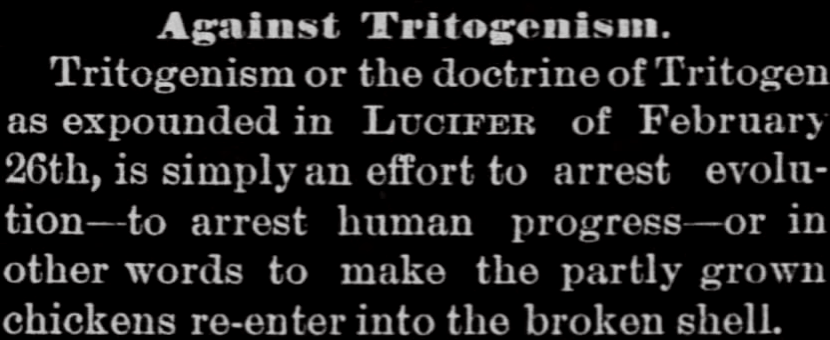
Against Tritogenism. – Diogen 3/12/1886
Tritogenism, or the doctrine of Tritogen as expounded in LUCIFER of February 26th, is simply an effort to arrest
evolution—to arrest human progress—or, in other words, to make partly grown chickens re-enter the broken shell.
The Liberals, as a class, do not reject the moral government of the universe; they only reject the supposed Divine
will supernaturally revealed. Listen to what Herbert Spencer says in Data of Ethics, and it will give new life to those
who believe in “moral obligation, justice, humanity, liberty”: “If, for the Divine will supposed to be supernaturally
revealed, we substitute the materially revealed end toward which the power manifested throughout evolution works,
then, since evolution has been, and is still working toward the highest life, it follows that conforming to these principles
by which the highest life is achieved is furthering that end. The doctrine that perfection or excellence in nature should
be the object of pursuit is, in one sense, true, for it tacitly recognizes that ideal form of being which the highest life
implies, and to which evolution tends. There is also a truth in the doctrine that virtue must be the aim, for this is
another form of the doctrine that the aim must be to fulfill the conditions for achievement of the highest life. That the
intuition of a moral faculty should guide our conduct is a proposition in which a truth is contained, for these intuitions
are the slowly organized results of experiences received by the race while living in presence of these conditions.”
Standing upon this truth, we can also afford to laugh back at the “sharks” who would laugh at us. The idea that men
in the social state could live and progress without regard to justice is simply laughable; for the idea of justice is so
strongly implanted in human nature that even most of the lowest crimes, and most of the dirty tricks, have for motor
a misconception of justice. It is manifest among the savage, and even among beasts, in a crude form. When a life is
paid for by a life, or an act of aggression is met with equal aggression, it simply means equalization of conduct,
which is the base of justice.
Nor is it true that men act exclusively upon the theory that whatever they can grab and retain belongs to them. In
every mind of average development, there is at least a feeble sense of moral obligation in every transaction of life.
The system of laws of all nations is simply a search for means to apply or administer justice; but justice can only
be revealed and administered in proportion to the extent that the lawmakers and the people themselves possess
the sense of justice. Even the proposition of Tritogen, that power is the only condition of justice, is a crude and feeble
recognition of it. For in opposing power to power we may produce a state of equilibrium, in which that which is good
or bad for John will equally be the same for Paul. But it is much better when the moral sentiment is so developed as
to recognize the validity of justice without having recourse to force—that is, what in a crude state is only done through
force, and sometimes with regret, is done with great pleasure in a highly developed state of mind. Moral obligation,
then, runs without compulsion; it flows with nature and leads to the private as well as the general good. Respect for
others’ rights, the fulfilling of contracts, the paying of just debts, etc., produce many pleasurable sensations. The mind
of man is so constituted that, no matter where we go, we find with mankind a current of thought (sometimes indistinct)
that justice is the right course. As bodily pleasures are incentives and deterrents to action, the moral sentiments, when
well developed, produce the same results; and moral conduct becomes natural conduct. Even the cooperative proposition
of Tritogen cannot be carried out unless there is a human, just, and moral sense of obligation among the participants.
Method for Success – Tritogen, 5/14/1886
I long ago abandoned the moral standpoint and resolved all conduct into inclination and intelligence, with
its limitations of fear and that secondary form of fear—superstition. I wrote of moral obligation as a shadowy
humbug. My motive is to advance the evolution of individual self-consciousness as power for reform, by
correct analysis. M. H. conceives that I do not consistently follow out egoism because all errors make me
feel sad. Is not gladness the opposite of sadness? Let me ask M. H., do you become glad, or merry, from
a sense of duty to be merry? No, of course not. Sorrow and joy come of observing events that make against
or for what we desire. I want knowledge and reciprocity to prevail, that we may get out of the pit of oppression.
This is the manifestation of myself. It is inclination, not duty or conscience. To constitute a union of reciprocating
individuals they must be real, self-conscious egos. I do not mean hogs, but I do mean to say that the idea of
moral obligation, conscience, or duty, giving a law or rule of conduct from a source outside of the individual
and dominating him by a “moral idea”—as that “he ought to do what is against his inclination and he ought to
refrain from doing what is his inclination”—is essentially religious, a limitation of the individual, a superstition,
and the last superstition. It must go. It will go, and then, instead of relying vainly upon “conscience” to induce
abnormal human organisms to put a check upon themselves, you will find the check in the other persons,
whose wants and wills shall speedily compel good behavior all round. The integrity of the unit, with its law
purely in its own constitution, is the condition of an intelligible scientific relation of units. Do kings abdicate
voluntarily, or do their subjects compel them? Which way do you prefer—to preach equality to kings or to
show the subjects that kingcraft is an imposition? First becoming units in your selfhood, all action will resolve
itself into your will and pleasure, calculation, prudence, and so forth. Such words as justice and social
obligation may then be used with definite force as relating to the mutual advantages and pleasures of
reciprocity, bearing in mind that for A, social obligation is whatever B, C, and D require; whereas the
present “moral obligation” pretends to control A by his idea of what he “ought” to do to B, C, and D,
and to me this seems a varnished relic of what was formerly believed to be a command by the gods.
M.H., you have to know the fact which you find it hard to realize. Conscience is nothing to me but a
superstition, yet I sympathize with every man or woman who suffers. I have seen the young man,
trained in orthodoxy, whose reason taught him to read on Sundays, but whose conscience continued
to give him some uneasiness. We see evidence of opposite teachings or admonitions of conscience.
It is slavery of mind. Your conscience—Liberals will not dare to make a simple calculation of the means
most effective to shake off oppression, and use those means. I would not have you suppose me peculiarly
an advocate of violence. I say that when any considerable number of people shall know themselves
in their complete, simple selfhood, they will not be imprudent, but they will be unconquerable; and
what you apostrophize as a cause—the reciprocal relations which you evidently mean by the word
justice—will be the effect of their acting out their selfhood, their will and pleasure, as free from any
dominating idea of duty as the gods are supposed to be free from it. Your success depends upon correct
analysis. That will give correct method.
Response – H. 5/14/1886
Tritogen regards conscience—the “ought” principle—as “essentially religious, a limitation of the individual, a
superstition,” etc. I agree that conscience has commonly been dominated by superstition, but I do not think it
necessarily synonymous with, or a “relic” of, superstition. What we need is not to get rid of conscience as a
controlling force in human action, but rather to properly educate it. Let enlightened reason be its tutor instead
of superstitious fear; then conscience will no longer be a factor of evil—of oppression and of misery—but a
most powerful engine to lift humanity to the higher levels. As to “sorrow and joy,” I think I can truly say that my
highest joy comes through the gratification of the “ought” principle, and my keenest pain through a knowledge
of its defeat and outrage; and therefore, to sum up the matter in few words, I would say I could not get rid of
conscience if I would, and certainly would not if I could.
Man, the Unhappy Animal – Tritogen, July 2nd 1886
Consciousness arises from facts. Science arises from dogmas imposed as facts. Fear is the method
of the dogmatist. He says: Subject thyself, reverence, obey. Conscience is religious. Religion is the
practical part of theology. Its purpose is to tame and subject men. When religion is preserved as well
as may be without theology, religion brings into its subject person a substitute theology—the ideal
humanity, etc. This is the old theological humbug under a new form. The believer is taught that he is
mean and needs to be elevated by the infusion into him of more of the spirit of humanity; that some
things are “sacred,” i.e., he must not touch them. Thus, the subjection of the individual to an idea and
to the purposes of the expounders of the idea is accomplished under the religion of humanity. The
humanists see nothing in a person but an example of “humanity.” Humanity is what they “respect.”
A person who does not conform to their idea of humanity has no “rights.” They can find excuses for
suppressing whatever they do not like, because the individual is not worthily living up to the adored
“humanity.” Humanism employs fear of censure and subjugates minds left quite prepared by theology
for a yoke. If a man will stand straight up and realize his position, he requires no elevating. The insanity
of humanism is that it would send everybody upon a wild goose chase to be something different from
what he or she is. “Moral obligation” lurks in the notion that I ought to improve myself according to a
standard of excellence. Then poor I, great standard! But why should I be governed? Why should I
think myself less than the standard—than something else, the standard? I am not interested in
improving myself away, lessening myself, and enhancing something else.
I am at the best elevation with my two feet on solid ground and kick the standards of excellence to the devil,
for I want to be myself, and I have no duty to “improve” and elevate myself. True, it is my interest to whet my
intelligence so that it will serve me to cut and bend surrounding objects to my purpose, but this is not knocking
under to the superstition of self-subjection and allegiance, or duty to something outside of and superior to myself.
Liberals may cant about sacred duties, elevating humanity, conferring rights, and so forth, but these notions
are a continuation of the humble submission and self-abasement of the individual in theology and religion.
Grasp the idea that the existence of everything is its own good and sufficient reason, and that a man has no
more reason to strive to change himself than has any other animal. He makes such efforts only because he
has been taught that he was born in sin, etc. Considering how much ashamed men are of their bodies and
of natural action without consulting a fashion, you may form some idea of the extent to which religion has
debased them, and of the small extent to which free thought has liberated them.
Diogen to Tritogen 7/23/1886
While I can agree with Tritogen in regard to his construction of “humanism,” with its relations to the
individual, I cannot agree with him in his construction of science and moral obligations. We have here
in Kansas two well-defined instances of how humanism will trample on the individual, and how these
individuals are ready to bow the neck under the yoke. Those two cases are prohibition, and the
suppression of the Police Gazette and other papers of that class. But why are individuals so ready to
bow their necks to the behest of humanity, when promulgated by a few rotten politicians, and why are
those politicians so ready to transgress upon the individual? It is simply for the want of conscience and
moral obligation. Go all over the earth and study men; study them in their everyday relations of life, and
you will always find that those who do not feel any moral obligation concerning others’ rights do not know
their own. They are only fit subjects to be despots or slaves. Show me a man who knows his own rights,
and I will show you a man that knows the rights of others. Show me a man who wants to boss everybody,
and I will show you a man who cannot stand a feeble suggestion in regard to his own conduct. Show me
a woman who takes delight in snubbing her husband or lover, and I will show you a woman who cannot
stand the least departure from love and duty in that man. All such conduct, which embitters life, arises
from want of clear conscience and moral obligation. Now I will give to Tritogen my definition of moral
obligation in comparison to his own. He thinks that by improving himself according to a “moral standard”
he is lessening himself; that by governing himself he is a loser; that he must refrain from certain acts
because it would be a detriment to his neighbor, etc. If I took such a view of the subject, I would also
call it “superstition,” but I take a different view. I base everything in those relations exclusively upon the
individual. His actions must concern him before anybody else.
He is not to improve himself for his neighbor, but for his own good, and in doing so does not lessen himself
but augments himself. He is not to refrain from certain acts on account of the other man, but for his own good.
In governing himself he is not becoming a slave; he has succeeded in the greatest feat of this life—he is free
—and all for his own individual good. The man who is a slave to the popular mob, to lucre, to lust, to fashion,
to vanity, always reminds me of a dog who is wagged by his own tail. If each individual had a good sense of
moral obligation, he would be benefited, and it necessarily follows that social life would improve. Man, instead
of being the “unhappy animal,” would find life to be a festival. Taking life as it is, if a man can govern himself
he has gained one point, but it is only a half conquest if he has to dwell among those who are destitute of
conscience, and who only know fear or force as the criterion of conduct. Therefore, as Liberals, we strive to
improve the moral tone of men; we are seeking our own good, which must react to the good of others. Although
it is possible and beneficial for the individual to govern himself in what society has not stolen from his individual
realm, we are yet forced to admit that he is governed in a general way by some laws outside and superior to
himself. The atmosphere, the topography of the country, the surroundings—wild nature or tame nature—will
shape in some measure not only his moral force, but his physical aspect also. All the planets are deflected from
their orbits by the force and integrity of other planets, and the same must be with man in social life. The course
of each individual must be modified on account of another individual.
Let us suppose that Diogen goes down to Galveston and says: “I am free; I kick the beam of excellence; I owe
no duty to anybody.” He then meets Tritogen on the sidewalk, which is already crowded. Instead of giving a part
of the remaining space to Tritogen, he spreads himself and the two come in contact. Diogen then says: “I owe
you no moral obligation for a space on this sidewalk.” Tritogen would have a right to say, “This is also my ‘ticket,’”
and the question would have to be settled by brute force. After Tritogen had limped to his office, and while he
rubbed liniment upon his bruises, I believe that he would conclude that duty and moral obligation are necessary
for men in the social state; that they are good and compatible with individual freedom.
What They Did – Tritogen, 7/30/1886
No more valuable book for radical reformers has appeared in many years than Tchernychewsky’s narrative,
What’s to Be Done, now first published in English by Benjamin R. Tucker, Box 3366, Boston, Mass., price
$1.00, in cloth binding. It may be all true, though in the form of a novel. It is intensely interesting as a story
of domestic life, and tells what certain people did in such a way as to teach what others can do. It gives
much insight into various phases of personal character. Here is the mother, a shrewd, sharp businesswoman,
determined to be no more virtuous than circumstances show to be profitable according to her requirements,
which are many, and include a comfortable life. Her husband is not exactly the head of the wife. Their daughter
is a bright and beautiful girl. How various young men become acquainted with the family; how the daughter
marries to escape from persecution; the high character of the husband whom she chooses in her constraint
and inexperience; their great friendship; the difficulty about subsequent and greater passional attachment;
their philosophy; the establishment of a cooperative business by young women on the equitable principle;
the separation and second marriage—are all told in an earnest, pure, and sparkling style. The author was
one of the greatest of the present century, and is now suffering in the mines of Siberia for his truth and courage.
Incidentally to the main story, there is an episode which commends the book as most valuable to place before
any parent who has a difficulty in approving the choice made by a daughter. Katinka was courted by a worthless
young fellow. Her father knew his character and hastily opposed the acquaintance. At this the daughter fell in
love with the scamp. A wise friend manages to persuade the old man to try a simple plan by which the young
lady is saved from making a great mistake.
There would be no elopements, and fewer unhappy unions, if all parents were so well advised. Nine-tenths of the
novels of the day are stuffy and not worth reading; but this one is lively, full of strong thoughts easily comprehended,
and will quietly dissolve a number of unsocial and superstitious ideas. It teaches tolerance, honest dealing, and self
-government by individuals as best for all. It shows how people, by being natural and true to themselves, behaved
better toward others than they could have done by trying the plan of hypocrisy or reciprocal tyranny. What’s to Be
Done has been well abused by the capitalistic papers, and is enjoying the benefit of a rapid sale in consequence.
I cannot sufficiently describe its charm, its merits as a literary work, and its utility as an aid to the spread of free
thought and the liberation of woman by developing a noble individuality. Mr. Tucker has made a correct translation,
and his printing is superb. Liberty is giving us a library of which we can be proud, and by taking copies of works
thus presented on the cost principle (as the price shows), we shall be strengthening Mr. Tucker’s hands to do
more, and thus put within our reach other valuable books.
Spontaneity vs. Conscience – Tritogen, 8/27/1886
Nature gives pleasure and pain, not duty and a guilty conscience, as indices to nutrition and exercise. As the
best conduct in individuals is natural and spontaneous, so the best step toward harmony in the mass will be
the development of an individuality which is its own law. This individuality will not be unsocial and ungenerous,
because its sign is pleasure, not constraint. Diogenes appears to be what I should call an egoist—that is to
say, one who acts from self, or agreeably to his own natural impulses and reason, and not from a moral
obligation which could not be traced to the egoistic principle. Therefore I do not feel that he has demolished
my argument. Two men meeting may be foolish enough to fight rather than yield room to pass, but it is not
generally so. Two horses, wolves, or snakes will avoid unnecessary collision. This action requires only
common sense and animal instinct. I have read of a caged lion attached to his keeper on board ship. For
some breach of discipline the keeper was tied up and scourged with the cat-o’-nine-tails. The lion bounded
and tried to break out, so much so that the flogging had to be stopped. When the keeper was returned to
the lion’s cage, the animal licked the man’s bleeding back and placed his paws around him protectively,
and continued so for half an hour. Do you suppose that the lion acted from conscience, or a sense of duty,
as these words are generally understood and applied to mean? The lion acted as his nature prompted.
Con means “with,” and science means knowledge. Hence conscience may be defined as the feeling which
accompanies knowledge. The ego free from superstition can have no guilty conscience. Has he done his
own will and pleasure? He has a comfortable feeling accompanying the consciousness and each recollection
of the fact, except where he has miscalculated. In the latter cases he has a feeling of regret for his ignorance
and error, which have resulted in disaster.
Guided by reason, he is unwilling to be confused and swerved from a reasonable course by the accumulated
impressions received from teachers who have indoctrinated him with ideas of duty or moral obligation. Conscience
means little if it does not mean an authority in the mind to be obeyed, to which the reason and will must be
subjected. To revert to our definition of conscience—the feeling which accompanies knowledge—in the general
acceptation it means that a rule of thinking and action having been laid down for the individual, the conscience
is the feeling which accompanies his knowledge that he has broken the commandment or rule of moral conduct.
That is the guilty conscience. Or that he has obeyed the commandment and kept the moral law; that is the good
conscience. This is the almost universal application and understanding of the word. When dogmas are discarded
and each individual stands to all other individuals as molecules, they will arrange themselves according to their
natural attractions and repulsions. I believe that by discarding moral obligation (the force of the idea as authoritative)
oppression will become impossible. But I believe that oppression will be practiced so long as it is possible, though
oppressors and oppressed may have, as you and I have, the idea that it would be better for the mass if it were renounced.
The true ego can smile at the alarms of conscience advocates among atheists who are themselves examples showing
how well men can behave without God, the alleged author of conscience. The true ego finds in instincts, tastes, and
intellect terms without confusion, and surrenders nothing to an authority which is like an ineffective blockade. Let us
make our blockade against the tyrants and thieves effective. With paper laws and moral dogmas they make a blockade
against equity, and conscience-stricken fools submit by deference to conscience-dictated methods of reform. “All things
are lawful to me, but all things are not expedient.” Though I always act from myself, I act with pleasure for others.
I submit also, even to oppression, but it is because I must. The ego may be a slave, but he has not given his consent
to remain a slave longer than prudence dictates. At the same time it must be said that the true ego is probably the only
sort of person who, being a slave, cannot be goaded by oppression into making his case worse. Physical obstacles
thwart his will. He goes around them till he can remove them. He measures his powers against the obstacle. The
slaveholder and all his aids are regarded as physical obstacles. The intelligent ego, in such a matter as young Mr.
Foote’s publication, does not inquire whether women have a “moral right” to control their reproductive function. He
leaves that issue just as he would leave the canon law, or a dispute about baptism. He wants to know what additions
have been made to scientific knowledge. The best argument against theism is the intelligent, well-behaved atheist
himself. Perhaps an equally good argument against moral obligation is the ego who acknowledges no such thing as
moral obligation, yet finds it most agreeable to himself to do to others of his species every kindness in his power.
The greatest kindness is to show them the truth, which shall set them free. It is this: You will always be ruled while
you are not unwilling to be ruled. You will give plain meaning to the word duty when you use it in a business sense.
It is no man’s duty to be a sailor, but if he becomes a sailor it will be his duty to go aloft or swab the deck.
Egoism vs. Altruism – Diogen 9/10/1886
The first law which acts upon man and beast is the law of self-preservation. In its immediate relations to
the individual, it is strictly egotistic, but it is eminently right, for without it life could not be maintained. It is
so potent that, in some instances, the efforts to save life or prevent bodily injury are automatic. They execute
themselves without previous thought. When the finger gets burned, it withdraws immediately, without
waiting for the intellect to say: “Get out of the way.” Self-preservation being the first law, all laws governing
individual actions are related to it. As individuals congregate into tribes and nations, they are still governed
by that same egotistic law; but as they increase in intelligence, each individual soon realizes that others
are governed by the same impulse—that by preserving the rights of others, he preserves his own; that by
increasing the intelligence of his surroundings, he increases his capacity for enjoyment. When egoism
has reached that point, it is called “altruism.” It is immaterial whether we classify the actions of altruism as
bearing upon the good of self first, or the good of others first; for in such conduct, the good of one reacts
to the good of all, the good of all to that of one—and such are moral actions. The manner in which Tritogen
argued this subject in former articles made me think that he was afraid the poor little “myself” was going to
be left out in the cold in performing moral actions, and for that reason (to reassure him) I based those moral
actions upon the egoistic standpoint. But since moral actions are altruistic, I could just as well have based
them first upon the good of all. I knew very well that as soon as he felt his platform shake, he would jump
over the fence and accuse me of standing upon it as an “egoist.” But it was not I who said: “I kick the beam
of excellence and owe no moral obligations to anybody.” A sensitive conscience and the feeling of moral
obligation are the motors that give strength to combat fraud, oppression, and inequality in all its forms.
It is immaterial whether moral obligation has been inculcated in the mind by previous teachings; the question
for us to know is whether it was right or not. What can be more righteous than the individual striving to improve
himself for the good of others, or striving to improve others for his own good? It is evident that if individual actions
were so conducted that they had no bearing upon the good of self, others, or posterity, such conduct would be
superstitious; for when one would be asked: “Does your conduct make you happy?” he would have to answer,
“No.” If asked if it made his neighbors happy, he would have to answer that he did not care. As each and all
individuals were interviewed, their answer would be the same; and it is plain that the bearing of all actions
must be: self and others, others and self. Why have heroes, poets, divines, and philosophers tried, by example
and teaching, to inculcate a moral standard of conduct? Was it so that they should be miserable while others
were happy? Not much. They felt that by raising life to a higher plane, the sum total of happiness would be
raised, and that others, their children, and themselves would inherit their share. It would not do for one moment
to think that the spontaneity of untutored nature would all lead toward the good. Nature has two distinct sides.
I do not doubt that lion story, but I would say that while one lion has roared when his master was whipped, one
hundred lions have torn their masters to pieces.
What is Expected – Tritogen, 9/17/1886
A learned, wise, and good man chides me for entering upon an evil way, deriding conscience and duty. Yet I can
perceive, I think, that his conscience is only the natural instinct of a well-bred and intelligent man. My learned
friend’s motto is: “On doit—on ne doit pas.” Now, you may expect me to translate this as: “We ought—we ought
not.” But I shall translate it as an ego: “It is expected—it is not expected.” The capitalist says: “My money ought
to bring me more than six per cent.” Do you say it ought, my anarchistic friend? He expresses the idea that if it
did not, there would be a deviation from the rule. There is an “ought” for every authority and power which makes
rules. Words must undergo the same modification—or be disused—as views change. The Christian has much
to say of justification, redemption, grace, sanctification, etc. The Liberal does not require all this vocabulary, but
he requires another. The ego does not require all the supernal liberalistic vocabulary. He is not fettered by the
ideas “I ought—I ought not.” They mean either conformity to authority, to reason, or to general expectation.
Ought is from to owe—that which is owed: a debt, due, duty. These words are all closely related. When Admiral
Nelson said, “England expects every man to do his duty,” he was tautological. What was the duty expected?
To kill French marines and sink French ships. In what sense was that a duty? It would not have been a duty in
any sense if England had not desired it. Frenchmen’s duty was to kill English mariners and sink English ships.
If they had a duty to perform in fighting, it was because they were paid to do it, ordered to do it, and it was
expected of them. It was therefore their alleged duty to do what, by the standard of my esteemed friend’s
admirable reason, is wrong. England, therefore, simply expected every man to do that which England had
commanded and expected. She expects him to do his duty, and his duty was to do as she expected.
It all depends on your authority and your standard to create and determine what is due and owing. “We ought
—we ought not.” There lurks sometimes a superstition, sometimes an ambiguity. There is a large opening to
bring in slavish submission of the mind. Let other men make their demands upon me for correct behavior so
plain that I must obey. No man shall wrong me with impunity. Meanwhile, the instincts of an ego will pan out
better than the conscience of a believer. But we know that believers do many excellent acts which they attribute
to belief, yet such acts proceed from natural impulses of their organization.
“Spontaniety vs. Conscience” – Conscience, 1/7/1887
(Lucifer Aug. 27.)
Tritogen’s caption betrays the confusion of his ideas. The real enemy he would attack is the authority of convention,
to which conscience—a principle of sentiment or feeling, as well as reason, the principle of thought—may be enslaved
by education. Conscience will rarely, if ever, be naturally opposed to spontaneity in the developed character, though
it may be so during evolution. For example, cruelty is spontaneous with many children, even of gentle character;
they amuse themselves by killing or torturing animals. Instruction, with reflection, corrects this tendency. Morality,
which is the conventional rectitude of a given social sphere—or rather, moralism, the influence of this sphere over
individual conduct—is the antithesis of spontaneity. Conscience, spontaneously in self-centered characters and
by reflection in their growth, opposes certain conventional authorities and initiates revolution. Tritogen will insist
that his notion of conscience as the principle of authority, clerical or secular, is the practical one, because the
greater number of so-called individuals are not individuated from their social sphere, so that their consciences
are polarized by its constitution. If received in Christendom, their conscience will be monogamic; if in Mormondom,
polygamic; if in Turkey, neutral as to these customs. Also, in a given country, you shall find as many consciences
as castes or social classes. The conscience of our capitalist class calls for the blood of the Chicago communists.
Presently, the state social conscience of our governmentalist class will call for the blood of anarchists of all sorts.
But this is only a form of statement for the fact that, in the economy of character, original force is scarce, but
imitation and susceptibility to influence are general. You cannot prevent this by the spiritual amputation of
conscience, any more than by the physical amputation of the spleen, which dogs survive very well. But certainly,
by better methods of education, the faculty of independent reasoning may be cultivated, and the prejudices that
abuse conscience lessened. Originality, with its individual conscience, may thus come to predominate over the
conventional conscience of the masses. Tritogen subtly remarks that a theist, while nominally expunging God,
remains enslaved to the God-idea under the name of conscience. It is probably true that conscience was what
the Paines, the Parkers, the Garrisons meant when they said God; for after discarding the authority of “Revelation,”
what is there in common between the religion of loyalty to truth, justice, and beneficence, and the religion of sacrifice
and torment—whether of others or oneself—with a view to propitiate an imaginary being constructed after the
pattern of human tyrants?
Tritogen defines conscience as “the feeling that comes with knowledge;” this is nearer the truth than his other idea
of it as the voice of authority. Conscience implies that intimate knowledge which we term consciousness, of external
facts, more especially personal, but it is the feeling not merely of their existence, and not merely of our sympathy
with them or otherwise, but of how we should act with regard to them; it pivots on the integrity of the selfhood. It is
only such knowledge as calls for my personal intervention that touches my conscience. An earthquake in Java does
not shake it, but one that tumbles down my neighbor’s dwellings calls on it effectively for aid. Being only a sentiment,
conscience, unenlightened by a sound sociology, falls prey to superstition and is the favorite game of charlatan
reformers like Karl Marx, whose sophisms against private property have roped seven heads in Chicago within
the noose of capitalistic conscience. The discipline of reasoning from the basis of enlightened self-interest would
have prevented such enslavement of conscience to spurious duties magnetically imposed by Marx towards the
collective proletariat. A disease with which Christian morality is peculiarly afflicted—though perhaps no more so
than the Buddhist—is meddlesomeness with our neighbors’ conduct, irrespective of its bearing upon ourselves.
A charlatan monk, like Peter the Hermit, preaches a crusade to deliver the Holy Sepulchre from the hands of the
Infidel, and to this imposition, this superstition, this tax levied by fantastic prejudice upon conscience, Europe
sacrifices its blood and its treasures. The remedy lies no more in eliminating conscience than in extirpating
hearts. The sentiment directive of conduct, like the ship’s rudder, in the hands of an ignorant or treacherous
pilot, may run the ship upon the rocks or into a hostile port; but that is no reason for building ships without
rudders. Our fallacious education, as has been happily shown by George Combe in his Constitution of Man,
arbitrarily attaches conscience in plastic childhood to anything or everything except physical hygiene, or the
conduct bearing on our health, which is not only of primary importance to us, but indirectly affects our neighbors
and all our functions in the larger organism of society.
Actually, all the prescriptive duties of conscience are colored by altruism, nay, morbidly dyed in it. A good egoist
education of conscience is needed to correct this, so that sympathy should not betray us into manias. “’Tis
conscience,” says Shakespeare or Bacon, “that makes cowards of us all.” The case of the soldier illustrates
and qualifies this. The educated or sophisticated conscience of the soldier makes him a coward before his own
government, while adding to his courage in the face of the enemy. Fanatics make the best soldiers for national
armies. The Indian, an individualist and amateur soldier who fights on his own hook, curiously contrasts with
the army soldier: he evades many dangers to which the latter is exposed through his cowardice before authority.
He is brave with calculation, as the other with superstition. If, unfortunately, we have come to that pass of slavish
corruption which seems to justify Tritogen in saying that “conscience means little if not an authority in the mind to
be obeyed, to which reason and will must be subjected,” then the need to emancipate them is all the more urgent.
But authority implies an author external to ourselves, and conscience—the sentiment impulsive to action—must
be emancipated from such alien authority along with reason, which enlightens it, and will, which it employs.
“Conscience.” – Conscience, 2/11/1887
(Lucifer, Dec. 30.)
Conscience banished from respectable society, and taking refuge among cranks, thanks LUCIFER for his hospitality:
As to her monogamy when “received” in Christendom, where she was reared, from the manger, that is a reception
by the printer’s Devil, who is naturally after some mischief and probably wants a monopoly of the pretty girls. Let him
consider in his inky heart that a poor turkey has no better chance than the most moral Christian stork of the church
steeples. Conscience condones his recep- tion of her, for the opportunity of saying that Tritogen’s onslaught upon
her is gratuitous discourtesy on his part. She happens to know that he is not a road- agent, nor a statesman, nor
a priest, nor editor of a great metropolitan luminary, nor president of a railroad system, of a National Bank, or of the
United States; he is not even the infallible Pope. He has therefore no reason for bearing mal- ice against her and
no use for the phi- losophy of rascality. His present of this to the Lucifer, for whom Conscience, located in the palace
of “self respect,” with “mutually agreeable” windows, has become rather a costly guest and difficult of entertainment,
is an act of disinter- ested benevolence, not justified by enlightened self-interest.