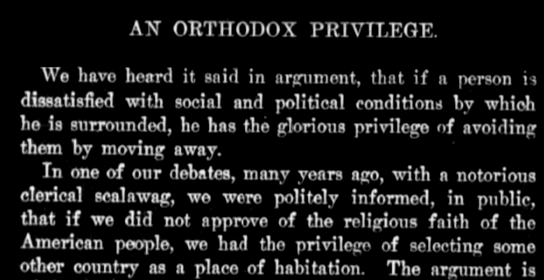
An Orthodox Privilege – The Blue Grass Blade, 9/5/1909
Republished from the free-thought publication The Blue Grass Blade
We have heard it said in argument that if a person is dissatisfied with the social and political conditions by which he
is surrounded, he has the glorious privilege of avoiding them by moving away. In one of our debates many years ago
with a notorious clerical scalawag, we were politely informed, in public, that if we did not approve of the religious faith
of the American people, we had the privilege of selecting some other country as a place of habitation. The argument
is of the double-action variety. It can be made to work both ways. A great deal may depend upon the advantage of
the one who happens to say it first. Moving away may not always be palatable to the mover, but this is precisely what
the forefathers of the American Republic did when they emigrated to the great and unexplored Western continent.
Religion was principally responsible for their departure from the Old World, and now that infidelity is becoming more
and more fashionable in America, the orthodox have the privilege of moving away at their own sweet will. Members
of the orthodox churches at Morrisville, Pa., so it is reported in the Chicago Journal of Monday, August 23, are putting
this into effective practice and are really moving away, because one solitary infidel got the best of them by using timely
precautions to check them from moving him after his demise. It is reported that one Samuel McCracken, an infidel,
died and was buried in the cemetery at the place named. At the head of his grave he had caused to be placed, by
express trust, a stone tablet which bore the following inscription: “In Memory of Samuel McCracken, who died April
13, 1862. ‘If leading politicians and priests All go to heaven, then I am bound To stop at some other station.’” Within
the last few weeks a protest has been made against allowing the inscription to remain. The cemetery authorities
were appealed to in vain, and the latter were all at sea as to what course to pursue, for while the orthodox church
members had threatened to dig up and move their dead away to some other cemetery or burying place, and thus
leave the McCracken tablet alone in its glory, it was found that his tablet could not be moved because of the fact
that he had owned a considerable interest in the cemetery, and the plot in which he and his wife were buried side
by side was actually owned by him before his death.
It appears, however, that McCracken’s wife died first. No tablet had been put at her grave. When McCracken died,
the executors of his will carried out the trust imposed upon them by placing the tablet he had himself designed.
Now, it is said, the church workers grew indignant, and finding no other opening for revenge, they got together
and had a tablet made for the wife, with an inscription thereon which reads: “In Memory of Phoebe, wife of Samuel
McCracken, who died March 30, 1860. She died a firm believer in Christ, her Savior.” As Mrs. McCracken died
fifty years ago, it can hardly be expected that any of the present generation could know what she believed or what
she did not believe at the time of her death. But what sort of man was this Samuel McCracken? Let the report of
the newspaper speak for him, and in it one may see what infidelity means to personal character. It says: “McCracken,
who many years ago owned half the town and entertained lavishly, posed as an old-time country gentleman, and
was considered a jolly good fellow by all who knew him. He was lenient with his tenants, generous to their children,
and sympathetic with them in their distress. His home was filled with guests almost continually, as the host loved
company. In his boyhood he took a dislike to religion, and in his manhood was an infidel. He despised politics
and politicians. ‘No decent gentleman is a politician,’ was his contention. His hatred for the clergy in general
was intense. He also believed that when a man became mortally ill he should not wait for death.”