Woman and a New Humanity – Sara Campbell, 3/3/1904
Republished from our predecessor publication Lucifer the Light Bearer
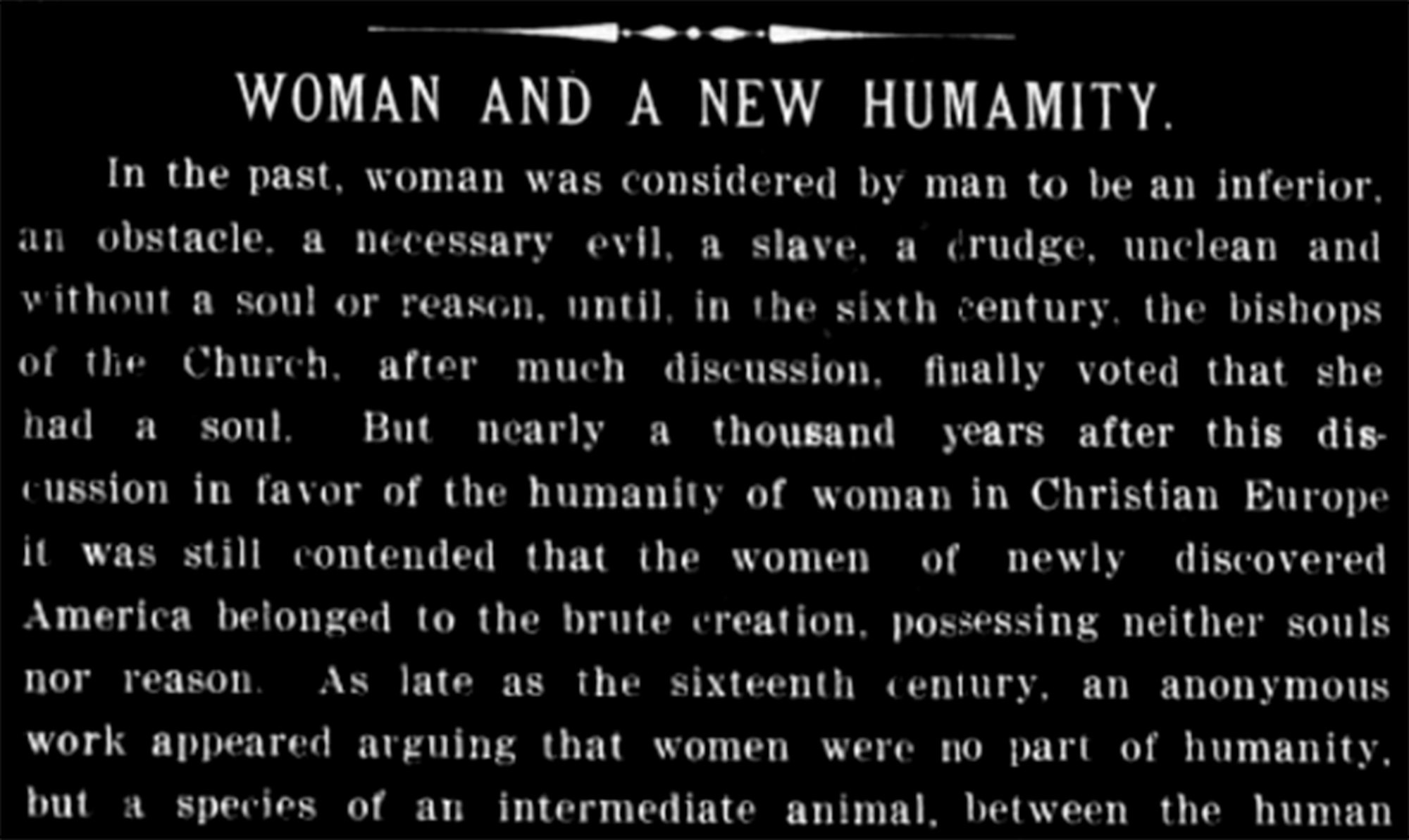
In the past, woman was considered by man to be an inferior, an obstacle, a necessary evil, a slave, a drudge, unclean,
and without a soul or reason, until, in the sixth century, the bishops of the Church, after much discussion, finally voted
that she had a soul. But nearly a thousand years after this discussion in favor of the humanity of woman in Christian
Europe, it was still contended that the women of newly discovered America belonged to the brute creation, possessing
neither souls nor reason. As late as the sixteenth century, an anonymous work appeared arguing that women were
no part of humanity, but a species of an intermediate animal between the human and brute creation. Until the time
of Peter the Great, women were not recognized as human beings in the Greek Church. As late as the Woman’s
Rights Convention in Philadelphia, in 1854, an objector in the audience cried out, “Let women first prove they have
souls; both Church and State deny it.” All this and much more can be learned by reading Woman, Church and State.
And the Bible view of woman is little better; not even the New Testament, with its “Let your women keep silence in
the churches,” and “I suffer not a woman to teach,” and “Wives, be under subjection to your own husbands,” and its
view of young widows, and much more to the same effect. But notwithstanding all this, and with the common school,
college, and all institutions of learning closed against her until within the last century, in spite of all that has been done
by man to degrade her and prevent her progress, woman has slowly but surely improved intellectually, physically,
and spiritually, until today she is a recognized equal, standing side by side with man in almost every walk of life.
This she has achieved in spite of much opposition. And now that the barriers are mostly withdrawn, now that the
schools are open to her, now that man encourages her efforts, woman of today may well be thankful that she lives
now instead of in the past. Few of the women of this day know what they owe to Mary Lyon of Massachusetts and
those like her who have so smoothly paved for them the pleasant ways of learning. One hundred years ago, girls
were not allowed to go to school.
In 1788 it was voted in a town meeting in Northampton, Massachusetts, not “to be at any expense for the schooling
of girls.” When the first high school for girls was opened in Boston in 1825, there was such a great outcry against the
innovation, and so many girls applied for admission, that the scheme was abandoned and was not again attempted
until 1853. In 1826 the school committee of Concord, Massachusetts, passed a resolution that “from the first day of
December to the first day of April, no misses under ten years of age shall attend school in the center of the town, nor
any over the age of ten years where there are forty male scholars attending the school.” Such was the actual position
of young women in this country with reference to the means and opportunities of an education when, in 1837, Mary
Lyon opened her school at South Hadley. When her scheme became known and she began to ask assistance to
build and furnish such a school, the whole thing was declared to be impractical, unnatural, unscriptural, unfeminine,
unchristian, and whatever else was wrong and visionary. It was believed to be an innovation unheard of and uncalled
for; that women did not want to be educated, and this in the face of the fact that the girls’ school in Boston was closed
because so many sought admission. And if women were educated, it was said, it would ruin their health, impair their
womanly delicacy and modesty, unsex them, and unfit them for their proper sphere. Against these railing accusations
Mary Lyon had nothing to plead but her heavenly vision, and she pleaded as for her life. The past is too horrible, and
we gladly turn from it to consider the present and the future. Step by step woman has advanced until today her prospects
in life are as bright as those of man. Already she wins as many or more school honors as man, and whatever she
undertakes her success compares favorably with his. And the future is all before her, with its opportunities to help
make this world a fit dwelling place. The combined efforts of both man and woman are necessary to right the many
wrongs which man, in his ignorance, has created. A few men and women have come to believe that if only desired
and designed children were born, they would be better children and consequently better men and women. If this
idea could be universally taught and believed and practiced, and love take the place of what is considered by man
to be love, in time we would have a humanity in which there would be little in common with what we now have.
To teach man her idea of love is part of woman’s work, and man must learn and believe the right meaning of love
before we can hope to have a much better humanity. Woman’s idea of what constitutes love between the sexes is
widely different from man’s. Man thinks physical attraction is the chief and almost the only necessary element in love,
and by acting upon this idea has, to a very great extent, caused pure-minded women to depreciate physical attraction,
thereby doing almost, if not quite, as much harm as man has done by overestimating its value. The thinking, pure
-minded woman would have harmony of temperament, similarity of tastes, congeniality of disposition, likeness in point
of capacity, and a similar degree of culture, as well as physical attraction. Humanity has gradually improved, not because
of the teaching of the Church, but because nature always does its very best with the material it has to work with. So
now that man has evolved to where he knows that woman is an actual necessity, and woman to where she knows
she is an equal necessity, neither of more importance than the other, we can dream a dream. We can dream we see
a land, and on the hills walk brave men and brave women, hand in hand, looking fearlessly into each other’s eyes,
and the women also holding each other’s hands. And our reason tells us that such will be the future of this world,
when our new humanity comes upon the stage of action and so changes conditions that it is possible for heaven
to be on earth and in this life.