The Constitution of Democratic Kampuchea
Preamble
On the basis of the sacred and fundamental desires of the people, workers, peasants, and other labourers as
well as those of the fighters and cadres of the Kampuchean Revolutionary Army; and Whereas a significant
role has been played by the people, especially the workers, poor peasants, the lower middle peasantry, and
other strata of labourers in the countryside and cities, who account for more than ninety-five percent of the
entire Kampuchean nation, who assumed the heaviest responsibility in waging the war for the liberation of
the nation and the people, made the greatest sacrifices in terms of life, property, and commitment, served
the front line relentlessly, and unhesitatingly sacrificed their children and husbands by the thousands for the
fight on the battlefield; Whereas great sacrifices have been borne by the three categories of the Kampuchean
Revolutionary Army who fought valiantly, day and night, in the dry and rainy season, underwent all sorts of
hardship and misery, shortages of food, medicine, clothing, ammunition, and other commodities in the great
war for the liberation of the nation and the people; Whereas the entire Kampuchean people and the entire
Kampuchean Revolutionary Army desire an independent, unified, peaceful, neutral, non-aligned, sovereign
Kampuchea enjoying territorial integrity, a national society informed by genuine happiness, equality, justice,
and democracy without rich or poor and without exploiters or exploited, a society in which all live harmoniously
in great national solidarity and join forces to do manual labour together and increase production for the
construction and defence of the country; And whereas the resolution of the Special National Congress
held on 25, 26 and 27 April 1975 solemnly proclaimed recognition and respect for the above desires of
the entire people and the entire Kampuchean Revolutionary Army;
Chapter One
The State
Article 1 The State of Kampuchea is an independent, unified, peaceful, neutral, non-aligned, sovereign,
and democratic State enjoying territorial integrity. The State of Kampuchea is a State of the people, work
-ers, peasants, and all other Kampuchean labourers. The official name of the State of Kampuchea is
“Democratic Kampuchea”.
Chapter Two
The Economy
Article 2 All important general means of production are the collective property of the people’s State and
the common property of the people’s collectives. Property for everyday use remains in private hands.
Chapter Three
Culture
Article 3 The culture of Democratic Kampuchea has a national, popular, forward-looking, and healthful
character such as will serve the tasks of defending and building Kampuchea into an ever more prosp-
erous country. This new culture is absolutely opposed to the corrupt, reactionary culture of the various
oppressive classes and that of colonialism and imperialism in Kampuchea.
Chapter Four
The Principle of Leadership and Work
Article 4 Democratic Kampuchea applies the collective principle in leadership and work.
Chapter Five
Legislative Power
Article 5 Legislative power is invested in the representative assembly of the people, workers, peasants,
and all other Kampuchean labourers. This Assembly shall be officially known as the “Kampuchean
People’s Representative Assembly”. The Kampuchean People’s Representative Assembly shall be
made up of 250 members, representing the people, the workers, peasants, and all other Kampuchean
labourers and the Kampuchean Revolutionary Army. Of these 250, there shall be: Representing the
peasants 150 Representing the labourers and other working people 50 Representing the revolutionary
army 50
Article 6 The members of the Kampuchean People’s Representative Assembly are to be elected
by the people through direct and prompt general elections by secret ballot to be held throughout
the country every five years.
Article 7 The People’s Representative Assembly is responsible for legislation and for defining the
various domestic and foreign policies of Democratic Kampuchea.
Chapter Six
The Executive Body
Article 8 The administration is a body responsible for executing the laws and political lines of the Kam-
puchean People’s Representative Assembly. The administration is elected by the Kampuchean People’s
Representative Assembly and must be fully responsible to the Kampuchean People’s Representative
Assembly for all its activities inside and outside the country.
Chapter Seven
Justice
Article 9 Justice is administered by people’s courts, representing and defending the people’s justice, defending
the democratic rights and liberties of the people, and condemning any activities directed against the people’s
State or violating the laws of the people’s State. The judges at all levels will be chosen and appointed by the
People’s Representative Assembly.
Article 10 Actions violating the laws of the people’s State are as follows: Dangerous activities in opposition to
the people’s State must be condemned to the highest degree. Other cases are subject to constructive re-
education in the framework of the State’s or people’s organisations.
Chapter Eight
The State Presidium
Article 11 Democratic Kampuchea has a State Presidium chosen and appointed by the Kampuchean People’s
Representative Assembly once every five years. The State Presidium is responsible for representing the State
of Democratic Kampuchea inside and outside the country in keeping with the Constitution of Democratic Kam
-puchea and with the laws and political lines of the Kampuchean People’s Representative Assembly. The State
Presidium is composed as follows: a president, a first vice-president, and a second vice-president.
Chapter Nine
The Rights and Duties of the Individual
Article 12 Every citizen of Kampuchea enjoys full rights to a constantly improving material, spiritual, and
cultural life. Every citizen of Democratic Kampuchea is guaranteed a living. All workers are the masters
of their factories. All peasants are the masters of the rice paddies and fields. All other labourers have the
right to work. There is absolutely no unemployment in Democratic Kampuchea.
Article 13 There must be complete equality among all Kampuchean people in an equal, just, democratic,
harmonious, and happy society within the great national solidarity for defending and building the country
together. Men and women are fully equal in every respect. Polygamy is prohibited.
Article 14 It is the duty of all to defend and build the country together in accordance with
individual ability and potential.
Chapter Ten
The Capital
Article 15 The capital city of Democratic Kampuchea is Phnom Penh.
Chapter Eleven
The National Flag
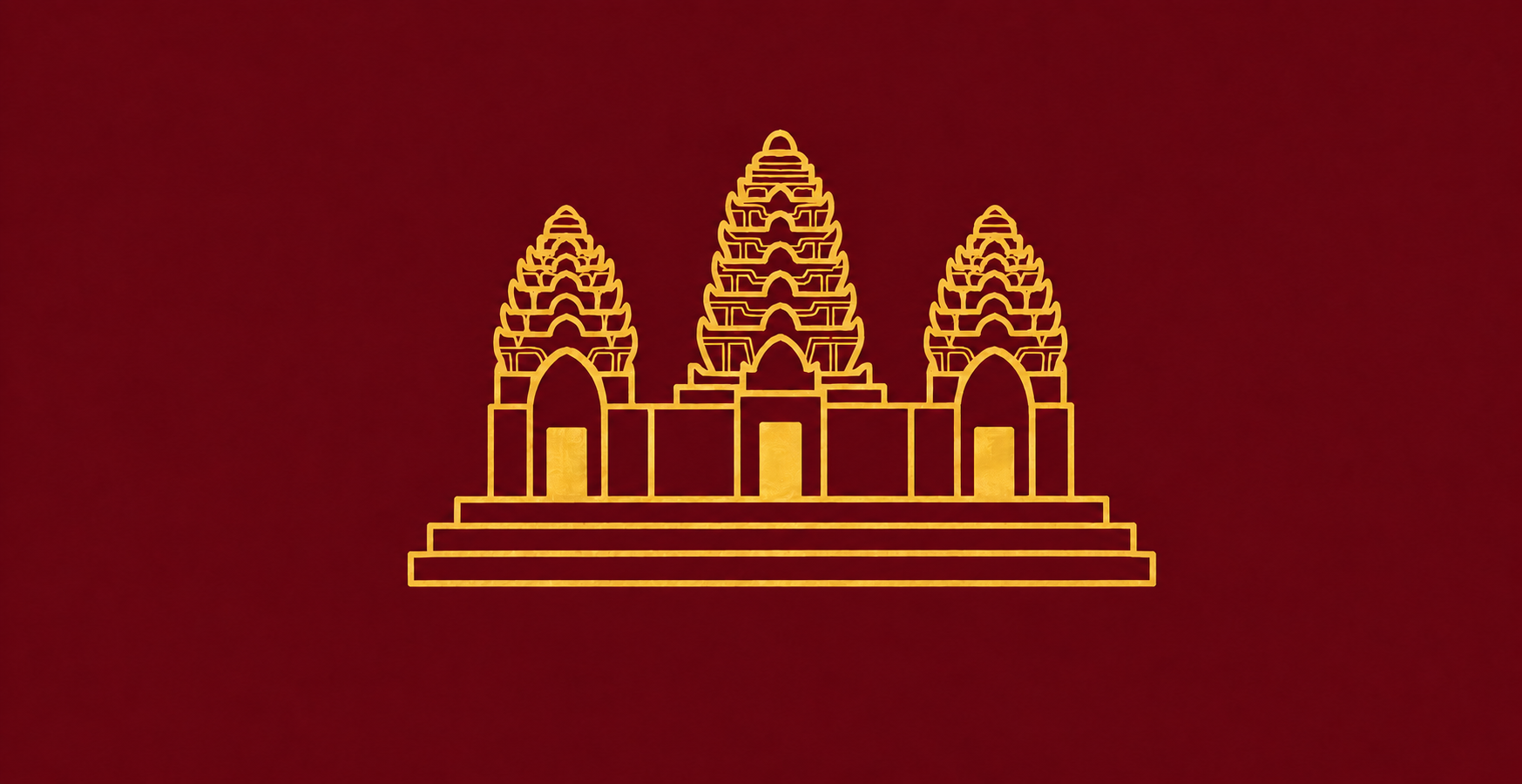
Article 16 The design and significance of the Kampuchean national flag are as follows: The background
is red, with a yellow three-towered temple in the middle. The red background symbolises the revolutionary
movement, the resolute and valiant struggle of the Kampuchean people for the liberation, defence, and
construction of their country. The yellow temple symbolises the national traditions of the Kampuchean
people, who are defending and building the country to make it ever more prosperous.
Chapter Twelve
The National Emblem
Article 17 The national emblem consists of a network of dikes and canals, which symbolise modern agri
-culture, and factories, which symbolise industry. These are framed by an oval garland of rice ears, with
the inscription “Democratic Kampuchea” at the bottom.
Chapter Thirteen
The National Anthem
Article 18 The national anthem of Democratic Kampuchea is the “Dap Prampi
Mesa Chokchey” [“Glorious Seventeenth of April”].
Chapter Fourteen
The Kampuchean Revolutionary Army
Article 19 The three categories of the Kampuchean Revolutionary Army—regular, regional, and guerrilla—form
an army of the people made up of men and women fighters and cadres who are the children of the labourers,
peasants, and other Kampuchean working people. They defend the State power of the Kampuchean people
and of independent, unified, peaceful, neutral, non-aligned, sovereign, and democratic Kampuchea, which
enjoys territorial integrity, and at the same time they help to build a country growing more prosperous every
day to improve and develop the people’s standard of living.
Chapter Fifteen
Worship and Religion
Article 20 Every citizen of Kampuchea has the right to worship according to any religion and the right not to
worship according to any religion. Reactionary religions which are detrimental to Democratic Kampuchea
and Kampuchean people are absolutely forbidden.
Chapter Sixteen
Foreign Policy
Article 21 Democratic Kampuchea fervently and earnestly desires to maintain close and friendly relations
with all countries sharing a common border and with all those near and distant throughout the world in
conformity with the principles of mutual and absolute respect for sovereignty and territorial integrity.
Democratic Kampuchea adheres to a policy of independence, peace, neutrality and non-alignment. It will
permit absolutely no foreign country to maintain military bases on its territory and is resolutely opposed to
all forms of outside interference in its internal affairs, and to all forms of subversion and aggression against
Democratic Kampuchea from outside, whether military, political, cultural, social, diplomatic, or humanitarian.
Democratic Kampuchea refuses all intervention in the domestic affairs of other countries, and scrupulously
respects the principle that every country is sovereign and entitled to manage and decide its own affairs with
-out outside interference. Democratic Kampuchea remains absolutely within the great family of non-aligned
nations. Democratic Kampuchea strives to promote solidarity with the peoples of the Third World in Asia,
Africa, and Latin America, and with peace- and justice-loving people the world over, and to contribute most
actively to mutual aid and support in the struggle against imperialism, colonialism, neo-colonialism, and
in favour of independence, peace, friendship, democracy, justice, and progress in the world.