Speech on The 10th Anniversary of the Founding of the Revolutionary Army – Pol-Pot, 1978
“We all deeply and wholeheartedly respect and admire our Revolutionary Army of Kampuchea, for they are the
strong backbone, the faithful and loyal armed forces, and the instrument of the proletarian dictatorship of the
Party. They have successively fought in the revolutionary war movements from 1968 up to now and have won
successive victories. They have highly enhanced and held aloft the prestige, honour and dignity of Kampuchea
— which had been despised before — as well as those of the whole people, the revolution and the Communist
Party of Kampuchea, both on the national and international arenas. Phnom Penh, January 17, 1978. I would
like to extend my respect to all the comrades, representatives of the Revolutionary Army of Kampuchea, the
comrades representatives of the workers, all the comrades representatives of the departments, organs and
all revolutionary units who have come and participated in this meeting. At first, on behalf of our Communist Party
of Kampuchea, the Military Committee of the Central Committee of the Communist Party of Kampuchea, the
Government of Democratic Kampuchea, and on behalf of the whole collectivist worker-peasant people through
-out the country, I would like to extend my deepest, warmest and most cordial respect and admiration towards the
whole Revolutionary Army of Kampuchea — including those who are present here, those in different units, and
particularly those at the front throughout the country, who are heroically fighting to defend Democratic Kampuchea,
the worker-peasant state power of the Party, and our collectivist people. Therefore, while gathering together
to commemorate and greet the 10th Anniversary of our Revolutionary Army, we have very great pleasure and
unbounded pride towards the Revolutionary Army of Kampuchea. This Army has fought, surmounted all kinds
of difficulties and sufferings, and has accepted all kinds of sacrifices during dozens of years for the national
and people’s liberation, for the worker-peasant revolutionary state power of the Party, for the prosperity of
Kampuchea and its entire people, and for the defence of Kampuchea’s territory to ensure its everlastingness.
It is only after being aware of the history of our Revolutionary Army of Kampuchea that we would have full
confidence in them and would wholeheartedly appreciate and be proud of them. As for the history of our
Revolutionary Army of Kampuchea, we have had the opportunity to talk and discuss about it many times.
On this occasion, I would like to bring up only some problems to inform our meeting. 1. THE FOUNDING
OF THE REVOLUTIONARY ARMY OF KAMPUCHEA On this first point, I would like to raise the following
questions: How was the Revolutionary Army of Kampuchea founded? From which source? In which circu
-mstances was this Army born, further developed and strengthened in size and strength? The Revolutionary
Army of Kampuchea was not born through one, two, four or ten circulars of some government or some
parliament. It was not some organization which had signed to enlist the youth into the army and give them
military uniforms and arms to join the Revolutionary Army of Kampuchea. Our Army was born in the people’s
revolutionary struggle under the leadership of the Communist Party of Kampuchea. It was the Communist
Party of Kampuchea which defined the strategic and tactical lines to fight against imperialism that had come
to interfere, aggress and occupy Kampuchea, and to fight against the feudalists and reactionary capitalists
who had exploited and oppressed the people of Kampuchea. To fight against the imperialists and the exploit
-ing classes, our Party decided that we had to carry out an armed struggle. And in order to wage an armed
struggle, we must have an army. This army has the revolutionary task of fighting against the imperialists and
the exploiting classes. Under the constant leadership of the Party, this army was born from scratch — one
fighter, two fighters, three fighters, four fighters, five fighters — fighting against the enemy.
They have fought against the enemy through revolutionary violence, particularly through armed violence. They
have fought against the enemy with traditional weapons, semi-modern weapons, up to modern weapons. They
have fought against the enemy with one fighter, one squad, one platoon, one company, up to battalion, regiment,
division and with many divisions. That is how the Revolutionary Army of Kampuchea has been successively
developed under the leadership of the Party, which has decided on the correct line — that is, to wage an
armed struggle against the enemy and to have a revolutionary army for this armed struggle. This brief history
of the Revolutionary Army of Kampuchea has shown that our army was not created by one or two circulars
and letters. This army was born in the flames of struggle, starting from scratch up to its present development.
This development is not insignificant. This army has been developed by inflicting ignominious defeats on
the US imperialists — the most powerful chieftain of imperialism in the world — and up to now by inflicting
ignominious defeats on the Vietnamese aggressors, annexationists and swallowers of territories. They have
been able to do so because this army was founded in the struggle under the leadership of the Party. As for
another question: From which source was this army founded and has it been developed? I would like to
answer as follows: The Revolutionary Army of Kampuchea was born from the workers and peasants, from
the people of the poor and lower classes. From its founding up to now, its social composition is made up of
an overwhelming majority of peasants from the poor strata. After them, there are also peasants from the
lower-middle strata. Ninety-eight per cent of cadres and fighters are from the peasants of poor and lower-
middle strata. Besides, there are also peasants from the middle strata and other revolutionaries.
Through this social class composition of our Revolutionary Army, we can see the source from which our Rev
-olutionary Army was born. It is these poor people who are the source of the founding of our Revolutionary
Army. It is these poor people who are the force to strengthen and develop the Revolutionary Army of Kam
-puchea. The peasants of poor and lower-middle strata, and the peasants of middle strata, are very numerous
— more than 80 per cent of the entire people of the country. These people are an inexhaustible and immense
source in supplying forces to our Revolutionary Army, to make it more developed and more powerful. We
are not worried that the source of our army would become exhausted, for the people of the lower classes
are very numerous. Besides quantity, our Revolutionary Army also has the same genuine class nature as
these people. The peasants of poor and lower-middle strata can be considered as belonging to the proletarian
and semi-proletarian classes in the countryside. With the peasants of poor and lower-middle strata, who
are so numerous and belong to such a genuine lower-class nature, our army can develop and strengthen
itself both in number and at the same time firmly preserve its class nature as a proletarian and semi-prole
-tarian army. These peasants of poor and lower-middle strata, belonging to such a good class, are not
isolated and scattered; they are under the leadership of the Party and have good qualities in the fields of
politics, ideology and collectivist organization. It is these people who supply forces to the army. It is these
poor people who are the mothers of our army. If these mothers are good, their sons and daughters are
also good. These mothers belong to a good original class and they have been successively and firmly
armed with politics, ideology and collectivist organization by the Party. With such good mothers, their
sons and daughters would also be good.
Through this awareness, we can see the quality of our Revolutionary Army of Kampuchea and have full
confidence in our army. In the future, we still have to base ourselves on the source of the peasants of
poor and lower-middle strata to strengthen and develop our Revolutionary Army of Kampuchea. If we
base ourselves on other sources, then our army would no longer be strong. Let us say that if in the future
we turn to other sources to select our fighters, our army would not be strong anymore, no matter how
many modern weapons we might have. If the original source is not good, then this army would not be
strong. A strong and healthy mother gives birth to a healthy baby. The good health we are talking about
here is a strong class nature, a firm revolutionary stand, the ability to surmount difficulties, and to struggle
valiantly. A mother with a strong revolutionary nature would also have sons with a strong revolutionary
nature. These are the sons who have powerfully fought against the enemy and won over any enemy,
however strong they were. This is the line and the stand we will follow forever in organizing our Revo
-lutionary Army. In the future, we must still follow this way in building up, strengthening and developing
our army, mainly from the original source of the peasants of poor and lower-middle strata, in order to
have an army with a strong genuine class nature — both by its own original nature and its genuine
proletarian class nature educated by the Party. Our army has no ranks, no salary. It is an army carrying
out a genuine revolution, fulfilling its high revolutionary tasks in defending the country, the worker-
peasant state power of the Party and the collectivist people. Therefore, it must have a very high
revolutionary spirit to heroically carry out the fighting. The factor of revolutionary people is the main
and fundamental factor. As for the factors of materials and technology, they are only of secondary
importance. Once we have strong revolutionary people, our fighting will be very powerful.
In which circumstances was our Revolutionary Army founded? Our Revolutionary Army was not founded
in peaceful times, in any military school or military academy. Our army was founded in the blazing flames
of struggle, in the revolutionary struggle full of successive difficulties, sufferings and endurance. This Rev
-olutionary Army has struggled against and overcome all kinds of obstacles to build up, further develop
and strengthen itself. Therefore, this Revolutionary Army has passed the tests not at school but in rev
-olutionary wars: the civil war from 1968–1969, the war against the US imperialists from 1970 to 1975,
and from 1975 up to now, our army has fought both against the US imperialists and their lackeys and
against the Vietnamese aggressors and swallowers of territories. Thus, this army has been successively
developed, strengthened and tempered in the flames of fighting. Being tempered in fighting like this, this
army has become powerful. The fighting has founded, further developed and strengthened our army to
become successively more and more powerful. The fighting is a tempering and a test serving to appreciate
our Revolutionary Army, our cadres and our men and women fighters through their concrete acts in the
actual movement. And through the experiences in this fighting, our army can be further and powerfully
developed and strengthened under the leadership of the Party. In brief, our Revolutionary Army of Kam
-puchea was founded: Under the leadership of the Party through the line of concrete revolutionary violence,
that is, by waging a revolutionary war; This army was founded from the poor people. That is why this army
is so powerful. These people have their class origin as peasants of poor and lower-middle strata. Besides,
they have the Party to lead them in political, ideological and organizational fields, and they are organized
in collectivity. This army has fought, been tempered and tested successively in the blazing flames of the
revolutionary war.
Thus, this army has fulfilled all the characteristics and qualities required as an army of our Communist
Party of Kampuchea. Therefore, in the future, our whole Party and our entire people will strive to build
up our Revolutionary Army of Kampuchea in conformity with these principles in order to make our army
ever more powerful and never allow it to change its nature. Now, I would like to speak about the successive
victories won by our Revolutionary Army of Kampuchea during our National Democratic Revolution as well
as during our Socialist Revolution. How has our Revolutionary Army of Kampuchea, which was founded
and has been gradually developed, won its successive feats of arms and victories during the revolutionary
war? We must recall and further illustrate these feats of arms and victories in order: On the one hand, to
develop more and more our pride, satisfaction, love, respect, admiration, and firm confidence in our Rev
-olutionary Army of Kampuchea, and to strive to develop and strengthen our Revolutionary Army of Kam
-puchea so that it becomes steadfastly stronger and more powerful in all fields — political, ideological,
organizational, and in the fighting line of the Party. On the other hand, to completely smash the propaganda
of the imperialists, reactionaries, aggressors, and annexationists — swallowers of territories — who,
adhering to the standpoint of their class interests and their policy of aggression and territorial annexation,
have always used perfidious propaganda to prophesy and discredit the revolutionary armies of poor
countries that lack armaments. They have claimed that the armies of these countries could absolutely
not defeat the aggression and annexation armies of the great powers, imperialists, reactionaries, and
big countries that possess large populations, big armies, and abundant armaments of all kinds. In the
history of our Revolutionary Army, they have repeatedly prophesied that our army would be completely
destroyed. They have made such prophecies with the intent to wage psychological war and political war
— to threaten, frighten, and mislead in advance the peoples and revolutionary armies of small and/or
poor countries, so that they can freely aggress, invade, and swallow the territories of others in
accordance with their ambitions.
For all the above-mentioned reasons, we must recall the successive feats of arms and victories of our
Revolutionary Army of Kampuchea on the solemn occasion of this 10th Anniversary of its founding. I
would like to briefly recount the grand feats of arms and successive victories won by our Revolutionary
Army of Kampuchea during the revolutionary war from 1968 to 1978, by dividing this revolutionary war
into three periods: From 1968 to March 1970: the period of struggle for national liberation. From March
1970 to April 1975: the period of struggle for national liberation. From April 1975 to January 1978: the
period of struggle for national defence. 1. From 1968 to March 1970 In this period, a civil war broke out
in our country. Against our revolution stood the reactionaries — the exploiting classes — with militarists
Lon Nol and Sirik Matak as chieftains, and the US imperialists pulling the strings behind them. At that
time, the balance of forces was as follows: the Lon Nol clique, lackeys of the US imperialists, had an
army of 60,000 men in the land, naval, and air forces, including regular soldiers and provincial guards.
As for us, in 1968, throughout all regions we had fewer than 1,000 guerrillas. Thus, compared to the enemy,
we were very weak and very small, while the enemy had a very large force. The enemy was like a big
elephant, and we were like a small ant. In that situation, the prophets of the imperialists and exploiting
classes, both inside the country and abroad, predicted that the “Khmer Rouge” would surely be completely
annihilated. But what was the concrete result? We succeeded in defending and strengthening ourselves.
From almost nothing in 1968, by March 1970 we had built an army of 4,000 regular soldiers and 50,000
guerrillas throughout the country, waging guerrilla warfare in 17 out of 19 provinces. We had a liberated
zone as our rear base with 60,000 people, guerrilla bases with 300,000 people, and guerrilla zones with
700,000 people. In total, in 1970, our liberated zone, guerrilla bases, and guerrilla zones encompassed
more than one million people. Our forces constantly increased. We always succeeded in defending,
developing, and strengthening our army, our people, our liberated zone, our guerrilla bases and zones,
our regular army, and our guerrilla units.
These forces were very strong in the civil war and inflicted very heavy defeats on the enemy. Why were we
able to defend, develop, and strengthen the forces of our army and our revolution? Because we had a correct
line and correctly carried out the People’s War as defined by the Party. Therefore, the prophecies of the imp
-erialists and exploiting classes against our revolution, both inside the country and throughout the world, were
completely smashed and dissolved. 2. The Period of National Liberation War against the US Imperialists
(1970–1975) During this period, the prophets of the imperialists and reactionaries continued to make pred
-ictions. They used every means to spread propaganda against our revolution in order to deceive our people,
our army, our Party, and world opinion — to make us frightened of the great powers and willing to bow our
heads and accept oppression. At that time, the enemy forces consisted of: The Lon Nol clique, with forces
ranging from 60,000 to 200,000 men; More than 100,000 troops of the Thieu-Ky regime that had penetrated
our territory; Many tens of thousands of US imperialist troops that aggressed our territory in April and May 1970.
In addition, they used large numbers of planes to bomb our airspace. The Thai reactionaries, South Koreans,
Taiwanese, and others also participated in activities against us. All these forces were very large. The imperialists
and reactionaries predicted that the Kampuchean revolution would be completely destroyed and defeated. But
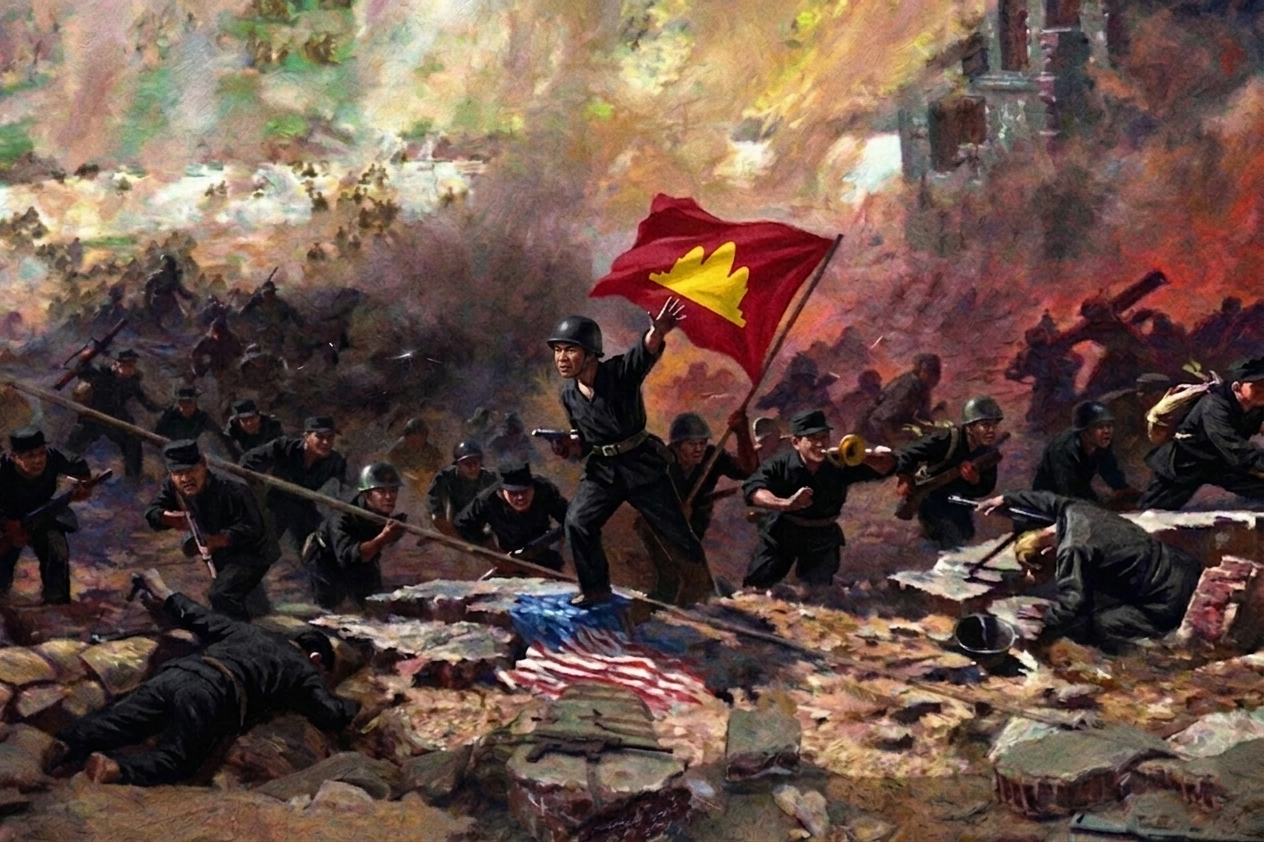
the concrete result was the grand victory of April 17, 1975. Our Revolutionary Army, which in 1970 had only
4,000 regular soldiers and 50,000 guerrillas, rapidly developed and was organized into battalions, regiments,
and divisions. The army and the people developed self-sufficiency in the economy and won the great victory
of April 17, 1975. This was a great victory in the history of Kampuchea and also a grand victory in world history
— the first time the US imperialists suffered such an ignominious defeat.
The Revolutionary Army of Kampuchea defeated the US imperialists because it was led by our Party, was
composed of the sons and daughters of the worker-peasant people — especially poor and lower-middle
peasants — and was steadfastly tempered in the flames of revolutionary war. Therefore, this army became
increasingly powerful, growing from nothing and acquiring more and more armaments while fighting and
defeating the aggressor enemy one victory after another. Our victories smashed the perfidious theories
and poisonous propaganda which claimed that “a small country cannot fight,” “a poor country cannot fight
and stand up,” “a small country must be dominated,” and “a poor people must be dominated.” We broke
down this poisonous propaganda of the imperialists and reactionaries, thereby encouraging peoples
around the world to become stronger and to continue their struggle to win victories. 3. The Struggle aga
-inst the Vietnamese Aggressors, Annexationists, and Swallowers of Territories Now, during the fighting
against the Vietnamese aggressors, annexationists, and swallowers of territories, the prophets have once
again made predictions. They are the prophets of the US imperialists, reactionaries, and various expans
-ionists in the world. They foretold that “the Vietnamese army, which had been tested in war for many
decades, would take Kampuchea within only 24 hours.” They spread this propaganda to mislead world
opinion and frighten small countries and poor peoples with their poisonous theories: “a small country
cannot struggle,” “a small country must be dominated,” “it is impossible to be independent, sovereign,
and self-reliant,” etc. Despite this propaganda, they could not completely mislead world opinion. World
opinion at that time was divided, but as a whole it supported and expressed sympathy with Kampuchea.
The majority believed that the Revolutionary Army of Kampuchea would surely defeat the Vietnamese aggr
essors, since it had already defeated the US imperialists. A small number, however, expressed anxiety, think
-ing we might not be able to stem the Vietnamese aggression. I would like to speak about the fighting results
and the quality of our Revolutionary Army. The Vietnamese forces that came to aggress Kampuchea since
May 1975 can be divided into three categories: Border defence security forces: These forces machine-gunned
our people working in the fields and our patrolling army units. They constantly shelled inside our territory,
repeatedly moved their installations into our land, and allowed their people to build houses with pillars on
both their soil and ours — even entire villages deep inside our territory. They swallowed our land centimetre
by centimetre, metre by metre, and kilometre by kilometre. They repeatedly carried out provocations along
our borders. In the Southwest alone, in 1975–1976, they caused an average of 30 killed or wounded per
month through machine-gunning and shelling. Regional army: This is the provincial army of the Vietnamese
provinces along our border. These forces participated with the border security forces in constantly creating
troubles and difficulties for our border population, behaving arrogantly and haughtily as “fathers of Indochina”
or “elder brothers of Indochina,” saying “the times in Indochina must comply with my orders” and “whatever I
do, you small ones must obey me.” Military region forces: These are the regular troops of each military region,
used as the core force for military intervention in the provinces. These three categories of Vietnamese forces
launched many attacks against us from May 1975, especially in 1977. However, they clearly felt the efficiency
of our Revolutionary Army of Kampuchea, which punished them severely every time they aggressed us.
For this reason, in order to launch their large-scale aggression against Kampuchean territory in November
and December 1977 and January 1978, the Vietnamese had to dispatch many divisions of their regular
army from Hanoi headquarters, along with hundreds of sophisticated tanks and pieces of heavy artillery.
They used these as core forces to break through our border defence lines and penetrate many kilometres
deep into our territory (and dozens of kilometres in some places), particularly along National Road No. 7
and in Svay Rieng province in the East, as well as in Takeo and Kampot provinces in the Southwest. They
sowed mourning, devastation, and suffering among our people, destroying villages, cooperatives, cattle,
poultry, cultivated land, rice fields, and property. If the Vietnamese acted in this way, what kind of “revolution”
is this? What kind of “special friendship” is this? What kind of “negotiations” to solve the border problem is
this? We have seen only the ideology of big-country chauvinism, arrogance, and cruelty toward us, along
with annexation and swallowing of our territories, aggression against our country, subversion, and attempts
to stage a coup d’état to overthrow the regime of Democratic Kampuchea. However, I would like to speak
about the concrete results of this large-scale Vietnamese aggression and expansion against Kampuchea.
Did they win or fail? They suffered a very heavy defeat, and our victory was also great — comparable to the
glorious victory of April 17, 1975. It was the grand victory of the people and the Revolutionary Army of Kam
-puchea over the Vietnamese aggressors, annexationists, and swallowers of territories on January 6, 1978.
Vietnamese Defeat in the Military Field Concretely, the Vietnamese aggressor army on all fronts was driven
back by our Revolutionary Army of Kampuchea all the way to the border. The enemy suffered 29,000 killed
or wounded. More than 130 big and modern enemy tanks (each costing many millions of dollars) were
destroyed or damaged. Many dozens of pieces of heavy artillery were destroyed or damaged.
Five enemy divisions of regular troops were broken. We won such great victories because, as a whole, we
correctly carried out the People’s War line of the Party, and particularly because our Revolutionary Army of
Kampuchea firmly grasped and efficiently implemented the Party’s fighting line. The enemy relied only on
their tanks and artillery. When our Revolutionary Army attacked, destroyed, damaged, or immobilized their
tanks, their infantry fell into confusion. It is not difficult to attack tanks. We used many mines placed across
national roads, provincial roads, and paths where the tanks moved (since enemy tanks could not cross our
rice fields, swamps, or irrigation canals). We also used B-40, DK-75, and DK-82 weapons to destroy them.
As for heavy artillery, it had to move along the same roads by truck or tracked vehicle and could not escape
our mines. Another weak point of the Vietnamese aggressor army was that they had no rice to eat and were
forced to eat only bran. By eating only bran, they could not win in their war of aggression. Vietnamese Defeat
in the Political Field In the political field, the Vietnamese aggressors also suffered a very heavy defeat. They
were seen by the world as aggressors, annexationists, and swallowers of Kampuchean territory. The over-
whelming majority of independence- and justice-loving countries and peoples clearly saw the true face of the
ideology of big-country chauvinism and the “Indochina Federation” policy of the Vietnamese. Vietnam became
very isolated and was strongly condemned both officially and unofficially. The Vietnamese people themselves
also clearly understood that the policy of aggression had brought suffering and devastation to their country and
people. Vietnamese Defeat in the Economic and Financial Fields In their large-scale and systematic aggression
against Democratic Kampuchea, the Vietnamese had to spend enormous economic and financial resources
at a time when their own country and people were suffering from severe shortages of food and money to
solve post-war problems.
They spent a great deal to aggress others, hoping to win and make profit. But when they were defeated, they
lost everything — both capital and interest. Their national economy and finances suffered even greater damage
and devastation. Dear comrades, We have achieved a grand victory over the Vietnamese aggressors. Our
friends, near and far, and all independence- and justice-loving countries and peoples the world over have
warmly acclaimed our great victories. We have firmly held aloft the banner of “independence, sovereignty,
self-reliance, and being master of our own destiny,” the banner of “independence, sovereignty, and territorial
integrity,” and the banner of “honour and dignity of the Kampuchean nation and people.” We have strongly
smashed the Vietnamese banner of aggression, annexation, and swallowing of territories, as well as their
banner of the “Indochina Federation.” Our whole Party is united as one in leading the fight to wipe out the
enemy. Our whole people are united as one, maintaining a high revolutionary political and ideological stand.
Our valiant Revolutionary Army of Kampuchea has correctly and efficiently carried out the military line and
the People’s War line of the Party. All our revolutionary departments and services have fulfilled their tasks
well and actively. We have rice and paddy in all our rice fields. Our friends near and far have supported and
expressed sympathy with our cause of national defence against the Vietnamese aggressors. We have clearly
seen that aggression has been defeated and independence has surely won. However, these are only the first
-step victories. We must continue to struggle because enemies of all kinds continue to pursue activities to
harm us and place our country under their domination through various means: aggression, spying, threats,
subversion, attempted coups d’état, assassinations, machine-gunning and shelling along the borders, etc.
Therefore, all of us must firmly grasp the main tasks of our Party: To defend Democratic Kampuchea, To
carry on the socialist revolution, To build socialism well. Concretely, we must: Raise higher our revolutionary
vigilance, always arm ourselves firmly with the political, ideological, and organizational stand of the Party,
keep secrets, and defend our Party, our revolution, our collectivist people, our revolutionary power, and
our Revolutionary Army. Improve, develop, and strengthen our national defence forces — regular army,
regional army, and guerrilla forces — so they become ever more powerful, and destroy the enemy’s net
-works and activities of psychological warfare and spying. Hold high the spirit of fighting and enthusiastically
fulfil the 1977 plan of 3 tons and 6 tons per hectare and the 1978 plan of 3.5 tons and 7 tons per hectare.
Every factory, worksite, unit, department, and service must efficiently carry out its tasks to fully achieve
or surpass the plan. Do our utmost to strengthen solidarity with revolutionary and progressive forces the
world over, in conformity with the foreign policy of the Party as clearly stated in the Constitution of Demo
-cratic Kampuchea. We preserve and firmly adhere to the policy of independence, peace, neutrality, and
non-alignment. Democratic Kampuchea resolutely remains within the great family of the Non-Aligned coun
-tries. As for the conflict with Vietnam, our Government has clearly stated its position several times. On this
occasion, I would like to restate it once again on behalf of the Government of Democratic Kampuchea, in
accordance with Article 21 of the Constitution of Democratic Kampuchea If the Vietnamese side stops its
interference, subversion, machine-gunning, pounding, aggression, and annexation against Democratic
Kampuchea by completely eliminating its ideology of big-country chauvinism towards Kampuchea, its
principle of “Indochina, China, what are the roots of the Vietnamese policy of intimidation, threatening,
subversion, aggression, annexation/swallowing of territories against Kampuchea,” then there would be
no contradiction between us and a genuine friendship would be established and would be further
developed and strengthened.
This is the aim of the Government and people of Kampuchea, which is so small and has no interest in
creating trouble. “Democratic Kampuchea is endowed with goodwill and is firmly determined to maintain
close and friendly relations with all countries having a common border with her, and with all countries,
near or far, throughout the world, on the strict basis of mutual respect for sovereignty and territorial
integrity. “Democratic Kampuchea firmly abides by the policy of independence, peace, neutrality, and
non-alignment. No foreign country whatsoever is allowed to establish military bases in her territory.
She resolutely struggles against all foreign interferences in her internal affairs, against all kinds of
acts of subversion and aggression from outside — whether military, political, cultural, economic,
social, diplomatic, or through so-called humanitarian acts. “Democratic Kampuchea resolutely does
not interfere in the internal affairs of any country whatsoever. Democratic Kampuchea resolutely
respects the principle that each country is sovereign and has the full right to dispose of and decide
by itself its internal affairs without any foreign interference.” We firmly abide by our foreign policy
stipulated in our Constitution She only wishes to have peace in her independence and territorial integrity.
The glorious Revolutionary Army of Kampuchea has been developed and strengthened day by day.
This Revolutionary Army has gone through a long, hard fighting path, through and surmounting all
kinds of difficulties, and by consenting to all kinds of sacrifices for our class, our revolution, our people,
and our country. The way through which all the comrades of our Revolutionary Army have gone is a
very noble, brilliant, and glorious one in the history of Kampuchea. The revolutionary heroism of the
comrades of our Revolutionary Army is very sublime, worthy of profound respect and admiration.
We all are very proud of this Revolutionary Army of Kampuchea. But we all know that the tasks of our
Revolution in Kampuchea, the worker-peasant movement of our Party, our revolution, and the national
edification of Democratic Kampuchea remain very heavy. The tasks of our comrades of the Revolutionary
Army of Kampuchea are indeed heavy, but they are very noble and glorious. Let comrades further hold
aloft the banner of victory of our Revolutionary Army of Kampuchea: By striving to educate yourselves
and your units to make them always good, sound, and firm in conformity with the political, ideological,
and organizational stand of the Party, and also with the line of the people’s war and the line of fighting
of the Party. Every unit has to impetuously fulfil their revolutionary tasks as vanguard, overcoming all
obstacles and difficulties to win new great victories. Long live the correct and clear-sighted Communist
Party of Kampuchea! Long live the powerful Revolution of Kampuchea! Long live the glorious people
of Kampuchea! Long live the valiant and powerful Revolutionary Army of Kampuchea!