Memory in the Dying – H.P.R., 1889
Republished from the theological & occult magazine Lucifer
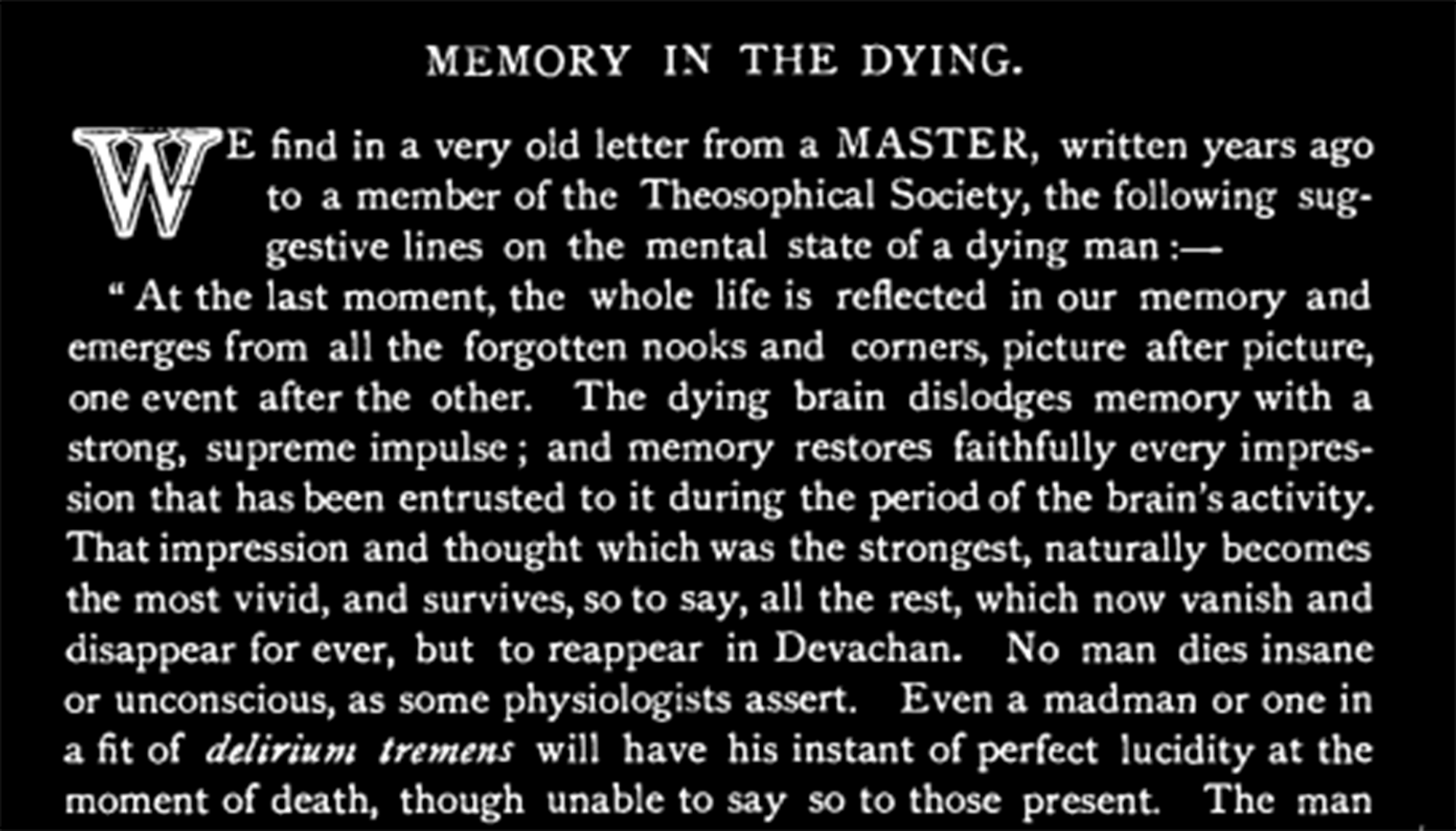
We find in a very old letter from a master, written years ago to a member of the Theosophical Society, the
following suggestive lines on the mental state of a dying man: “At the last moment, the whole life is reflected
in our memory and emerges from all the forgotten nooks and corners, picture after picture, one event after
the other. The dying brain dislodges memory with a strong, supreme impulse; and memory restores faithfully
every impression that has been entrusted to it during the period of the brain’s activity. That impression and
thought which was the strongest naturally becomes the most vivid, and survives, so to say, all the rest, which
now vanish and disappear for ever, but to reappear in Devachan. No man dies insane or unconscious, as
some physiologists assert. Even a madman or one in a fit of delirium tremens will have his instant of perfect
lucidity at the moment of death, though unable to say so to those present. The man may often appear dead.
Yet, from the last pulsation, and between the last throbbing of his heart and the moment when the last spark
of animal heat leaves the body, the brain thinks and the EGO lives, in these few brief seconds, his whole life
over again. Speak in whispers, ye who assist at a death-bed and find yourselves in the solemn presence of
Death. Especially have ye to keep quiet just after Death has laid her clammy hand upon the body. Speak in
whispers, I say, lest you disturb the quiet ripple of thought and hinder the busy work of the Past casting its
reflection upon the veil of the Future…” The above statement has been more than once strenuously opposed
by materialists. Biology and (scientific) psychology, it was urged, were both against the idea; and while the
latter had no well-demonstrated data to go upon in such a hypothesis, the former dismissed the idea as an
empty “superstition.” Meanwhile, even biology is bound to progress, and this is what we learn of its latest
achievements. Dr. Ferré has communicated quite recently to the Biological Society of Paris a very curious
note on the mental state of the dying, which corroborates marvellously the above lines.
For it is to the special phenomenon of life-remembrances, and that sudden re-emerging on the blank walls
of memory—from all its long-neglected and forgotten “nooks and corners”—of “picture after picture,” that
Dr. Ferré draws the special attention of biologists. We need notice but two among the numerous instances
given by this scientist in his Rapport to show how scientifically correct are the teachings we receive from
our Eastern Masters. First Case The first instance is that of a moribund consumptive whose disease was
developed in consequence of a spinal affection. Already consciousness had left the man when, recalled to
life by two successive injections of a gramme of ether, the patient slightly lifted his head and began talking
rapidly in Flemish—a language no one around him, nor yet himself, understood. Offered a pencil and a
piece of white cardboard, he wrote with great rapidity several lines in that language—very correctly, as
was ascertained later on—fell back, and died. When translated, the writing was found to refer to a very
prosaic affair. He had suddenly recollected, he wrote, that he owed a certain man a sum of fifteen francs
since 1868—hence more than twenty years—and desired it to be paid. But why write his last wish in
Flemish? The defunct was a native of Antwerp, but had left his country in childhood, without ever knowing
the language; and having passed all his life in Paris, could speak and write only in French. Evidently
his returning consciousness—that last flash of memory that displayed before him, as in a retrospective
panorama, all his life, even to the trifling fact of his having borrowed, twenty years back, a few francs
from a friend—did not emanate from his physical brain alone, but rather from his spiritual memory,
that of the Higher Ego (Manas, or the reincarnating individuality).
The fact of his speaking and writing Flemish, a language that he had heard at a time of life when he could
not yet speak himself, is an additional proof. The EGO is almost omniscient in its immortal nature. For indeed
matter is nothing more than “the last degree, and as the shadow, of existence,” as Ravaisson, member of
the French Institute, tells us. Second Case Another patient, dying of pulmonary consumption and likewise
reanimated by an injection of ether, turned his head towards his wife and rapidly said to her: “You cannot
find that pin now; all the floor has been renewed since then.” This was in reference to the loss of a scarf-pin
eighteen years before—a fact so trifling that it had almost been forgotten, but which had not failed to be
revived in the last thought of the dying man, who, having expressed what he saw in words, suddenly stopped
and breathed his last. Thus any one of the thousand little daily events and accidents of a long life would
seem capable of being recalled to the flickering consciousness at the supreme moment of dissolution—a
long life, perhaps, lived over again in the space of one short second! Third Case A third case may be noticed,
which corroborates still more strongly that assertion of Occultism which traces all such remembrances to
the thought-power of the individual, instead of to that of the personal (lower) Ego. A young girl, who had
been a sleep-walker up to her twenty-second year, performed during her hours of somnambulic sleep the
most varied functions of domestic life, of which she had no remembrance upon awakening. Among other
psychic impulses that manifested themselves only during her sleep was a secretive tendency quite alien to
her waking state. During the latter she was open and frank to a degree, and very careless of her personal
property; but in the somnambulic state she would take articles belonging to herself or within her reach
and hide them away with ingenious cunning.
This habit being known to her friends and relatives, and two nurses having been in attendance to watch her
actions during her night rambles for years, nothing disappeared but what could be easily restored to its usual
place. But on one sultry night, the nurse falling asleep, the young girl got up and went to her father’s study.
The latter, a notary of fame, had been working till a late hour that night. It was during a momentary absence
from his room that the somnambule entered and deliberately possessed herself of a will left open upon the
desk, as also of a sum of several thousand pounds in bonds and notes. These she proceeded to hide in the
hollow of two dummy pillars set up in the library to match the solid ones; and, stealing from the room before
her father’s return, she regained her chamber and bed without awakening the nurse, who was still asleep
in the armchair. The result was that, as the nurse stoutly denied that her young mistress had left the room,
suspicion was diverted from the real culprit and the money could not be recovered. The loss of the will
involved a lawsuit which almost beggared her father and entirely ruined his reputation, and the family
were reduced to great straits. About nine years later, the young girl—who during the previous seven years
had not been somnambulic—fell into a consumption of which she ultimately died. Upon her death-bed, the
veil which had hung before her physical memory was raised; her divine insight awakened; the pictures of
her life came streaming back before her inner eye; and among others she saw the scene of her somnambulic
robbery. Suddenly arousing herself from the lethargy in which she had lain for several hours, her face showed
signs of some terrible emotion working within, and she cried out: “
Ah! what have I done?… It was I who took the will and the money…Go search the dummy pillars
in the library, I have—” She never finished her sentence, for her very emotion killed her. But the
search was made, and the will and money were found within the oaken pillars as she had said.
What makes the case more strange is that these pillars were so high that even by standing upon
a chair, and with plenty of time at her disposal instead of only a few moments, the somnambulist
could not have reached up and dropped the objects into the hollow columns. It is to be noted,
however, that ecstatics and convulsionists (vide the Convulsionnaires de St. Médard et de Morzine)
seem to possess an abnormal facility for climbing blank walls and leaping even to the tops of trees.