Conformity – B.F. Henley, 8/11/1888
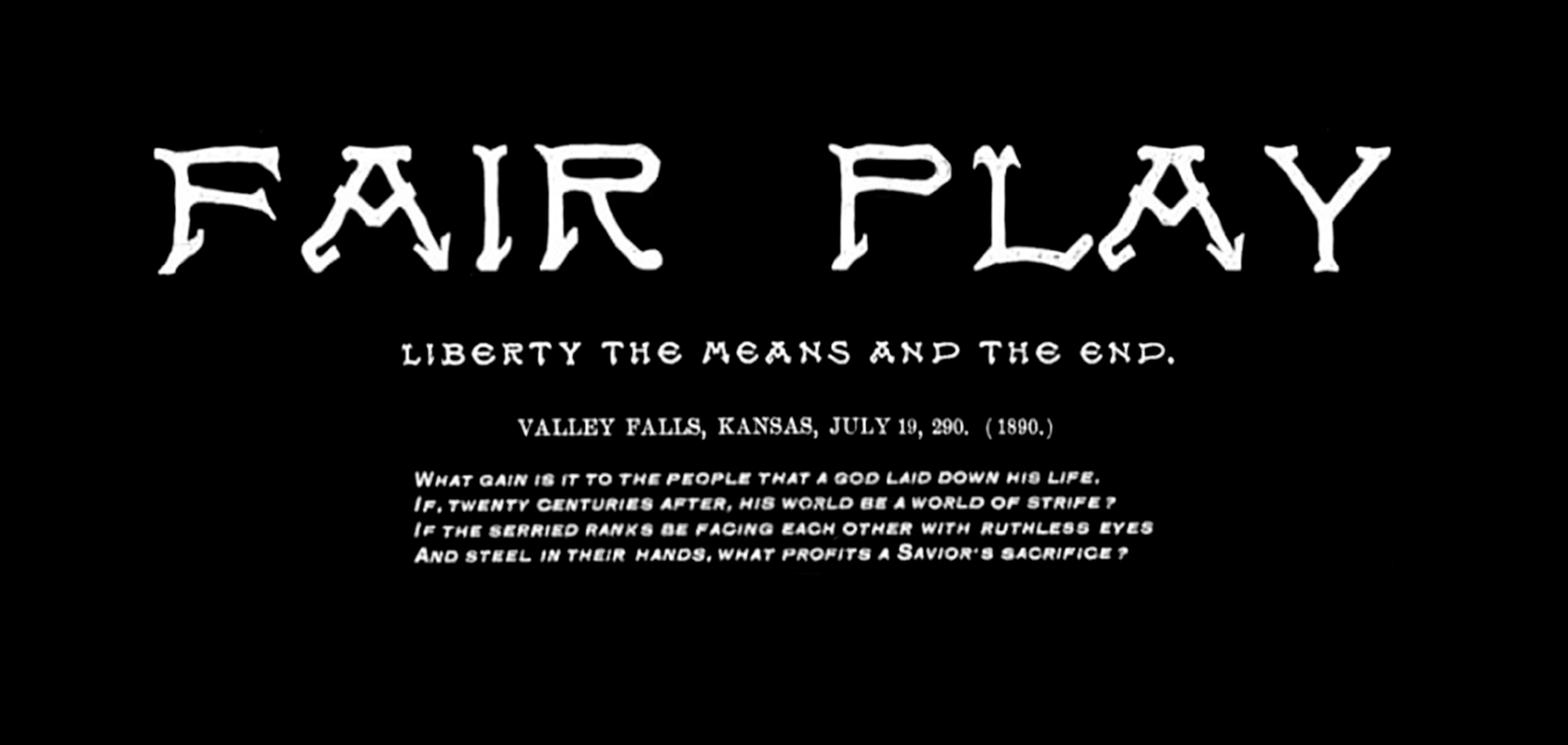
Republished from Lucifer’s sister publication Fair Play
Once upon a time I religiously endeavored to conform to the rules of politeness, but peculiar circumstances having made
it difficult for me to be uniform in my practice, I gave up trying. Samuel Butler observes that “we damn the sins we have
no mind to.” Not only that, but we often strongly incline to damn as sins what we cannot, ourselves, effect. On impersonal
grounds I find satisfactory reasons for neglecting to strive after conventional forms. I know that such a conclusion on
my part, derived under the circumstances, is justly liable to grave suspicions. Intellectual hypocrisy occurs frequently.
Very well, then. Bacon began his philosophy with, “Francis of Verulam Sic Cognovit.” Seriously, why should I, or anyone,
be expected to do as others do? The Emperor Charles V is said to have proposed the converse of this question. Why
should he expect others to agree with him? He had a number of clocks and watches hung on the walls of his apartments
at Yuste, and although he gave considerable time to the task, he failed to make them run alike. Is not the human mind
a more complex mechanism than any time-piece? If Charles ever struck out this conclusion, he failed to catch its import;
if he had, he would not on his death-bed have exhorted his son to be a burner of heretics. Of course, as a fellow member
of society, there are certain things that I must not do, but that is another and quite distinct matter. I have a right to the
full exercise of all my faculties, bounded only by the equal right of all others. With this limitation, everybody has a right
to follow his own judgment. Recede one jot from this position, and, logically, you concede an authority for all the excesses
that tyranny of the well-meaning sort ever committed. Not only am I under no obligation to conform to the ways of others,
but such conformity is undesirable among men. It hinders and contorts personal and social development. The automaton
-like being of the Chinese illustrates the consequences of allowing personality to become imbedded in the cake of custom.
History tells us that the race owes almost everything to the men who dared to be original. Dared to be original! What a
word! Yet so it is. No two blades of grass are alike. Every child born into this world has that in him which constitutes his
personality, which differentiates him from all other men—from all the myriads of men that were, are, or shall be; yet
powerful social engines are constantly at work to crush out the flavor of that personality, and to force all through the
moulds of custom. How much human nature suffers in the process cannot be known.
But we do know that we are greatly beholden for the joy and sweetness we find in life to the personalities that
persist through the press of conventionalism. To be original is the birth-right of every one; yet society punishes
originality. A few generations back it was wont to roast the kind of men to whom the world owes most. In one of
the old Greek States, the proposer of a new law was required to present himself at the place of public assembly
with a halter around his neck, ready to be hanged on the spot if the people did not approve of his measure. An
innovator among the Locrians had need for considerable nerve. When it is remembered that among the ancients
the scope of legislation included the entire range of conduct, domestic, religious, and social, as well as political,
we must admit that we have our being in a far more liberal age. Society, however, is still “even poor in thanks.”
Still too often, as has been observed, the world breaks the hearts of its benefactors and then builds monuments
to their memory. “Is not there a strong smack of Anarchy about this?” We will not quarrel about terms. I believe
that the most difficult and painful steps in the progress of society have been taken in the process of “nation-making,”
the only thing needful was to form a cake of customs strong enough to restrain the various elements of society
from deeds of personal violence. The crumbling strongholds, beetling over the crags of the Rhine, speak of the
time when warriors patrolled the roads to pillage the public. In those days the great desideratum was a central
government strong enough to render “the king’s highway” free from robber barons. But these “warriors bold” are
gone, and their dens are in decay. We do not much need the strong arm of central Government in that way now.
As the process of adaptation to the social state progresses, the need for the exercise of Government authority is
lessening, while the range of Government function is constantly narrowing. This is a plain though negative proof that
Government is not in itself a good thing; it is an evil, in the present stage of the world necessary, but an evil which
the social man will get rid of as soon as may be. Many people demur to this; yet a little reflection should convince
them that no one loves Government for its own sake. Watch the average man when that agent of Government,
the tax-gatherer, approaches him. Smiles do not wreathe his countenance as he produces his pocket-book.
As the human race slowly staggers along towards the goal of perfection, the era of no Government will surely fall
within the line of march. “The perfect man is a law unto himself.” That is the teaching of both Scripture and philosophy.
This, good friend, is philosophic Anarchism. A long way from the common, and every-day sort, we must admit. True,
the alternative, State Socialism, has had many valuable advocates, and has many attractions for those who think they
think; but it is discountenanced by the fundamental principle of social science, namely, that all have a right to the free
exercise of their faculties, limited only by the equal right of each. Man cannot otherwise reach his highest development.
Ignore this principle and sociology falls into chaos. Mark Twain tells us how Huckleberry Finn fled from civilization,
donned his rags again and went back to the old life among his native hogsheads, rather than endure the restraints
of the pious widow’s household. “’Taint no use, Tom,” he explains to his friend, “the widder is good, but she sleeps
by rule, eats by rule,” etc. The poor waif could not stand it. Some of Huckleberry’s habits were bad, but the core of
his complaint was sound. The widow was good—good as she could be, but she had no right to expect others to abide
by her notions of the fitness of things. In the sum of her excesses and defects the widow’s conduct may, or may not,
have been more nearly correct than that of average people. We only know that taking human nature as it is, her life
would be intolerable to most. In a word, is it not gross ignorance for any of us to set up our ideal of conduct as a standard
and insist that others should follow it? Harmony of life, individual and social, is the ultimate goal of all earthly striving,
and it can only be attained by the free interplay of all the impelling forces of human nature—not of any individual, but
of all the uncounted elements that go to make up the social unit. “Every New England deacon ought to see one Derby
day to learn what sort of a world this is he lives in. Man is a sporting as well as a praying animal.” So observes the
ever-amiable Doctor Holmes, in his introductory to “Our Hundred Days in Europe.”