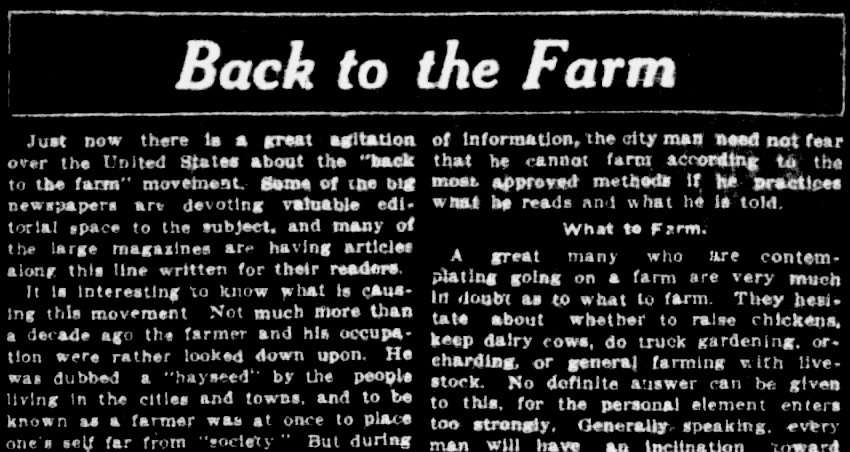
Back to the Farm – Charles E. Hoke, 7/21/1910
Just now there is a great agitation in the United States over the “back-to-the-farm” movement. Some of the big
newspapers are devoting valuable editorial space to the subject, and many of the large magazines are publishing
articles along this line for their readers. It is interesting to know what is causing this movement. Not much more
than a decade ago, the farmer and his occupation were rather looked down upon. He was dubbed a “hayseed”
by the people living in the cities and towns, and to be known as a farmer was at once to place oneself far from
“society.” But during all this time the farmers were not idle. They were establishing agricultural colleges and
experiment stations throughout the United States through their representatives in Congress. Many of them were
using these experiment stations to learn better methods of farming. Along with this came modern conveniences,
such as are now found in any well-developed agricultural community, and which really make farm life so highly
desirable today. As soon as the sons and daughters were graduated from these colleges, they began to come
back to the farm. Not all of them, by any means, for a great many men and women were needed as teachers in
the agricultural and domestic sciences in the many new schools that were continually being started. The call for
teachers is still heavy, but in spite of this fact, many agricultural college graduates are now on the farm and are
putting into practice what they learned in college. The establishing of these agricultural colleges and experiment
stations, the spreading of better methods of farming both by lectures and by publications, the educating of the
young folks from the farm in these colleges, and the scattering of many of these college graduates among the
people as teachers and actual farmers have, I think, largely given the farmer and his occupation the standing
they have today. As a natural result, many people who had before considered farming and farm life as beneath
their notice are now thinking seriously of going back to the farm. This change of attitude toward the farming
industry, together with many other smaller factors, has caused the present agitation and movement toward
the farm.
Four Classes
The vast number of people who are now seeking country life I have divided into four classes. First, we have the
man who is looking for something easy and has heard that the farm is the place to find it. Second, we have a more
serious class—usually low-salaried, hard-working people in the cities—who are having a hard time making a decent
living at the occupation in which they are now engaged because of the high prices of foodstuffs and the extremely
low wages paid in many cases. They consider the farm, not because they think it is easy work and ready money,
but because they think it offers a better, healthier, and more independent life than they can ever hope to have in
the city. Third, we have the class who want to live in the country because it seems to be fashionable among the
wealthy to own a country home. The fourth class is composed of men who have been on a farm but, for some
reason or other, have moved to town; and, having failed in many cases, are now thinking of going back. To the
first class I have nothing to say, except that it is vastly easier to farm while sitting in an office or under the shade
of some tree than it is when at actual work on the farm. The third class, being in the business purely for pleasure,
we need not mention. It makes little difference to them if they “make or break,” and so long as they do not become
too numerous and keep needed land away from the man who knows how to make it productive and would, if given
the chance, we need have no concern about them. To the fourth class, I would say that if they have quit the farm
merely for the sake of what they considered would be an easy life, and now, seeing their mistake, want to go back,
they are very liable to find, as did Jeffries, that they “can’t come back.” But to another division of this class—who
have in many cases been very successful farmers and moved to town for the purpose of educating their children
—I would say that the farm needs them and is calling for them. It is the farmer’s own fault that he has to move to
town to educate his children. With the vast amount of money that is being spent each year for higher education,
the farmer certainly ought to see that a goodly share of this money goes to establish better country schools.
If this were the case, there would be no need of moving to town simply for educational purposes. It is in the
great second class that we are most interested. To them I would say that if they are willing to work and ready
to learn, the farm offers a great opportunity. Of course, not all of these men would make successful farmers
from the ideal standpoint, but they can at least be as successful as they are in the city, and the greater
majority of them more so. It is for this second class that this paper is written.
Knowledge Necessary
To farm in a successful manner, knowledge of the business is necessary, just as much as in any other business.
But fortunately there are many kinds of farming that a man can do at the start without expert knowledge. Then,
as he gains experience and learns by study and observation, he can begin to branch out into the more complicated
systems of farming. The old idea that any man can farm has been replaced by the new one that it takes a man
with a well-trained mind to make a successful modern farmer. The time is coming rapidly when the man who
has no particular knowledge of how to farm and thinks none is necessary will be put “down and out” by the so
-called “college or book farmer.” In spite of the fact that there are only a comparatively few college men on the
farm at present, these are making good and will continue to make good. But this need not discourage the man
from the city who is willing to work and learn. Our agricultural colleges and experiment stations have a corps of
well-trained men and women, and they are giving the knowledge that they have—and that they are finding out
every day—to the farmers by means of publications and lectures. It is the farmer’s own fault if he does not avail
himself of the opportunities thus offered. The state board of agriculture in this state has established county
demonstration farms in nearly every county, and on these they are showing the farmers the best methods of
farming. The United States Department of Agriculture, through its various offices, is continually sending out
publications on all phases of farming. In addition to these bulletins, it has a great many representatives in the
state who are willing and ready to help the farmers at all times. With all of these sources of information, the
city man need not fear that he cannot farm according to the most approved methods if he practices what he
reads and what he is told.
What to Farm
A great many who are contemplating going on a farm are very much in doubt as to what to farm. They hesitate
about whether to raise chickens, keep dairy cows, do truck gardening, orcharding, or general farming with live
-stock. No definite answer can be given to this, for the personal element enters too strongly. Generally speaking,
every man will have an inclination toward some special phase of farming, and when this is the case, it would
be better, other conditions being equal, for him to take up that special line. The man must largely use his own
judgment in the matter, taking into consideration the capital needed, markets, climate, soils, location, etc.,
before finally making his decision. For instance, it would be bad policy for a man to try to grow corn, alfalfa,
and hogs on a poor sandy upland farm, where trucking, orcharding, or dairying would pay much better; or to
establish a truck garden or chicken ranch a long way from town with a long, rough haul and try to compete
with the fellow closer in.
Truck Growing
Around many of our larger cities, especially where those cities are growing rapidly, the truck business
is a very profitable one. One has to be careful, however, in starting this business to make sure that it
is not already overdone. Just at present there is a great opportunity around some of the larger cities
in Oklahoma for this industry. Truck growing is very interesting and remunerative work, but it requires
more expert knowledge than is required for general farming.
Poultry Raising
Generally speaking, for the average man the poultry business is unsafe. It is very easy to raise a few chickens
in the back yard, where the cost of production is not reckoned, but to produce them in large numbers and, after
taking all the cost into consideration, have any profit left, is quite a different undertaking. In the first place, to
properly equip a poultry house and ranch it takes more capital than the average man cares to invest. Some
writers estimate a needed outlay of $2 per bird capacity. Second, there are very few who know anything about
chickens, and they fail for that reason. Nearly every man, until he tries it, is of the opinion that it requires no
expert knowledge to raise chickens, when as a matter of fact it requires the very highest kind of skill, and there
are very few who have this necessary knowledge. For the man who understands how, and other conditions
being all right, the poultry industry offers a good opportunity; but to the man who doesn’t know how and isn’t
willing to go slow until he learns, it offers a sure road to financial ruin. Most of the men going back to the farm
would prefer general farming, or this in connection with some kind of livestock. This kind of farming is the safest
for the beginner; and when properly conducted, it is the most profitable of all the different phases that a man
might take up. A variety of crops should be grown, for the one-crop system will soon rob the soil of its fertility.
The combination of alfalfa, Bermuda grass, corn, and hogs is hard to equal in this state. Also, alfalfa, corn,
Bermuda grass, cowpeas, bur clover, and other green crops for soiling and winter pasture will prove highly
profitable in connection with dairy cattle or hogs and dairy cattle. The kind of crops grown will depend altogether
upon what the marketable product is to be, as will also the combination in which they are grown. Just now there
is a great opportunity in Oklahoma for livestock farming, as very little has been done up to the present in
comparison with what might have been done. In conclusion, I wish to impress upon my readers that farming
is a business, just as much as selling goods in town is a business, and that it should be looked upon as such.
Careless methods will no more work on the farm than in town, as many a failure will attest. Farming is at
once a science, a profession, and an art.
The Farmer’s Life – Unknown (Next Article)
We hear much of the drudgery of the farmer’s life, his long hours of labor, and the discontent that life on the farm
occasions. Well, what of it? Every man who amounts to anything in any calling has to work like a slave at times.
There is drudgery everywhere. Every trade and profession has it—only it is not the same drudgery; that is all.
Everybody is discontented, more or less, with his own fate. He thinks the other fellow’s life comes easier. The
farmer is surrounded by the crops he has planted and the animals he has raised. They talk to him pretty loudly
and demand attention. And so, in their season, they call for active, constant labor. But it does not last the year
through, as do the demands of the mechanic, the tradesman, or the professional man. Take the year as a whole,
the farmer has as much leisure as any man who attends to his business. Besides, the farmer is the only man who
retires from business. Every village and small city is full of retired farmers. We do not see retired mechanics, or
tradesmen, or merchants, or manufacturers very often, until old age has compelled them to quit. This talk about
the hard drudgery of the farmer’s work and his long hours of labor needs to be considered in a comparative light
with the lives of other men. Hard, constant work is the edict of nature in everything if we win more than a bare living.
Thousands of farmers have won a good farm worth from $10,000 to $25,000 and their living in a few years. Had
they been set at that task in any other calling, they would have failed. Farmers live longer and better than men in
villages and cities. It is time every farmer appreciated the advantages of his calling. It is both a subsistence and
a business. No other calling has this double advantage. Let every farmer take courage and consider its blessings.
If he will but make a friend of nature by becoming a student of her ways, through the light of science, she will
favor him generously. She turns her back on those only who refuse to study her laws.