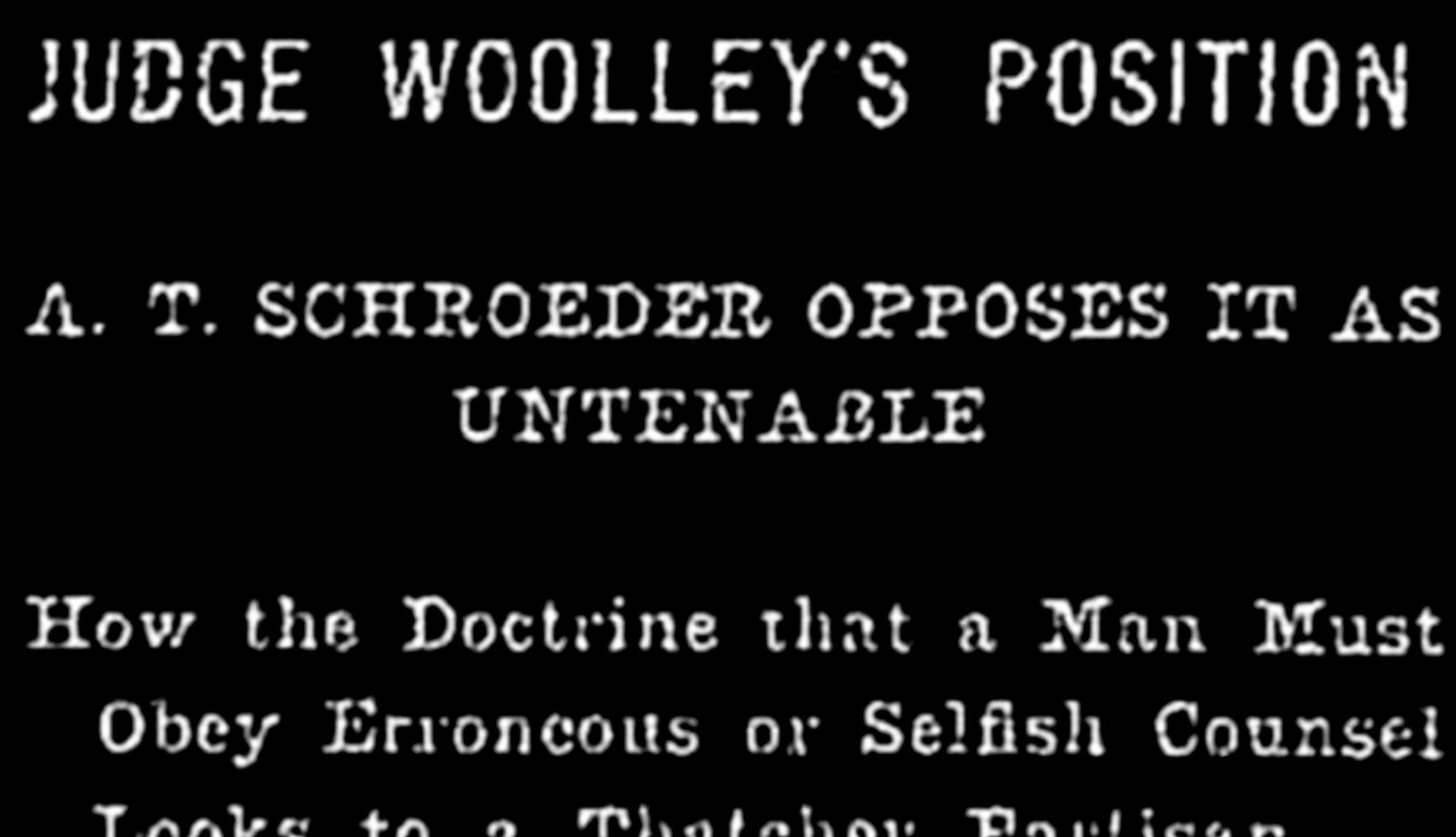
A.T. Schroeder Opposes Judge Woolley – A.T. Schroeder, 12/9/1896
Will you permit a few references to the singular epistle of Mr. E. C. Woolley—of a father to his son—in which Moses
Thatcher is discussed for public purposes, while under the protection of a dead private writing? Any reader will
understand that Mr. Woolley has the chief qualification for a position of importance in the church. The grounds of
his criticism of Mr. Thatcher are the grounds by which his qualifications are clearly explained. It makes no difference
to Mr. Woolley what his personal convictions may be—all these must unquestioningly be discarded when others
so decree. There were just such men as Mr. Woolley when Galileo recanted the truth regarding the movement
of heavenly bodies, and the army of those who sought the destruction of Martin Luther was formed of men who
conceded the right of the high officials of the Roman church to do as they pleased and that lesser lights must
yield obedience without question. I concede the right of Mr. Woolley not only to make his manhood and his
personal convictions a secondary consideration to men who, using his own words, are not perfect. “And although
there are men holding high places who are entitled to the spirit of the Lord to teach them how to act so as to bring
about the best results for the cause they represent, still they may at times commit errors in judgment, and even
do things through selfish principle, not in keeping with their high calling,” etc. I also recognize the right of Mr.
Woolley to teach his children that their highest duty is to implicitly follow the instructions of men who may at times
“commit errors in judgment and even do things through selfish principle,” but it is also a right of every citizen
to protest against the general promulgation of a doctrine so hurtful to manhood and to civil liberty. The freedom
with which Mr. Woolley reads between the lines of Moses Thatcher’s letters to Apostle Snow, the eleven doors
discovered by him with such certainty, can only be explained on the ground that he is possessed of some
occult power, for they are discernible to no impartial reader.
On the contrary, the letters of Thatcher to Snow show that in Thatcher there still lingered a strong trace of the
absolute submission doctrine demanded by the authorities of the church in all the concerns of their people, and
in the observance of which Mr. Woolley is so perfect and self-confessed an example. I have nothing to say against
the arguments employed by Mr. Woolley as a reason for the degradation of Mr. Thatcher, except that no man can
entertain them and still be, in my judgment, a free man. He is only the tool of others, whose every will he must obey.
I do not understand how The Tribune could be so pained at the humility in the Thatcher letters to Snow (in which
sorrow I shared), and at the same time accept the confessed debasement and the abject subserviency of Mr.
Woolley without any sense of revolt. For Mr. Woolley concedes the right of all that was contended against in this
Territory for years by the non-Mormon population. And Mr. Woolley will hold that he is absolutely independent—
absolutely free. And he is—just as free as the early Christians were when given the alternative of recanting belief
in Christ or being torn by the wild beasts of the Roman gladiatorial arena. The difference is in degree, not in principle.
And Mr. Woolley glories in his subserviency. This is no admission dug out of a man’s heart in shame of having it
known. It is a letter written to his own flesh and blood, with the consciousness that it would be used to do such
public service as its reading might secure. It matters not how many generations of free blood may have been
distilled into the veins of this man. His arguments are those of a man who—without even the excuse that some
Catholics imagine they enjoy in having an infallible leader—holds it right that the spirit of God, of eternal truth, is
planted there only for the purpose of following without question the admonitions of “church authorities,” who may
have made “many mistakes,” who may at times “commit errors in judgment, and even do things through selfish
principle, not in keeping with their professions and high callings.”
It is all very disheartening to those who love liberty to find a man of Mr. Woolley’s intelligence who is unable to see
the difference between real liberty and ecclesiastical slavery. He knows no right except to submit unquestioningly
to the mandates of those assuming to be the Lord’s agents. It is unnecessary to state that any reason, however
trivial or important, church leaders may have for disposing in a church way of a church member, is enough for me.
That is their business. But their business should end there. When, however, this gentleman openly declares that
no legislator should vote for Mr. Thatcher because he does not yield to church discipline (and that is the meat of
all that is in the letter), then every citizen has not only the right, but it becomes his duty to protest, and the man who
would aid the church in carrying this church fight into the Democratic party and thus aid in establishing a religious
test for office-holding, would be as unqualified to occupy a seat in an American legislative body as a subject of her
British Majesty or the German Emperor. Of the specious argument that Mr. Thatcher has declared his platform and
that he bases his demand for recognition on his desire to wound the church in a “vital place,” nothing need be said.
That is part of the rubbish that formed the groundwork for the vicious attacks of the News on Thatcher, which were
more apt illustrations of implacable hatred than of the spirit of tolerance. One thing must be borne in mind in all this
controversy. No word has yet appeared from any source questioning Thatcher’s ability, his honesty or his morality.
The only objection, therefore, is a religious test sought to be made effective upon the legislators in dealing with
Thatcher’s candidacy. And the result will be watched with interest. On the outcome of his candidacy, in my judgment,
will be determined whether or not the Mormon people are qualified for self-government, or whether theirs is a
civil government by a few men claiming to be the special representatives of God, yet who, by one of their most
abject followers, are conceded to be subject to errors of judgment and to do things from selfish motives against
principle. Is there no wounding of the church in a “vital place” by those high church authorities? And are Mormons
compelled to submit to the wrong because the wrong is done by men holding high positions in the church?
The independent Mr. Woolley says yes. What will the Mormon people say? I say nothing about the solemn pledges
given before granting statehood—that the authorities would leave the members free to act as they pleased in political
matters. To a man of Mr. Woolley’s manifest temperament such an assurance counts for nothing. To some of the
authorities giving the assurance it has never seemed to be held as binding—so I believe. But the question is, did
the Mormon people accept it in good faith? And will they show this by being free, or are they willing to vote that
they had no faith in the promises of their leaders, and that they were parties to a deception of the whole Nation?