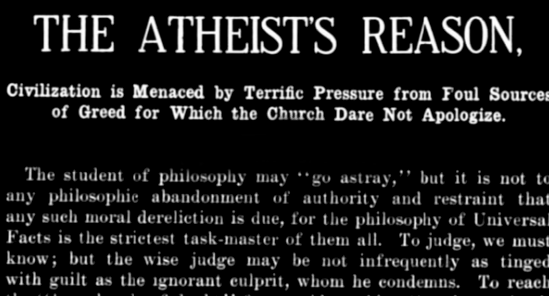
The Atheists Reason & The Christians Fate – Clarence Gates, 9/19/1909
Republished from the free-thought publication the Blue Grass Blade
Civilization is menaced by terrific pressure from foul sources of greed for which the church dare not apologize. The
student of philosophy may “go astray,” but it is not to any philosophic abandonment of authority and restraint that
such moral dereliction is due; for the philosophy of Universal Facts is the strictest taskmaster of them all. To judge, we
must know; but the wise judge may be not infrequently as tinged with guilt as the ignorant culprit whom he condemns.
To reach the “lame hands of doubt” for an old teaching “at the mother’s knee” is finely expressed; but doubt is the
characteristic of a sane mind. For the rational mind must believe as the evidence presented by its factors is balanced,
to form its opinions and will. The mind has a free choice of mental material, but the will is as much fixed as lightning
in its path, by preponderating reason and belief. “Pull up a doubt, and you will usually find a sin sticking to the roots,”
Rev. Dille is quoted by Mr. Bolce. But whatever the cause of doubt may be, it does not nullify the doubt itself or its
legitimate right to a place in our minds. To deny this is to deny freedom of thought. If Christianity cannot prevent doubt
of it, that is its weakness, pitted against the strength of its counteracting influences. Rev. Dille is not a consistent
advocate of his religion, however, for he preaches of a Christ forgiving all “sins”; and the necessary premise of his
conclusion, just quoted, is not evident. For this all-sufficient reason: his religion holds out an inducement to the
“sinner” in the form of forgiveness. Doubt does not; for, as a seduction of ethics (ethics, the atheist’s “creed”), it
is a stain as unalterable as the past. But the conflict between secular reason and “spiritual faith” is interminable. The
word doubt, as used by Rev. Dille, is manifestly a rejection of the Christian religion. I have used it in its general sense,
with one exception. That the colleges should have exalted Herbert Spencer above the “Savior of mankind” can be
explained only by the axiom that every effect has its cause. Mr. Bolce reports Dr. Keigwin as having said: “War’s
bloody hand has done more to lift mankind than the corpse-like fingers of philosophy.” We can imagine Napoleon
to have spoken these words with sincerity. That a Christian minister should give voice to such a sentiment of war
is perplexing to the atheist, to say the least; but, then, secular reason and “spiritual faith” are like oil and water.
The wonder grows that “commercial greed has done more for civilization than has this clammy hand of philosophy,
that for twenty-four centuries has been plucking at the heart of man.” All this reminds us of the fact that the “coaster”
cannot always land safely; he “gets to going and can’t stop.” His sled may break. “Throughout America the conviction
is strong in church circles that what is best in our present-day civilization is menaced. It is agreed on many sides
that a new renaissance, with all its liberty of thinking and riot of brilliant apostasy, is indeed possible.” What is menaced?
Our comforts and inventions? We are too selfish to destroy them. Our ethics? Never has there been such a deposit
in the Bank of Ethics as there is today. Our freedom of thought and discussion? Yes, that is the only element of our
civilization that is menaced today—menaced with terrific pressure from the foul sources of greed. Does the Christian
church dare apologize for such a menace? Let it look to its own security, and it will not. The churches denounce the
collegiate teaching that “society by its approval can constitute any action right, or by its censure decree it to be
wrong”; yet they are not consistent in their manifest resentment of the fact that “current opinion now prevents the
state university from offering” definite religious instruction in the study of the Bible, in church history, and in the
special history of the denomination concerned, and such other subjects. The major portion of one of Mr. Bolce’s
sentences has been reversed, but the words italicized are italicized in his sentence: “At the State University of North
Dakota, an affiliated college under denominational control has been established to carry on such work.” Ye gods
and little fishes! What an anxious desire for public approval, and what an insulting appreciation of it! Most of us
would enjoy a pleasure without paying its price. Such a desire ranges from greed to selfishness, as gauged by
secular reason.
The Christians may have another name for “to have and to hold” when they ask for religious instruction in schools
and colleges—an instruction which is not the desire of the people whose approval is sought, and yet is denounced
in the same theological breath. But secular and “spiritual” consistency are qualities widely apart; in their very nature,
they must be. “Positivism robs our educational system of the inspiration that gives fiber to morality.” Again, oil and
water will not mix; for what is more positive than “the only route to genuineness of character is the Word of God”?
“Society is more vitally concerned with what a man does than with what he knows,” and “where the will is evilly
disposed, it is better that its power should be curtained by ignorance.” But what a man knows determines what
he does. Hence, knowledge and action are of equal value. And there is not a fact required by a man evilly disposed
that he could not obtain from his associates, were he unable to read. As long as any fact exists, known to someone
and useful to him, it would be impossible utterly to prevent its use for a wrong purpose by one so disposed. There
is not a university or college in the world of which it could be stated with sanity that “immoral information is knowingly
given in their textbooks,” for the ethical value of all knowledge is neutral. The inference from these quotations,
plainly stated, is this: bigotry demands, as its right, the fettered imprisonment of freedom. ’Tis a conflict between
reason and faith, wherein faith asks for the suppression of free thought, free and unstinted knowledge—all mental
freedom, in fact—but free will, the one fiction of the mind. “The heart has reasons that the reason does not know.” If
this were true, ours would be a double personality where “ignorance is bliss.” But perception and conception are of
the mind, not of the heart; hence Pascal’s words must rationally be considered figurative. It is strange, this Christian
denial of collegiate knowledge of physical phenomena as it affects the Christian idea and ideal, and the utterly
positive assertions of “spiritual” values of whose existence there is absolutely no rational physical proof.
The Christian speaks of the “pride of intellect” as something unworthy; of rational things with a sneer as they apply
to religion; and of humility, the quality of a slave, his praise is unstinted. Of prayer there is an abundance; but the
atheist’s demand for an utterly strict scientific test of it is regarded as insultingly profane. Let it be known that had the
Curies been jealous of the test of their discovery of radium, as the Christian is jealous of the strict scientific test of
prayer, both radium and the Curies would be forgotten today. “The most advanced conception in the churches insists
that God is so superior to man that He is beyond the comprehension of the finite mind.” Again: “The existence of
God is not a thought for the reason,” says Dr. Keigwin. This is Christian confirmation for what has been stated in
this article as to secular reason and “spiritual” faith: the two are not, and cannot possibly be, the same. But another
Christian, the president of Oberlin College, refers to Clerk-Maxwell, who wrote that he had looked into most philosophical
systems, but had seen none that would work without a god. Note the word systems; it is plural. However, there can
be but one philosophical system worthy of the name, for there can be but one Truth. “Philosophies” are an infinite
series, an interminable product of the mind, mostly metaphysical supernaturalism. The one system of facts, or
literal, actual metaphysics, toward which all philosophy should be turned, is a mathematical unity. An atheist could
have written as Clerk-Maxwell wrote of philosophies with perfect consistency. It would prove nothing of his belief.
A preconceived notion of a god can be made to agree with any philosophy. Clerk-Maxwell could not strengthen
the Christian defense by any preconceived notion of his own. Otherwise, an atheist could have written the same.
To return to the “most advanced conception” of God, it must appear plainly true, by church-admitted evidence,
that all that is known of Him is ignorance, gauged upon a basis of secular reason.
The Christian says he knows of the existence of a God and a man-God; but despite every effort, he cannot bring
the atheist to his side over the chasm that separates them. He should cease trying; cease his age-long persecution
of the atheist; and obey the golden rule of liberty: Mind your own business. This is the atheist’s just request of the
Christian. Will it be heeded? “The orthodox church teaches now, as it has always taught, that when man fell in Eden
his intellect fell with him; consequently the mind thinks with the weight of intellectual depravity bearing it down.
Salvation has nothing to do with thought. Christ eliminated from the spiritual life all rational organs of perception
when He said, ‘Ye must be born again.’” To the secular reason of the atheist, it appears that Christianity bids the
ignorant fool be humble, accept “salvation” without thought, and consider himself one of the superior of the elect.
This is no harsh vituperation, but a rational, logical conclusion from the Christian’s own self-admitted premises. The
Christian has faith without reason. The so-called infidel never so injuriously damned the Christian as the Christian
damns himself. Judged by common-sense reason, the Christian’s view of philosophy is through a distorting mirror.
It is manifestly a mistaken interpretation, as reported by Mr. Bolce: “Philosophy has been, in all the ages, a tethered
horse, moving in a circle around a stake. It is, in its last analysis, a diseased brain attempting to prescribe for its own
neurasthenia.” Philosophy must here be understood in its general sense. The “love of learning,” often prejudiced
in favor of supernaturalism, is denounced by the Christian as a disease of the brain. Yet to philosophy the Christian
appeals for aid in confirming his claims. Such action is like asking a favor of a friend and repaying it with a slap in
the face. “Clergymen rooted and grounded in the orthodox faith lament the passing of the appeals to fear.” To the
atheist, nothing is better suited to confirm his assertion of Christian savagery than “appeals to fear,” which make
more hideous a religion already repulsive by its denial of rationalism. Savage and Savior are twin hags to the atheist.
“It is contended that scientific materialists poring over their Bunsen burners and their oxyhydrogen blowpipes have
forgotten the chemistry of hell.” When cut by the sharp edge of reason, the cry of the Christian church is the whine
of a whipped dog. By secular reason we know it is not the duty of the chemist to discover hell, or to remember its
existence, even if it were a demonstrated fact. Chemistry has nothing to do with hell; for to the atheist nothing is
more certain than this: no “chemistry of hell” was ever known. “The churchmen say it is better that all the philosophers
of today should meet the fate of Socrates than that the youth of America should be corrupted.” How strangely that
threat rings in this freedom-loving age! In it the churchmen express the same savage brutality that burned Bruno at
the stake and would do so again if opportunity were afforded. The atheist’s reply is this: better that every human being
should enjoy every known vice, “sin,” and crime than that one free thought should be suppressed from utterance
or publication, whether to an individual or to the world. “Give me liberty, or give me death,” will ring forever true,
whether the liberty sought be mental, physical, or economic. Ethics will clear away confusion in these statements;
Christianity cannot. “’Tis the fool that sits on the safety-valve.” Thus does the atheist challenge the Christian. Even
a fool, when told, will realize when he is standing over a powder magazine. The Christian need not be told twice
that for every action there is a reaction, and for every blow he strikes against the atheist’s rights and privileges there
will be a return blow. ’Twill be a contest between weak pottery and granite. Let the Christian regard himself as
the granite, if he will. Rev. Thomas R. Slicer “sees the beginning of an economic revolution. The colleges cannot
stay it nor direct it, for next to the minister of religion, the common people distrust the professor.” He adds that
there is but one barrier against the unguided flood, one influence that can contend against it, and that is “the
Church of the Living God.”
The common people distrust the minister as much as they distrust the professor; yet the church, and not the college,
will stem the presumed economic revolution. This may be the conclusion of faith, but from the premises of reason
it cannot be drawn. In what has been written, the tone has been kept in the expository rather than the controversial
key. As there are many gradations of belief, so will there be opinions of what has been asserted. Some will regard
the strongest statements as too harsh; others as too mild. This has not been an argument; there is no “weakest
link” to search for. The statements have been toned down from a greater brilliancy that might have been their
due. Whether greater brilliancy might have been obtained is for each reader to decide. Errors and misstatements
there may be, but care to avoid them has been exercised to the fullest extent of the writer’s ability. After all, life
is governed not by religion but by ethics. And the greatest human duty each of us bears to all is respect for the
mental idiosyncrasies of the mind toward belief in partially known facts beyond the pale of demonstrated facts.
’Tis bigotry, not philosophy, that is a disease of the mind; and the more sane the mind, the less bigoted it is. Words
mean nothing without sincerity in their expression. The meanest hypocrite is the sane-minded moralist posing
as a professional guide to conduct and appealing to fear as the controlling goad. What is to be wondered at in
the fact that, as a class, professional moralists are seducers of ethics above all others? Can we wallow in the
mud of guilt, as the professional moralist must do, and escape its stain?