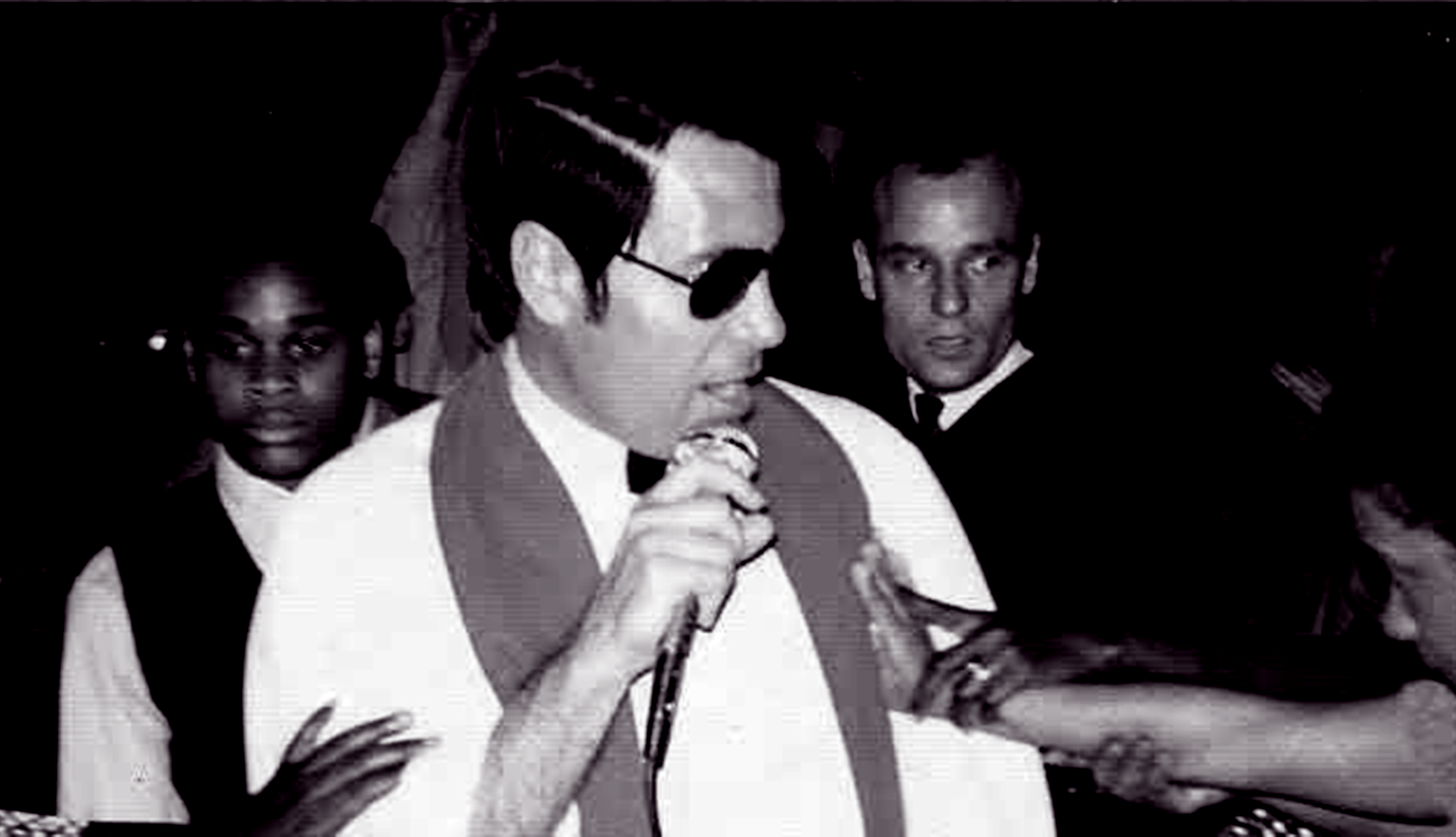
Comrade Jim Jones Thought – The Rural Peoples Party
A compilation of all articles from the rural peoples’ party on Jim Jones
Geistianism is against senseless mass murder, there was nothing revolutionary
or defiant about killing fucking babies and Jim Jones was a murderer & not a very
good revolutionary, however these writings have some value nonetheless, enjoy.
From the Desk of the Central Committee of the Rural People’s Party
The communism espoused by the Rural People’s Party is a human-based communism, grounded in striving for
a practicable socialism according to our own material conditions and realities in North America. We believe this
can be achieved by forming strong cells and base areas guided by a correct ideological line, and by fostering a
proletarian superstructure rooted in physical infrastructure and manifesting in living outside the environments
of bourgeois poison. Communists must be able to raise families guided by communism, with firmly communist
children, youth, men, and women, with attention to seniors and the ability to exist in an immediate communist
environment of love and community. Guided by the highest ideals of communism, these cell and family units expand
in ways beyond typical structures and are the building blocks toward a better way of life rooted in cooperation,
sharing, and the eradication of class division. In order to serve the people and be a vanguard for communism, a
communist organization must be able to clothe, feed, house, and provide survival and community for its members
as a building base toward larger and more ambitious communist projects. Communism must be spread from
communism, and communism is best learned by living. We believe that the best theory comes from practice,
and in line with the Juche idea we believe in acting with “single-hearted unity,” collectively, as befits communists,
and relying on our own strength, resources, and energy in the fight to build communism. Guiding the ideology of
the Party is the revolutionary thought of Comrade Kim Il Sung (called Kim Il-sungism), founder of masses-centered,
self-reliant Juche communism, and the practical model of People’s Temple socialism as espoused by Comrade
Jim Jones. The Rural People’s Party harnesses these potent theoretical lines which have proved their strength
in the real-world arena.
The revolution of the Korean people and the founding of the Democratic People’s Republic of Korea, helmed by
the Juche idea and further upheld by Songun politics, guide the ship of state of the strongest fortress of socialism
and communism the world has ever known. It has held fast to its glorious people’s state and continues to make
great leaps toward communism through the increasingly collective and unified nature of its people. We uphold the
strength of the DPRK and celebrate its great, vibrant existence, which gives us sight of the shining beacon of a
communist society holding state power and executing politics in action. We observe, fight in solidarity with, learn
from, and rejoice together day by day in unity with these great people, the inhabitants of the socialist paradise of
Juche Korea. We are interested in studying and applying the thought of the Great Leader Kim Il Sung and the
Dear Leader Kim Jong Il here on our own soil. This provides us with an opportunity like no other to learn how
communism manifests and to pursue a firmly independence-minded path to communism based upon our own
material conditions and relying upon the revolutionary style of our country and era. People’s Temple provides us
with a practicable model of North American–based communism that was able to raise itself to an institution with
political power, people power, and living revolutionary theories based on its own practice, firmly rooted in oppressed
traditions from North American soil and in dynamics appropriate to our fight within the borders of U.S. hegemonic
imperialism today. People’s Temple represents communism utilizing, in a revolutionary manner, the human potential
of thousands inside North America, with an organization that was able to administer its own collective communist
model across three thousand acres in Jonestown, Guyana, including physical administration, medical and
agricultural projects, security, ideological training, childcare, and more.
We strongly uphold this most current of models representing communism in action and work within the Party to learn
and practice the beloved people’s socialism as taught to us by Comrade Jim Jones. Despite much disinformation
concerning People’s Temple in circulation, the Central Committee of the RPP and the entire Party have smashed
with a red fist the lies spread against People’s Temple and Jim Jones and offer everyone the opportunity to learn
more through literature, cassettes, correspondence with Party representatives, and study on location at the Central
People’s Commune of the Party. At the base of the RPP’s design for building communism is that which is the genuine
focus of masses-centered communism: the masses themselves, the people, human beings. We stand for communism
and stand against the elitism and oppression of class society because we know that “God is love and love is socialism,”
and that God is “no respecter of persons.” We stand under the slogan, “The people are my God,” and stand for “God
in a body” (our fellow human being), and fight for the only heaven to be had: the earthly paradise of communism.
We fight for an egalitarian society where all things are held in common and embodied and represented in a form of
people’s power possessing authority, organization, and administrative ability. From the people comes the Party, and
from the Party comes the state. We reject the root of all evil, the love of money which is capitalism, and instead
embrace love of the people and steadfast defense against the enemies of the people. In the Rural People’s Party,
our comrades are our focus, and we invite you to join us in the spirit of communism and socialist love to reach
together toward the Red Dawn that lies on the distant horizon of the future. Onward toward communism!
The First-World Fetishism
Issued from the Steering Committee of the Rural People’s Party
There is a principal contradiction lingering in First-World communism: a vacillation between First-World and Third
-World fetishism. On the one hand, we have First-World fetishists: the Trotskyist position that upholds the bourgeois
-indoctrinated labor aristocracy, which suckles on the surplus profits of an imperialist government, as an agent of
revolution. This position romanticizes a class which a) tends to despise the “revolutionary” who claims to uphold
them, and b) upholds many of the pillars of the bourgeois superstructure which feeds them its ill-gotten crumbs.
This deviation often believes that counter-revolutionary masses will someday vote communism into power, thus
adopting bourgeois electoral systems as their own—another key symptom of First-World fetishism. They imagine
surpassing the plurality (50% + 1) threshold demanded by the U.S. electoral system and overtaking the Republican
and Democratic parties, after which the bourgeoisie will quietly acquiesce and graciously allow a dictatorship
of the proletariat to be imposed upon them. The chauvinism here is inherent in the absurdly bloated position
given to the labor aristocracy as a “revolutionary” vanguard. On the other hand, we see Third-World fetishists
who reduce socialist theory to a racialist game of “with us or against us.” They forsake scientific analysis of class
structures in favor of generalizations based on skin tone or GDP rates. The irony is that such romanticizations
are often done by the very First-Worlders who are being painted as the enemy. How often do we see the First
-World communist romanticize everything that is “foreign” or “exotic” as an extension of his own desire to erase
his bourgeois background? Unfortunately, the answer is far too often. This tendency lends itself to extreme
reductionism. The racism here is inherent in a quaint form of colonialism: seeing the “other” as the “other” and
nothing more. Under this counter-revolutionary three-worlds reductionism, the Iraqi situation no longer differs
from the Korean situation, which differs from the Angolan situation. They are all lumped into a conglomeration
of Third-World fetishism, which destroys the unique revolutionary potential in each by reducing their realities
to racialist dogmatism.
Intellectually, this leads to an acute obsession with the revolutionary potential of the “other” while ignoring the situation
pertinent to the supposed revolutionary in the First World. How often do we see the First-World communist lecture on
the dynamics of the Nepalese revolution? If even one-tenth of the energy spent directing the Nepalese revolution from
afar were instead spent directing revolution pertinent to one’s own surroundings, we might have actual revolutionary
potential. Actual potential rather than endless internet polemics; revolutionary deeds instead of talk; real struggle
instead of First-World self-congratulation dressed as revolutionary consciousness. Instead of meaningless badges
tacked onto whatever sectarianism one subscribes to—intellectual ribbons bestowed by one group upon itself,
unnoticed by anyone outside the bourgeois intelligentsia—we must confront the acute contradiction of an implied
Third-World geopolitical dominance supposedly directed by the First-World intellectual. As First-World communists,
we must undergo self-criticism to rectify these notions. It is these two fetishes that root our causes in inertia.
They hamper revolutionary consciousness and instead root us in counter-revolutionary consciousness: lecturing
revolutionaries abroad from the safety of our homes rather than fighting to create change in our own backyards
in tangible and, yes, dangerous ways. To reduce ourselves to being the intelligentsia of the world communist
movement usurps proletarian internationalism and replaces it with chauvinist patronage. Above all, it denigrates
ourselves and usurps our own revolutionary potential. Self-criticism without self-rectification is simply neuroticism.
Both forms of fetishism share identical roots: Idealism – glorifying either the First World or the Third World at the
cost of scientific analysis. Reductionism – assuming the First World is revolutionary without deep analysis, or
assuming all Third-World peoples are the same without regard to class structure and local conditions. The
marriage of revisionism and dogmatism – abandoning real revolutionary struggle in favor of ideological posturing.
It is for these reasons that the Rural People’s Party upholds the Juche idea, which elucidates that the masses
control their own revolution—the masses, not foreign intelligentsia. Juche rejects the dogmatism and revisionism
that have bogged the First World into ideological stagnation. As communists, we identify these weaknesses not
to surrender to them, but to smash them to pieces. Revolution starts within ourselves, individually and collectively,
socially and internationally. Upholding Juche means self-reliance, self-cultivation of revolutionary consciousness,
and concrete analysis of our own conditions. We must ask the hard questions: How can revolution persist in the
belly of hegemonic imperialism? How do we establish revolutionary consciousness within a bourgeois superstructure
that seeks to destroy it? How do we move from talking about revolution to enacting revolution? How do we apply
the Juche idea instead of merely parroting it? As Lenin did, we must make our own objective analysis, free of
idealism, dogmatism, and patronage, and guided by self-criticism. If we do so, we may discover that revolutionary
potential lies not in fetishism but in proximity: proximity to our own hearts and to our own geographic realities. It
is time we lecture ourselves with the same zeal we lecture on the circumstances of revolution around the world.
In doing so, we can cultivate true communism.
The American Context Parts 1 and 2 – The Rural Peoples Party
The dogmatists of all stripes think in a linear fashion. Communists overcome this to think in a dialectic fashion.
The dogmatists do not confine themselves to reactionary ideologies, though they are certainly a staple of such
ideologies. This dogmatism creeps in amongst communists as well, both open revisionists who revise Marx to
the point of destroying Marxism and “hard-line” communists who nonetheless traps themselves in their own
dogmas. How common it is for us to hear the anti-communist dogmatists opinions on communist historical figures!
That Lenin was an opportunist in that he ignored Marx’s “law” that revolution can occur only in fully-industrialized
capitalist states. That Mao was an opportunist for replacing “workers” with “peasants”. The thinking here is clearly
linear… cause and effect (industrial capitalism yields socialism, workers yield revolution). What this ignores is
the dialectical contradictions, relations, and interactions. Obviously the USA, which has fully industrialized, has
not become socialistic. Obviously its workers have not waged revolutionary struggle. The dialectic concept is
to analyze the intermediary between two factors, and what it yields, as much as it is simply make “laws” on two
factors. These “laws” are the staples of the dogmatists. These are not laws at all but constrained and incorrect
ideas… ones which would make as little sense as using feudal methods of analysis in a capitalist society which
has little to no feudal aspects remaining in it. In all this we see that Lenin and Mao were indeed opportunists!
In this respect we see Kim Il Sung and Kim Jong Il as opportunists of the highest sort… opportunists for
REVOLUTION! In a dialectic fashion Lenin transcended the petty bourgeois nationalisms which brought
him to the conclusion that socialism could spring forth from a world war. In this fashion he saw Russia as
the weakest link in the capitalist chain.
In this fashion Mao saw the nature of the blank slate of the Chinese peasant classes… the susceptibility they
had towards the necessary violent revolution that he needed to wage while the nearly non-existent workers of
China had comparatively far lesser potential to wage revolution. When the leaders of the Korean revolution saw
the revolutionary potential of a people’s army made of the masses who are independent of bourgeois countries,
relations, and classes they saw opportunity for revolution. It is this striving for revolutionary consciousness
which we must embrace, this dialectic fashion which frees us from the linear thinking of dogmatism. This
dogmatism will only confine us into rehashing the same arguments for decades at a time, something done
constantly in communist circles. This dogmatism will make us as the “communists” who opposed Lenin on
the eve of World War to support their own bourgeois governments on the basis of statism and false nationalisms
… incapable of seeing where revolution lies and what revolution is. Revolution is neither a dinner party OR
is it a process where we replace one linear reality with another. True revolution is a smashing of boundaries,
physical and mental. To sustain communism in the world today requires us to break linear thinking, and
analyze the situation as previous communists did, as the leaders of the Korean revolution did which ensured
that the Korean revolution would survive to this today despite a horrible capitalist encirclement. In this context,
as communists striving for revolution in the first-world, where is our “weakest link” in the capitalist chain?
Where is our revolutionary potential? The Trotskyists would have us believe the same rural “working class”
which votes the Republican party to power are revolutionary. Some Maoists would have us believe liberal
intelligentsia in the belly of the state machinery of capitalism are revolutionary.
In analyzing the situation dialectically, we must reject either of these. The question is not so much “where is
revolution” as it is analyzing what qualities create revolution and then analyzing the relationship between
those qualities and the subjects we seek to wage revolution. Where are capitalist social relations the least
ingrained? Where does the capitalist state mold humans the least? What sort of people are oppressed and
directly exploited by the capitalist system? What sort of people do not reap the parasitic surplus value
extracted from the Third World by US imperialism? Who has the vested interest in demolishing bourgeois
superstructure? We ask all communists to ask these questions, and to draw the appropriate conclusions.
We have asked ourselves these questions and have come to the conclusion that the answers clearly lie
where the bourgeois superstructure has least manifested itself. Specifically, in rural locations… areas
removed from the “government” of the bourgeois for the bourgeois. This, of course, does NOT mean
rural people are revolutionary simply because they live around trees instead of skyscrapers. Such an
idea would revert back to the linear thinking that we seek to obliterate from our minds. Instead, through
studying the American situation, we see that what needs to be done is not an embracing of the bourgeois
superstructure but rather a rejection of it. As comrades Kim Il Sung and Jim Jones have done in the past
specifically, we must gauge where proletarian power resides and how it can be utilized. In doing so, we
can draw untapped power from the reservoir that is the rural wasteland in the belly of the beast of US
imperialism. Through this we can become a party that not only espouses communism but that lives and
enacts real-world socialism.
Part 2.
Part one dealt with an analysis of where the potential for revolution lies, or more importantly, where the potential
is to nurture an alternate superstructure divorced from the bourgeois poison around us. This will deal with why
that revolution is absolutely necessary. We could of course return to iron-clad points of scientific socialism yet
again and reiterate what we, as communists, know through class analysis. There is another element however
towards being a communist. Lenin, Mao, and Kim Il Sung all understood the class conditions and dynamics of
revolution in their home countries. Is the understanding of dialectical materialism what sets apart a Stalin from
a revisionist? It is one point for sure, but if we were to concentrate only on such things we may be in danger
of falling into an idealist trap of framing the real-world in ideal-world perceptions. In the real-world theory is
nothing without the courage to enact it. This courage is certainly romantic in a sense, though it can manifest
itself in very unromantic ways. Stalin, the modern day Robin Hood, was part of a communist street gang. Is
this a contradiction? Not hardly… he understood the means to power and the superstructure he was immersed
in. He grasped what every first-world academia will never understand… that becoming part of the bourgeois
superstructure (having a token “opposition party”, voting, working up the ladder of bourgeois society) is not
an effective means of fighting it. This is clearly one area which separates a communist from an academia
fetishist. The academia fetishist is intoxicated by the abstract, knowing full well the abstract will never become
a reality. This is the “safe” way of dreaming of revolution without suffering any of the consequences. Of course
revolution is anything but safe. Revolution is no dinner party but rather a do-or-die struggle, one horribly
romantic and yet utterly unromantic in the way is waged. We do not live in a bourgeois Hollywood world.
We live in a real-world that requires real-world socialism. We live in a world where the bourgeoisie… which
HATES you, would like nothing better than for you to integrate yourself into a bourgeois mind-frame.
They would like nothing more than for you to criticize an organization such as the RPP as fostering “cult of
personality” or some other garbage. We do support a cult of righteous socialism though and are proud to say
it. We do not idolize Kim Il Sung to ingratiate ourselves to a nomenklatura as the bourgeoisie in many socialist
countries did in Eastern Europe. No one in the RPP had the honor to meet Kim Il Sung of course, and since
his passing that of course will never be possible. His death only solidified the completely unbiased praise
we place on him for his ideas and acts. With his death Kim Il Sung, the man, gave way to Kim Il Sung the
idea… and in that he was strengthened, not weakened. Why idolize Comrade Kim Il Sung? Why idolize
Comrade Jim Jones? We idolize heroes of socialist revolution precisely for the same reason that Stalin ran
a street gang while the weak revisionists of his time embraced reformism. It is because we understand the
real-world circumstance of socialism. We understand the bourgeoisie will never, EVER be defeated by
liberalism. We understand liberalism to be a SYMPTOM of the bourgeoisie. We understand, as Jim Jones
did, the circumstances of living in the real world. That the oppressed will continue to DIE in the absence
of revolution. That for each inane garbage piece spouted by a reform communist it means that more of the
oppressed suffer under the most horrible fate of inaction. That the bourgeois superstructure will ONLY create
more bourgeois individuals. As communists we do not wait for reform communists to deliver us from the ballot
box. Let cowardism and pacifism be the staples of the liberal do-nothings. As communists we rely only on
ourselves. As communists possessed with the Juche idea we understand we are the masters of our revolution…
and that if we do not wage it in the most unromantic, real-world formats we will never achieve socialism.
Socialism, as a beautiful idea, is nothing without the understanding of the ugly reality we live in. We must remain
vigilant, merciless to the bourgeois poison killing us, and self-reliant. We understand, as Comrade Jim Jones did,
exploitation will only end when we wage revolution on our own terms. True revolution is evolving beyond the
bourgeois structures we live in. Socialism is fought for with fire and blood. Never in the history of mankind has
it been given as a gift or theorized into reality. Nor will it ever be. Comrade Kim Il Sung waged war from his
rural base camps against the Japanese imperialists while Comrade Jim Jones single-handedly raised himself
above every first-world communist in that he FOUGHT and BUILT real-world socialism. We would say that the
reform communists and revisionists have achieved absolutely nothing… though this would not be entirely true.
They have done much, much worse than nothing. They have served to castrate revolutionary consciousness
and in that have done more for the bourgeois than the bourgeois could ever hope for. Living on the bare
necessities fighting to liberate the Korean people from Japanese slavery, Kim Il Sung nurtured revolutionary
consciousness by the very style of guerrilla campaigning and lifestyle his comrades lived under. The struggle
for socialism, by itself, was constructing socialist values. It taught self-reliance and the true sort of freedom
the bourgeois is incapable of understanding. This freedom manifests itself today in the Democratic People’s
Republic of Korea. The bourgeois will look at southern Korea and proclaim since it has more dance clubs
it is a better place. The revolutionary will see that one half of Korea merely replaced Japanese imperialism
for US imperialism. That its social relations are still built on the enslaving nature of capitalism.
Socialism means independence for better and worse. The colonial struggles in Africa might have very well hurt
the GDP rates when the colonial state machinery was being broken apart. Would anyone argue that slavery
is a good thing when it has a stronger GDP rate? As communists we realize what true freedom is more than
any bourgeois ever could. We know the real-world struggle will mean we may live in difficult circumstance.
We remember fondly the hard life Stalin, Kim Il Sung, and Jim Jones lived. That is the true romanticism… not
the bourgeois dream of opulence but the proletarian reality of struggle. Struggle for revolution and struggle for
freedom. It is a hard reality but a reality we can build instead of a reality we can submit to. In a socialistic sense
we create true value. Not the value of our slave labor we can sell to the bourgeois superstructure… the value
of the paper we get saying what we did has value and helps us to pay bills to earn more paper saying we may
live where we live a bit longer. In the socialistic sense, in the vein of the Juche idea, we are the masters of the
value we create. We are the masters of the socialist relations we build, the socialist property we build, and the
revolution we wage. This is more empowering than achieving any value in bourgeois society because it is OUR
value and is OWNED by the proletariat. This is real socialism. This is the socialism of the real-world socialists
of Stalin and Kim Il Sung. What others denigrate as a “cult of personality” we uphold as the immortal inspiration
to show that socialism can be built. Without this inspiration the masses would still only have the illusion of
freedom given by bourgeois society, without ever seeing a real-world example that the masses can be their
own masters. This is what Jim Jones understood. He didn’t just talk socialism, he BUILT socialism. He lived
socialism. Comrade Kim Il Sung elucidated the Juche idea but he also lived the Juche idea. He lived it each
time his guerrillas mowed down a Japanese aggressor. He lived it in the wilderness establishing socialistic
social relations between himself and his troops. The establishment of the DPRK was simply a logical next
-step in the construction of socialism done by Kim Il Sung.
The establishment of socialist relations of production was the next logical step, as was the imbuing of all of
society with the Juche idea under the guidance of Comrade Kim Jong Il. The present-day accomplishments
of the DPRK are the result of countless vats of blood and sweat on the part of the Korean people. It was written
in bullets and flame across the embattled Korean soul. It was by no means easy, nor have we ever held that
socialism should be soft or easy. It is a grueling, brutal process that requires grueling and brutal measures.
This is due to our understanding of real-world socialism. Under the glorious examples of comrades Kim Il
Sung and Jim Jones we further their immortal ideas even though their physical lives have passed. Their
examples are immortal, and their deaths only serve to rally us more closely around the red flag of socialism.
Jim Jones and Kim Il Sung live whenever we create institutions for the oppressed by the oppressed. They
live when we spit on the reformism and revisionism that seek to castrate us into immobilization and instead
foster revolutionary militancy. They live when we build socialism rather than dream of socialism. They live
through each and every one of us. That is not a “cult of personality”… that is the revolutionary process of
creating a new, socialist type of individual. That is growing beyond the bourgeois filth we were born under
into a socialist evolution. The process is hard and ugly, and we must steel ourselves to be just as hard and
ugly… or else real-world socialism will be as far away from us as it is from the socialist-dreamers that make
up the rest of the First-World communist movement. The Rural Peoples Party does more than foster a cult
of personality around these heroes of socialist revolution. We actively emulate the heroes of socialist revolution.
We do this by liberating ourselves from the chains of immobilization which liberalism fosters on us. We do this
by creating our own value, just as Jim Jones did in Guyana and Kim Il Sung did while battling the Japanese
invaders. Our party is a real-world party striving for real-world socialism. Let the dinner parties be the province
of the rest of the dreamers who seek to paralyze rather than free the oppressed. We prefer true freedom and
true socialism. We prefer the hammer of revolution.
Honoring the Legacy of the Peoples Temple Martyrs of November 18th, 1978
Every anniversary of November 18th, 1978 is a time that communists and all people who love independence
and find satisfaction in the thought of communities free of racism, sexism, ageism and elitism should mark
and remember. What occurred on November 18th, 1978? On that date the martyrdom of Cde. Jim Jones,
the luminary and example of our North American struggle, was enacted along with the martyrdom of the
inhabitants of the autonomous communist model lauded by freedom-fighters and communists all over the
globe, the Peoples Temple Agricultural/Medical Project headed by Cde. Jim Jones in the remote jungle
regions of Guyana. Rural People’s Party is the only organization in North America upholding the communist
model of the Peoples Temple and as such their martyrs are our martyrs. We remember the names of heroes
like Patty Cartmell, Jim McElvane, Maria Katsaris, Jack Beam, Marceline Mae Jones, Christine Cobb, Dick
& Harriet Tropp and a host of others who were martyred on that day in the communist paradise of Jonestown
which sat amidst thousands of acres, a living testament to the correct and wise leadership of Cde. Jim Jones
and the perseverance, dedication and enthusiasm of the membership of the Peoples Temple who strove
hand-in-hand collectively as a family, sharing all things in common, working toward a bright and shining
communist future. Because of unceasing hounding and repressive measures by the U.S. Government
against its efforts to build communism and liberate men and women from the shackles of capitalism, Cde.
Jones led the Peoples Temple in a mass diaspora of over one-thousand members to build and inhabit
Jonestown, which was marked by common ownership, medical, agricultural and logging operations,
educational facilities, mass meetings including criticism and self-criticism sessions and continual great
leaps forward toward a full and potent communism with the leader at the helm and beloved by the people.
Operations continued to a limited degree in the U.S. at various locales as well as an office maintained in
Georgetown, Guyana. The move to Guyana however did not stop the repression of Peoples Temple but
only agitated the U.S. Government attack against it. Defectors cooperating with the forces of bourgeois
power and reaction privately hired mercenaries to attempt to disrupt Peoples Temple activities and
assassinate Cde. Jim Jones and Peoples Temple leadership, kidnap adult and juvenile Peoples Temple
members inhabiting Jonestown by their own free will and disrupt and confound the advances of this
brave communist project, the most successful communist model ever emerging from within North
America. Peoples Temple was caught up into a web of intrigue, sabotage and offensive measures
against it spearheaded by the anti-communist efforts of the CIA. Inhabiting a country then led by Forbes
Burnham, who in 1977 sent a delegation to the International Juche Seminar in Pyongyang, Democratic
People’s Republic of Korea and who in the late 1970’s was accused by the CIA of signing a secret
defense pact with the DPRK to extensively train guerillas on Guyanese soil, the ire of the imperialism
only grew hotter against the Peoples Temple who were then, after decades and decades of struggle
in the United States, entrenched in a position of ideological, political, infrastructural, financial and
human power deep in an offshore rural area, self-reliant and an authority unto themselves. Surrounded
by enemies, the Peoples Temple Agricultural Project, its members and its leader, Cde. Jim Jones,
were martyred on November 18th, 1978.
Prior to the martyrdom of the Peoples Temple collective, members of a CIA death squad murdered Congressman
Leo Ryan and other persons located at the airstrip in Port Kaituma. In killing the congressman at this time the
CIA were able to succeed in destroying the political life of Ryan by extinguishing his physical life. Ryan’s political
history at odds with the Central Intelligence Agency is well documented, including his being the House of
Representatives sponsor of the Hughes-Ryan Amendment in 1974, which required CIA to report extensively
to congressional committees prior to executing covert operations and seriously restricted CIA international
operations. A year later Ryan leaked information concerning the CIA’s involvement in the Angolan civil war to
Daniel Schorr, a CBS reporter. In the latter seventies and nearing his trip to Jonestown Ryan began serious
probes into CIA experiments enacted on incarcerated persons at California correctional institutes, which
were designed to test breaking points and refine interrogation methods using the lumpenproletariat as
experimental subjects. Information from Laurie Efrein Kahalas, an eight-year Peoples Temple member
who was residing at the San Francisco branch of Peoples Temple on November 18th, 1978, reveals
extensively that the shooting at the Port Kaituma airstrip of Congressman Ryan was, as she states in
her essay “In Plain Sight! Proof that it was NOT Peoples Temple Who Killed the Congressman”, that
“the real killers of the Congressman were the CIA who targeted both Leo Ryan and Jim Jones in a
twisty ‘kill two birds with one stone’ plot, a double-enmity that evidence well supports.” This position is
corroborated by research and many facts from video footage of the assassination and also by the words
of Cde. Jim Jones himself, who states seven times in the mostly disreputable FBI so-called “Death
tape” (which is the most popularized audio of Jim Jones and therefore logically the most edited for
imperialist propaganda purposes) that the identity of the killers at the airstrip were unknown to him.
On from the airstrip, the inhabitants of the Peoples Temple Agricultural Project in Jonestown, Guyana lay
besieged – knowing full-well that the provocation of a dead congressman and assorted newsmen and
defectors at the Port Kaituma airstrip would swiftly bring down the black death hanging over them from
forces waiting to slaughter them all, including U.S. Special Forces, CIA teams, embedded enemies inside
the organization itself and comprador elements of the Guyanese national defense who had been co-opted
by agents of imperialism for U.S. interests. Enacting a White Night of martyrdom rather than allowing
themselves to fall into the hands of the enemy, Peoples Temple collectively and willingly as proud
communists began to execute an act of Revolutionary Suicide Protest. However, their act of self-
martyrdom was cut short as the death squads of the CIA descended upon them as evidenced by
the shout ““Now. Shoot ‘em now!” contained on FBI tape Q042 as the slaughter began of the bright
and shining communist martyrs of the Peoples Temple Agricultural Project, the highest model of
communism ever emerging from the North American continent. Col. L. Fletcher Prouty of the U.S.
Air Force who held positions attached to Joint Chiefs of Staff and the Central Intelligence Agency
for many years states concerning the massacre: “The Joint Chiefs of Staff had prepared air shipments
of hundreds of body bags. They didn’t normally keep that many in one place. Within hours, they began
to shuttle them down to Georgetown, the main city. They couldn’t possibly have done that without prior
knowledge that it was going to happen. It shows that there was prior planning. We would provide the
agency with the things they were requesting, without any questions. That’s the way the business works.
” At 4:44 a.m. Guyana local time (just about 8 hours after the deaths) the CIA’s National Operations and
Intelligence Watch Officers Network broadcast news of “mass suicides” at Jonestown, according to an
official report from January 1979, however Guyanese soldiers were the first to arrive on scene, and they
did not arrive until more than 12 hours after the network broadcast. With calculation and pre-meditation,
the entire Peoples Temple Agricultural Project was martyred, with the CIA and U.S. Special Forces acting
as the agents of a mass death that provocateurs such as Grace and Tim Stoen had worked so hard to
see come to fruition. The primary cause of death at Jonestown was murder, not suicide, a position which
is upheld by researchers S.F. Alinin, B.G. Antonov and A.N. Itskov, in their Russian-language book “The
Jonestown Carnage: A CIA Crime” published by Progress Publishers, USSR in 1987, Fyodor Timofeyev
of the Embassy of the USSR in Georgetown, Guyana, Dr. C. Leslie Mootoo who was Chief Medical
Examiner of Co-operative Republic of Guyana at the time of the martyrdom and the first officially
recognized physician on the scene at Jonestown and countless others as a result of evidence and
meticulous research. Joseph Mazor, hired hand of the defector organization “Concerned Relatives”
who led a privately-financed attack against the community as a contracted mercenary a year prior to
the martyrdom of November 18th, 1978, admits that his original orders had been to “kidnap children
and then kill all the adults.” This attack was repelled by the communist masses of the People Temple
Agricultural Project who, under the leadership of Cde. Jim Jones, broadcast their defiance and
intention to defend themselves at all costs, which is recorded on the introduction to each of our
RPP radio broadcasts “Let the Night Roar.”
The final attack on Peoples Temple, engineered by elite intelligence forces, could not be repelled. Each
November 18th we remember the martyrs who fell in defense of communism and not only on the anniversary
but each and every day we look to Cde. Jim Jones and the Peoples Temple, cutting through the elaborate
disinformation and black propaganda against them which is a result of the massive information suppression
by the capitalist power of the United States, as the heroes pertinent to our age and struggle as communists
operating inside the belly of the beast. We proudly uphold the Martyrs of November 18th, 1978 and petition
our comrades to shake the foundations of their struggle and stand hand-in-hand in lineage with the Peoples
Temple and Cde. Jim Jones in their fight to build a meaningful future for mankind, based on cooperation
and sharing and the eradication of class division. “Under the leadership of Cde. Jim Jones, Peoples Temple
has been actively engaged in combating injustice and struggling for civil rights causes for some twenty-five
years in the United States. The community that Cde. Jones has established here in Guyana represents a
successful attempt to build a society free from the economic and racial oppression suffered by millions of
people of all races and ages, from children to centenarians, many of them former inhabitants of America’s
ghetto areas. Here, on this agriculturally-based, home-made community, built without any outside funding,
this great fraternity of people, under the tireless, principled leadership of Cde. Jim Jones, is finding a new
lease on life, through pooling of resources, determination, and diligent work. We are aware of the possibility
that the United States may not permit the socialist government here to pursue its course (even though
Guyana is currently non-aligned), without similar efforts as were mounted in Chile, as well as in Cuba.
We do not see how our organization can avoid a collision course when we are a purely collectivist society,
absolutely aligned with the USSR, trying to exist in the context of a society that is nationalistic, with too
many in leadership with strong sympathies toward the United States. Various forces in the United States
may already be working through these elements to try to maneuver Guyana into their effective sphere of
economic (and hence, political) domination, and what could follow thereafter could spell disaster for us.”
Richard D. Tropp, General Secretary of the Peoples Temple Agricultural Community at Jonestown, in a
letter to the Ambassador of the Soviet Union in Georgetown, Guyana dated September 18, 1978, two
months before the martyrdom at Jonestown.
The Nature of the Theoretical Task – Comrade Jim Jones
“Therefore, while study may be the principal theoretical task before we who are communist at a particular period,
this must be a relatively brief period, not only- not- not that study comes to an end, but after an initial period, the
study of classical Marxism-Leninism must become subordinate to other theoretical and practical work, revolutionary
achievements, like we are now seeing in Jonestown. Produce instead in talk. There are so many communists
that we see in the United States that never produce anything in substance.” – Comrade Jim Jones, Peoples Temple
Important commentary essential to the understanding of Marxist dialectic materialism is essential. The nature of
theoretical task. Quotations will not do it. If they did, we would undoubtedly have won socialism in United States
and all over the world by now. For example, every US Marxist-Leninist is undoubtedly familiar with Lenin’s famous
comment: without revolutionary theory, there can be no revolutionary movement. Not too many people recall as
readily the sentence following that, in which Vladimir Lenin contrasts this point of view with those who have an
infatuation for the narrowest forms of practical activity, to which in our present circumstances, we might also
warn against an infatuation for the narrowest forms of theoretical activity. Theory is not spontaneous. Of course,
making a revolution is in the first place and primarily a practical activity. Only religious and secular mystics believe
that the revolution is in your head. Revolution is a struggle for power, and this is a most practical activity involving
large numbers of people taking actions and employing force. Nevertheless, that revolutionary activity will not
succeed. Indeed, those engaged will not even have a clear idea of their objectives, unless the process is guided by
scientific socialism. Scientific theory manifesting itself in a political program and a strategic plan. But where will all
this come from? A scientific theory capable of giving intelligent direction to the activity of millions and millions will
not develop spontaneously out of daily life, no matter how much in a condition of oppression that daily life might be.
In fact, the very state of oppression in all phases of the life of your citizen prevents correct theory from emerging,
because any deep going plans that embraces all aspects of social life requires rigorous investigation and debate
before it can be conceived. And wide application if it is to be properly tested. And the conditions of life among the
most oppressed work against their developing the time- these conditions of life among the most oppressed work
against their developing in time. Developing the time, the energy, the faculties and facilities to enable them to
do it on their own. Nor will the scientific theory for revolution emerge out of the disparate groups of intellectuals
consulting with each other on the basis of vaguely-defined common assumptions or a general agreement on
modus operandi, or- that is, methodology. We can say that only a Marxist-Leninist party can produce the basic
principles, long-term strategy and political program which might deserve to be called scientific theory, but for
us today, this really begs the question, since the task of bringing that party into being remains before us. What
then is a strategic concept that should guide communists in this period when the forming of a Marxist-Leninist
movement must be the objective that guides the political work in USA particularly, where there is very little
Marxist-Leninist substance. We have said that the principal aspect of this work at this time is theoretical. This
is true. But the formulation is rapidly becoming inadequate. Now we must begin to define more precisely the
nature of those theoretical tasks. In the process, we may help overcome some of the mystique that tends to
surround theory in our movement and locate our theoretical work in a more practical context. It should also
be emphasized that in locating theoretical work as a principle at the present time, we in no way rule out the
necessity for ongoing practical political activity. The spontaneous movements of struggle among the masses,
as well as the practical, even though limited initiatives, that communist groups can undertake at this time
likewise provide a school for the training and development of a communist cadre.
First of course is a question of study. Marxist-Leninism is a worldview embracing the realm of traditional philosophy,
human history, political economy and revolutionary change. And we must understand that in Jonestown the importance
of developing this communist philosophy. It views the world dialectically, and not empirically. What do I mean? That
is, it looks at all phenomena in their motion and not simply as they are at a given moment. As developed by Marx,
Engels, Lenin, Stalin, Mao and many others, Marxist-Leninism has been a way of both understanding the world
and changing it. In fact, many of the richest contributions to the body of thought called Marxism-Leninism have been
developed in the course of urgent, violent revolutionary struggle. Knowledge and mastery of this great theoretical
legacy should be an objective of all Marxist revolutionaries. Classical theory will not solve the problems of the
present, but it provides a theoretical underpinning for understanding contemporary phenomena and also supplies
the developing cadre with the ideological equipment they will need in order to develop their own necessary
theoretical work. To strive for knowledge and mastery of Marxism-Leninism, however, is a lifelong task. Likewise,
there will always be new people coming into the movement with only a limited knowledge of Marxist-Leninist
theory, like we have in our own movement. Some who have even an idealistic, impractical and even a mystical
approach to Marxism, which is not substance, and will always fail one in a revolutionary time of crisis. One can
go too far into the realms of violence without thinking. A good balance of thinking and violence seems to be
taking place in Italy with the Red Brigade, brilliant thinking that invades the insurance companies and gets
information as to who the richest people in Italy are that are violating their own capitalist laws by investing
abroad for insurance policies, then knowing who they can get – some are not kidnapped, they’re just intimidated
by a note, we know where your daughter is, we know what nursery school, we know your plans, and so many
rich people, really not that concerned about capitalism, other than their own selfishness, which is a contradiction
that will bring capitalism down, actually contribute to the Red Brigade just to get keep the Red Brigade off their
ass, as it were.
Well, we’ve got to get knowledge, and mastery of Marxist-Leninism. It’s a lifelong task. Likewise, there will always
be new people coming into the movement with only a limited knowledge of Marxist-Leninist theory. Therefore,
while study may be the principal theoretical task before we who are communist at a particular period, this must
be a relatively brief period, not only- not- not that study comes to an end, but after an initial period, the study
of classical Marxism-Leninism must become subordinate to other theoretical and practical work, revolutionary
achievements, like we are now seeing in Jonestown. Produce instead in talk. There are so many communists
that we see in the United States that never produce anything in substance. Marxist-Leninist organizations. Is
the study of Marxism-Leninism today therefore the principal theoretical task of the communist? Although it
was for several years, we must say that this is no longer the case. Evidence for this is to be found in the fact
that the study group form has, by in large, become outmoded in the movement. Study groups, of course,
continue to exist and should, particularly in Jonestown at the end of the work day, so we know what we are
fighting for. And new ones are constantly coming into being. While this was a new and rising phenomena of
a few years ago, it is no longer the case. Today the new and rising phenomena is in organizations of Marxist
-Leninist. Some of these are national organizations, some local, but it is obvious that there are thousands of
Marxist-Leninists in the United States who are now demanding a higher organizational form than the study
group. Hopefully, however, systematic and guided study of Marxism-Leninism will go on in these organizations
so that there can really be a strong communist movement, as also there must be a strong socialist movement
and a strong free trade union movement, if fascism and genocide, eventual nuclear war, is to at all, by any
chance be hoped to be stopped, and there’s no chance – not hardly a snowball’s chance in hell, particularly,
that nuclear war can be stopped.
Another critical theoretical task before the Marxist-Leninist has been the necessity to draw the lines of ideological
demarcation between themselves and various expression of bourgeois – it’s b-o-u-r-g-e-o-i-s – ideology in the
ranks of the left. First of all, revisionism, but also, Trotskyism, anarchism and social democracy. While this task
is far from being completed, we can say that in broad outline, its principal objectives have been accomplished.
There does exist today a widely-held critique of the principal errors of these retrograde tendencies. It is also true
that these tendencies towards revisionism, Trotskyism, anarchism and social democracy in varying degrees,
continue to exercise a dangerous influence on the movement in USA . But these take more of a hidden or
indirect form than an explicit attack on the fundamental principles of communism, Marxism, Leninism. We
must also recognize that the whole study group phenomena was itself a significant manifestation of the
struggle against revisionism and the other tendencies mentioned. Thousands of people went back to the
work of Marx and Lenin – in particular, Lenin – as well as other revolutionary thinkers, precisely because
their ideas and discoveries have been abandoned or distorted or slandered by the dominant left tendencies,
liberal left tendencies of the 60s. At the same time, no Marxist-Leninist can be satisfied with the level of
understanding reached so far around these questions. All too often, the critique of these tendencies is
ritualistic and superficial, making it all the more possible for their ideas to come into the movement again
wearing less obvious clothes. A correct definition of our theoretical task in this area, then, is a necessity
to deepen our critique of these incorrect tendencies, and again, what are those incorrect tendencies
that we need to look for and be aware of constantly on vigilant battle against? Anarchism, revisionism,
Trotskyism and social democracy. A correct definition of our theoretical task, then, is a necessity to deepen
our critique of these incorrect tendencies, with particular emphasis on revisionism.
Revisionism is the most dangerous enemy. Trotskyism is an enemy. Anarchy is an enemy. Social democracy.
But so much revisionism. Left opportunism. A third important theoretical challenge to Marxist-Leninist has
been the struggle against what has variously been called dogmatism, left opportunism, and flunkyism in
our movement. This struggle has led to an outright organizational break between those forces upholding
a proletarian worker international line and those following an objectively class collaborationist path, based
upon their adherence to China ’s foreign policy. But while the international wing of the Marxist-Leninist
forces, to its great credit, refused to follow the path that led others to becoming the objective allies of their
own bourgeoisie, we cannot say that it has thoroughly resolved some of the important theoretical questions
which this struggle brought to the foreground. Chief among these, of course, is an independent Marxist-
Leninist analysis of the socialist nations of the world. The greatest enemies of Marxism-Leninism, today,
though, is the class collaborationist path based upon the adherence to China’s nationalistic communism,
its renegade foreign policy that openly cooperates with US capitalism in spite of the good domestic policies
that we have seen in many instances in China. The dire consequences of China’s international line were
reason enough to exercise caution in the thesis of capitalist restoration. But this in turn has led to an
increasingly embarrassing silence on the question of other socialist nations. It has also led in some
quarters to an under-estimation of the role of hegemonist superpower in the world today than can
develop in some socialist countries, as well as to let up in the struggle against revisionism any form.
That’s why we’re glad to hear that Czechoslovakia, East Germany, and the Republic of Yemen, communist,
are assisting in the Red Brigade, not only theory, but practical works, where change is being made. The
Christian Democratic Party split by proving to the world that capitalists do not care about their own, like
Aldo Moro, five times elected Prime Minister of Italy, who wasn’t worth the substitution or exchange of
one humble black or poor socialist political prisoner in a jail.
It’s divided a party. It’s brought less dedication of capitalist. It’s brought fearful lack of financial support from
financial rich circles to the capitalist, because capitalists are highly narcissistic for the most part, except
perhaps those in the Trilateral Commission, who know that they are the greatest war criminals of all, and
face an instant justice in any revolution. A definition of our movement’s principal theoretical task in this
area, then, might be the necessity to strengthen our critique of China’s foreign policy from a firm anti-
revisionist perspective, guarding especially against a tendency to make right opportunist errors or to
adopt an eclectic view which does not sharply differentiate among different incorrect tendencies. A
second necessary theoretical task is a summing up of the principal errors made by the principal groups
and tendencies who at one time composed the new communist movement. There has been considerable
debate as to how this task should be approached. But Mao’s sage advice that the correctness or otherwise
of ideological and political line decides everything, offers sound guidance in this respect, in spite of China’s
incorrect application of Mao and the terrible, disgraceful way they have treated Mao’s wife [Jiang Qing],
who would’ve led China back into the international arena. Border clashes, incidentally, are still continuing
along the border of China and the Soviet Union , and China is still very strong on Radio Peiping that
nuclear war between USSR and China is unavoidable and is soon forthcoming. Still, even if this is not
our movement’s principal theoretical task, although currently it must be pursued. All that has been
mentioned so far is old business, however uncompleted it may be. But something else is now emerging.
A new urgency is beginning to make itself felt, although it is barely recognized as such yet. It comes out
of the felt needs of the study groups, the settling of accounts with ideological deviations and incorrect
lines, and it comes out of the beginning forms of organizations towards a new communist party.
And it is this necessity to begin to formulate the rudiments of the general political line on which the new or
reconstituted communist party will be founded. Involved in this are the thorough and concrete investigation
and analyses of the objective conditions of US monopoly capitalism today, and its interaction with the rest
of the world. Our forces must begin to study and make scientific appraisals, and not simply in an agitational
way of the current status and long term prospects of the US fascist economy, the bourgeoisie political parties,
class relationships and strengths in the USA. Political realities and currents in the working class mean political
trends in the movements of the oppressed nationalities, tendencies towards fascism that are so obvious
and much more. Need for analysis of United States workers is desperate. Especially important is an in-
depth analysis of the US working class today, with particular attention to the industrial working class, or
what we know as the proletariat. Such an analysis must take up the multi-national character of the working
class, role of women workers, status of the unemployed, movements toward organizing the unorganized,
role of the trade unions and the trade union bureaucracy, and some estimate of the nature of backward
consciousness in the working class, particularly in relation to racism that is so pronounced in the working
class in USA, and sexism, and their strong currents of anti-communism that is frighteningly, dangerously
leading to the destruction of USA. This investigation and analysis is of course only one aspect of the
formulation of a general line, and many other questions are involved, including an historical assessment
of the communist movement in the United States . Space does not permit a further elaboration at this
time of the many specific tasks connected to the development of general political line for a Marxist-Leninist
party. Suffice it to say that what is being put forward here is an attempt to give concrete and practical
definition to what is meant in saying that theoretical work is primary in our communist, Marxist-Leninist
building today. It is primary, no question of that. It is primary.
Comrade Jim Jones, Peoples Temple (Excerpts from transcript of Tape No. 284)
Juche and Songun: The Swords of the Korean People – The Rural Peoples Party