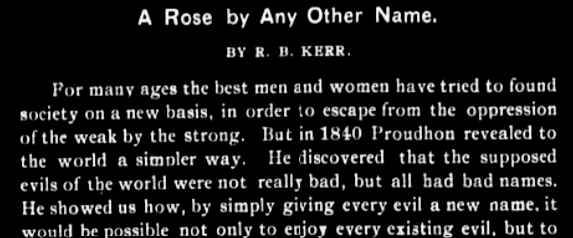
A Rose by Any Other Name – R.B. Kerr, 1/9/1902
Republished from our predecessor publication Lucifer the Light Bearer
For many ages the best men and women have tried to found society on a new basis, in order to escape from
the oppression of the weak by the strong. But in 1840 Proudhon revealed to the world a simpler way. He
discovered that the supposed evils of the world were not really bad, but all had bad names. He showed us how,
by simply giving every evil a new name, it would be possible not only to enjoy every existing evil, but to derive
unspeakable delight from the resurrection of all the evils of the past. His followers have extended his researches
with the happiest results. To the Proudhonian, “punishment” is an abomination, but for the sake of “protection”
dangerous persons should be confined for life. Those who were supposed to be “criminals” are really only “lunatics,”
and justice demands that they lose their liberty under a new name. Force must ever be abhorred, but it is right to
“resist invasion.” The Proudhonian says that property is robbery, but he greatly approves of “possession.” He would
allow a man to “use and occupy” the best corner lot on Broadway, New York, and erect on it a skyscraper twenty
stories high. On the ground floor he could run a store, and the mere advantage of position would enable him to do
a thousand times as much business as a man with an inside lot in the suburbs. The remaining nineteen stories he
could rent at fabulous figures, and soon accumulate a gigantic fortune. He would have to pay nothing for his location.
The single taxer would denounce this as “monopoly”; but the Proudhonian calls it “equality of opportunity” and smiles.
The Proudhonian would substitute “voluntary protective associations” for the present machinery of the law. The words
have a very familiar sound, especially to the ear of a Scotsman. Before 1746 the Highlands of Scotland were entirely
in the hands of such protective associations and were only nominally connected with the British government. There
was no central authority of any kind, only protective associations. The associations were quite voluntary, as far as
any law was concerned; though perhaps a man who wished to change his association might have had a good many
dirks in his body before he got very far.
We have all heard of the MacDonalds and the Campbells, how well they “protected” themselves and aggressed on
each other and all the world besides. Some centuries earlier the Lowlands had similar organizations, and I myself am
descended from the members of a famous protective association on the Border, whose historic feud with the Scotts
has been immortalized in The Lay of the Last Minstrel. The great business of the Scotts and the Kerrs was to fight
each other, collectively and individually; but the necessities of nature often summoned them to cross into England and
steal the cattle of the Dacres and Musgraves, incidentally burning every house and ravishing every woman they could
find. Some attention had also to be given to other Scottish protective associations, like the Elliots and the Homes.
But free association for protection was not peculiar to Scotland. We all know the sad story of Romeo and Juliet, which
resulted from a little misunderstanding between those worthy protective associations, the Montagues and the Capulets.
But why quote more cases? For during the greater part of human history in all countries free protective associations
prevailed, uncurbed by any central authority. Yet, strange to say, all historians have considered them an abomination.
All students of the past think that the most beneficent change in human history was the suppression of private war,
and the taking away from individuals and associations the right to bear arms and to use force, and the vesting of the
right to use force as a monopoly in the hands of the representatives of the whole people. And, strange to say, every
monarchy in the world owes its origin to the fact that the trading classes and the common people supported the monarch
against the voluntary protective associations. But it seems they were wrong. The protective associations were founded
on a splendid principle, but unfortunately they used a wrong name. They called themselves “clans.” The warlike traders
should have sent deputations to the Montagues and the Capulets, the Scotts and the Kerrs, urging them to change their
names to “voluntary protective associations,” and then I am sure they would all have been as meek as lambs.
Some years ago I got into a lively discussion with a delightful old gentleman who was against all “government of man by
man,” until it transpired that, although against government, he strongly favored an “administration.” I was surprised that
none of the Proudhonian journals quoted the figures lately given in the Literary Digest, showing that in the last sixteen
years fifty-one women and nearly two thousand men have been lynched in the United States. Such evidences of progress
must be very gratifying to the apostles of voluntarism. A murderer who is painlessly but legally electrocuted is indeed to be
pitied, but glorious is the fate of the innocent man who is burned to death by a voluntary association. Many writers have
bewailed the evils of competition. It was left for Proudhon to show that the only objection to competition is that there is
not enough of it. It should be absolutely “free,” so that the weak may have no chance of escape from going to the wall.
Sometimes a weakling inherits a fortune and escapes extinction, but Proudhon would give no favors except natural
monopolies, and one may be sure that they would always be in the hands of the strong. He would leave the weak and
the strong to compete at the same price in the same market, thus making it mathematically certain that every weakling
would go to the wall. In fact, he would restore pure Darwinian natural selection among individuals, just as we find it in
the Origin of Species. But all the close students of natural selection, like Huxley and Alfred Russel Wallace, have
denounced it as an inconceivably bad foundation for human society; and the latter, who was one of the discoverers of
natural selection, has adopted cosmopolitan social democracy, the sole aim of which is to abolish natural selection, both
as between individuals and between societies, and to depend wholly on free sexual selection for the future evolution of
the race. But the Proudhonians think natural selection would be very nice, if called “free competition.”
Proudhon, however, wishes one deviation from natural selection as it exists throughout nature. He wishes to bar the
form of competition called aggression. He thinks the strong should not use their strength, although the weak may use
their cunning. He would like to see the indolent and spendthrift athlete take his defeat from the puny man of thrift and
industry without an effort at redress. He would have us think that, if all men could bear arms and unite in voluntary
associations, those who could shoot best would take no advantage of those who could cheat best. But the beauty of
it all is that everything is called “liberty” by Proudhon. What matters it if half the men and women in the world are burned
at the stake without trial, so long as it is done by voluntary protective associations, in a world where government, the
only foe to liberty, has been abolished? I have said a good deal about Proudhon, for I am sorry to see the prejudice
now existing against all the great humorists. Comstock would suppress Rabelais and Boccaccio, and now Roosevelt
would suppress Proudhon. But such men cannot be suppressed, and Proudhon will be immortal, like the schoolboy
who said that the Iliad and Odyssey were not written by Homer, but by another poet of the same name.
Geistian notes: From a completely unrelated section of the paper, thought this was hilarious.
THAT EDITORIAL “WE.”
“Can you give us a comfortable room and a good dinner?
We have traveled all day and are very tired and hungry.” – Stranger (to the hotel clerk)-
“Certainly, sir. But where is the other party?” – Clerk
“Other party! Why, we have just registered our name. There is no other party.” – Stranger
“Oh, I beg your pardon, sir. I didn’t know you were an editor.” – Clerk