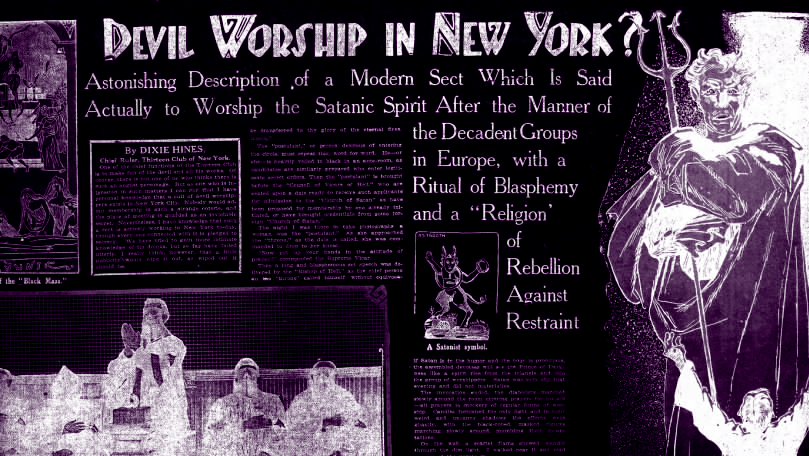
Devil Worship in New York – William Van de Weyde, 11/13/1910
Astonishing Descriptions of a Modern Sect which is said actually to worship the Satanic spirit after the manner of
the Decadent groups in Europe, with a ritual of blasphemy and a “Religion” of rebellion against restraint.
One of the chief functions of the Thirteen Club is to make fun of the devil and all his works. Of course, there is
not one of us who thinks there is such an august personage. But as one who is interested in such matters, I can
say that I have personal knowledge that a cult of devil worshippers exists in New York City. Nobody would admit
membership in such a strange coterie, and the place of meeting is guarded as an inviolable secret. Nevertheless,
I have knowledge that such a sect is actively working in New York today, though everyone connected with it is
pledged to secrecy. We have tried to gain more intimate knowledge of its doings, but so far have failed utterly.
I really think, however, that a little publicity would wipe it out, as wiped out it should be.
New York now has its little cult of “Satanists” or “Diabolists”—worshippers of evil, or of the devil, Satan. Paris has known
them for centuries; Berlin probably has several coteries; London possibly one or two. Martinique was their headquarters
in this hemisphere until Mont Pelée had its awful cataclysm and wiped out St. Pierre and its 25,000 souls. But now the
cult has come to New York. Its coming has not been heralded, of course. No member will admit his or her membership
—yes, there are women initiates here, just as there are elsewhere. The meeting place is a secret; the membership not
of record. There is no book of the coterie—nothing but a few spoken words will identify a member. To keep in hiding is
the chief design of these strange people who profess to worship Lucifer, though in reality their strange rites are a mockery
of all religion. “Services,” they call their regular meetings. They are held in rooms on the Lower West Side of New York.
Everything is shrouded in the utmost secrecy. The meetings are held late at night and under the guise of a secret fraternal
order. Even the janitor of the building where the few members meet does not know who his tenants may be—to him
they are members of some vague brotherhood, just as others are who use that room on other nights, and all the other
organizations which meet in other rooms there. They sometimes call themselves “The Hermetic Brotherhood of Chaldea,”
which means nothing at all, and least of all devil worship. But Lucifer to this group is hailed as the incarnation of all that
is really worthwhile, and to blaspheme God and religion is their delight. Their form of “worship” is simply an obscene
travesty of the sacred ritual of the Church. In the old days, when diabolism was quite common in Europe and especially in
France, the sacrifice of a child was a part of the blasphemous rites of the devil worshippers. Of course, in New York such
a practice is tabooed. This was later changed abroad to the slaughter of a dove or a lamb, but even this is not part of the
“services” of the New York group, who have a very lively respect for the law and do not desire to get caught. How do I
know all this?
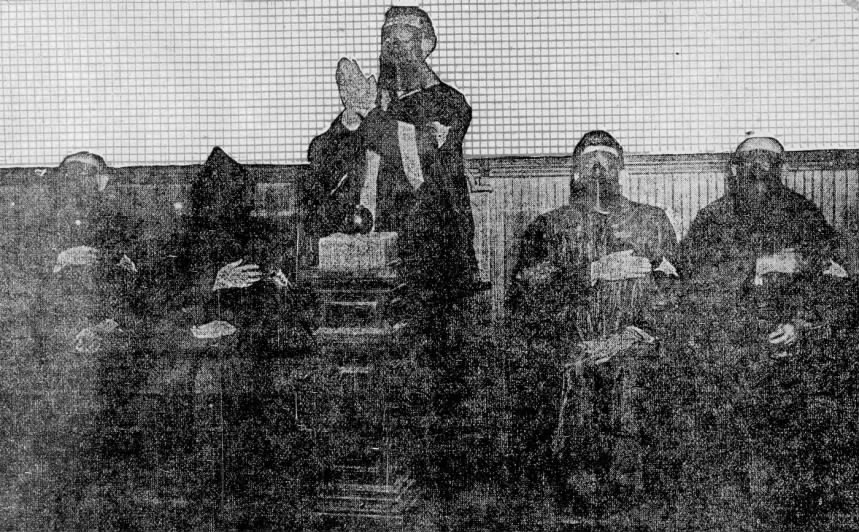
Simply because, in my capacity as a professional photographer in New York, I was called upon to take photographs of
these strange persons while they were at their strange rites. I was sworn to secrecy. Before I could get the order for the
work, I had to swear that I would neither tell the place of the meeting nor give the names of any persons present. After
the photographs had been taken and delivered, I asked one of the members if he would not, just for verification, give
me his real name and address, with the promise that even then it would not be published. He threw up his hands in
mock horror. “I’d just as willingly go out and commit murder as admit that I belonged to this group of devil worshippers!”
he protested. “I would be ruined forever, not only in New York but all over the world.” Nevertheless, I can say with certainty
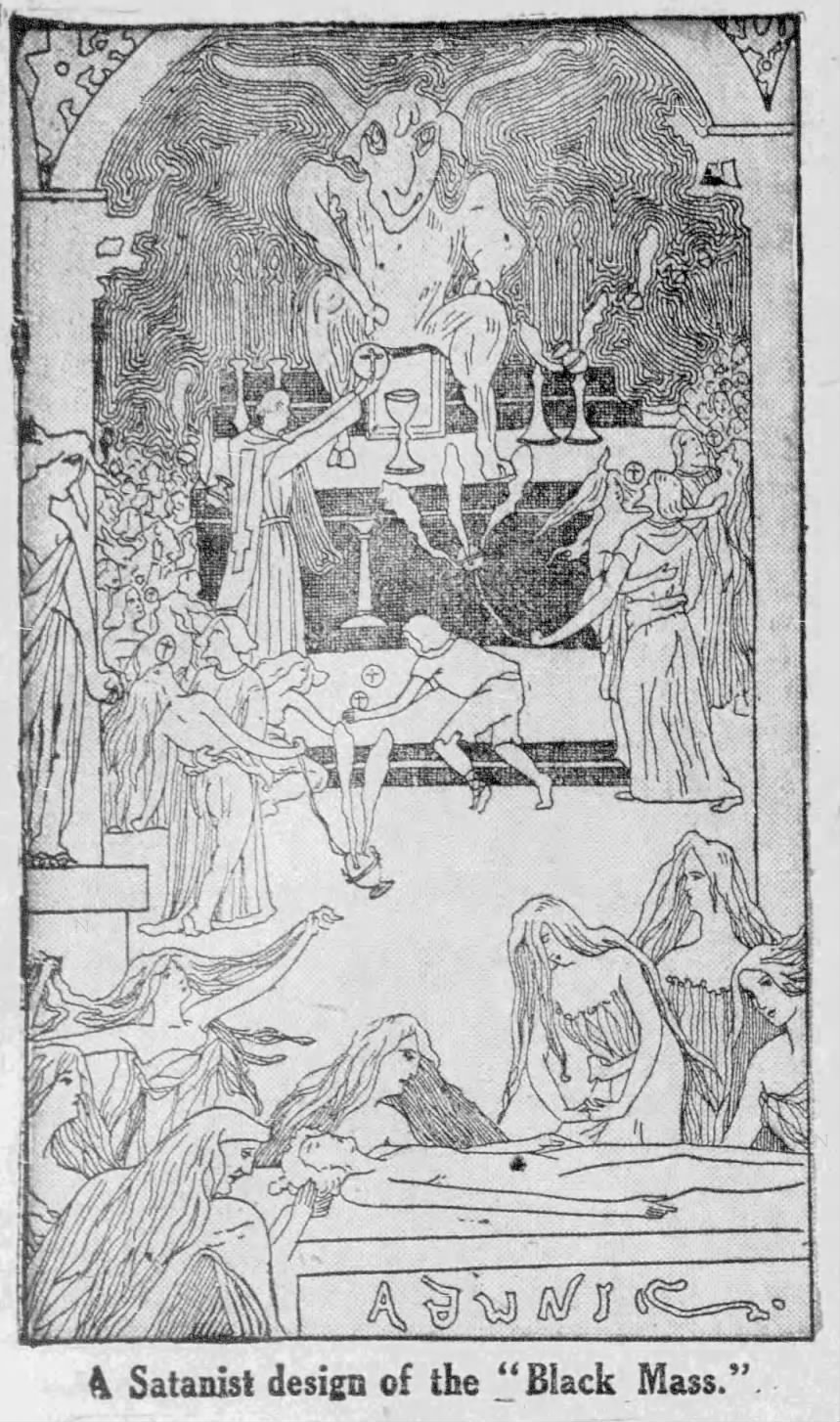
that devil worship exists in New York. Today its devotees practice the “Black Mass,” or messe noire, just as it was practiced
in France, but in a milder degree. It is a revelation of the depths to which blasphemy can sink, even in such an enlightened
country as the United States. It is enough to make anyone who believes in anything wonder that such things can exist. I
was present at one of the meetings for a time and was allowed to hear their “creed.” It runs: “To thee, Lucifer, I consecrate
myself with respect, love, and faith. Thou art the Good of Good, and I promise to hate the God of Evil. Thou art the Spirit
of Truth, and I shall forever hate falsehood, hypocrisy, and superstition. Thou, O Lucifer, art the eternal light, and I forswear
darkness; and in thy service shall I spend my last drop of blood. To thee I give myself, O Lucifer, body and soul. O Lucifer,
do with me as thou seest fit to glorify thy name. Accept my humble prayer and shed thy light upon my way. And when, O
Lucifer, my last hour comes, thou wilt find me calm and without fear or terror, ready to be transferred to thy glory of the
eternal fires. Amen.” The “postulant,” or person desirous of entering the circle, must repeat this word for word. He or she
is heavily veiled in black in an anteroom, as candidates are similarly prepared who enter legitimate secret orders.
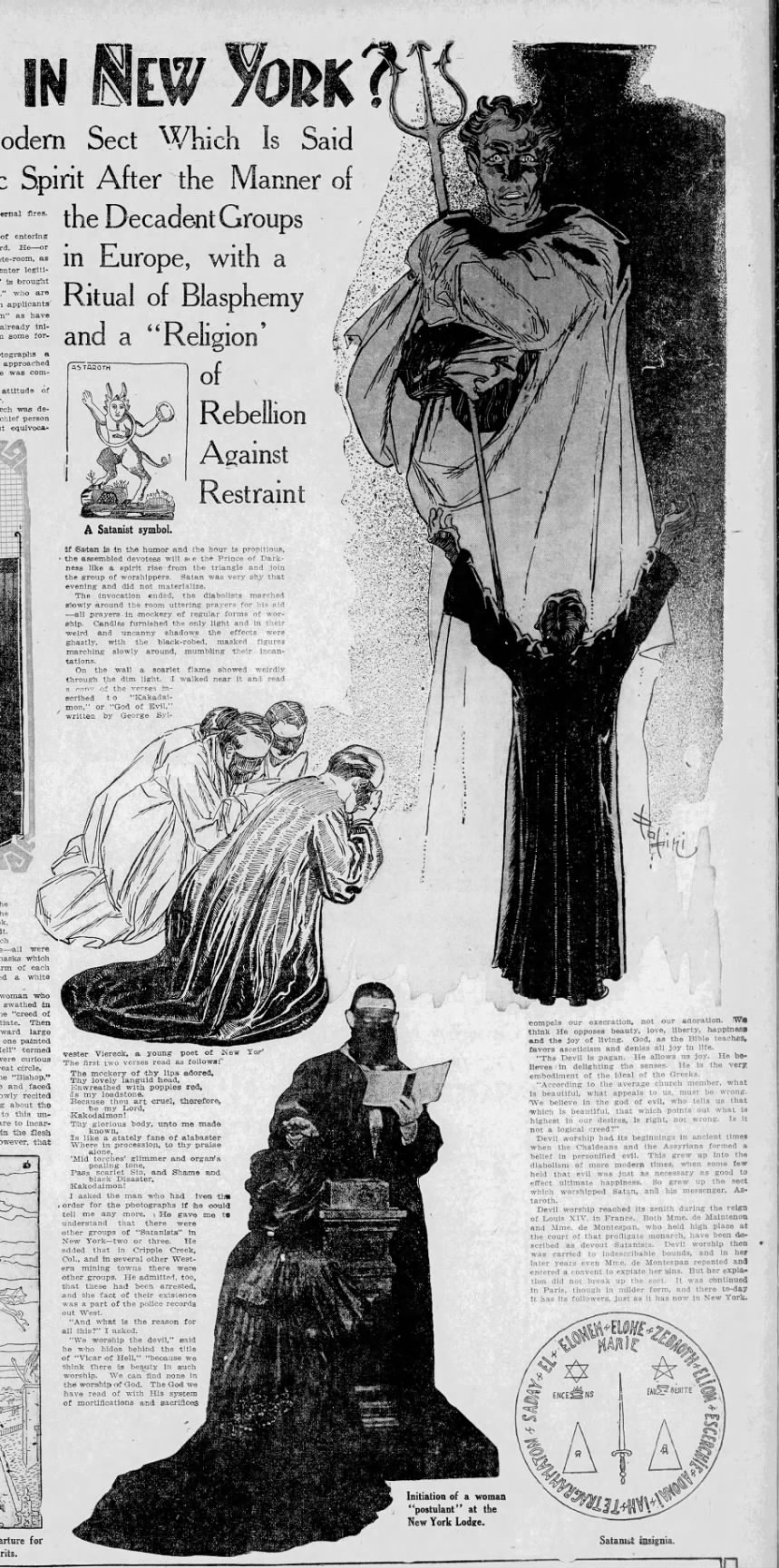
Then the postulant is brought before the “Council of Vicars of Hell,” who are seated upon a dais ready to receive such
applicants for admission to the “Church of Satan” as have been proposed for membership by one already initiated, or
who have brought credentials from some foreign “Church of Satan.” The night I was there to take photographs, a woman
was the postulant. As she approached the “throne,” as the dais is called, she was commanded to drop to her knees.
“Now put up your hands in the attitude of prayer!” commanded the Supreme Vicar. Then a long and blasphemous set
speech was delivered by the “Bishop of Hell,” as the chief person on the throne called himself without equivocation.
Standing with staff in hand, he held his outstretched hand over the woman’s head and read from a little book, the
“Pledge of Lucifer,” as he called it. Then followed strange oaths and much blasphemy. All were garbed in black robes
and wore black masks which entirely covered their faces. On the arm of each one present was prominently displayed
a white horned head—the lineaments of Satan. All present wore masks except the woman who was being initiated,
and her head was swathed in black veiling. Then she repeated the “Creed of Lucifer” and was duly declared an initiate.
Then came more incantations, directed toward large white sheets spread upon the floor. On one, painted in black, was
what the Bishop termed the “Great Triangle.” On the other were curious symbols and figures, surrounded by a great circle.
“For the invocation of Satan,” said the Bishop. Then he took his place in the circle and faced the triangle. With solemn
voice he slowly recited a long jumble of words meant to bring about the materialization of Lucifer. According to this
uncanny person, Lucifer does not always care to incarnate himself. At any rate, he was not in the flesh that night. It
was explained to me, however, that if Satan is in the humor and the hour is propitious, the assembled devotees will
see the Prince of Darkness rise like a spirit from the triangle and join the group of worshippers. Satan was very shy
that evening and did not materialize.
The invocation ended, the diabolists marched slowly around the room, uttering prayers for his aid—all prayers in mockery
of regular forms of worship. Candles furnished the only light, and in their weird and uncanny shadows the effects were
ghastly, with the black-robed, masked figures marching slowly around, mumbling their incantations. On the wall a scarlet
flame showed weirdly through the dim light. I walked near it and read some of the verses inscribed to “Kakodaimon,” or
“God of Evil,” written by George Sylvester Viereck, a young poet of New York. The first two verses read as follows: The
mockery of thy lips adored, Thy lovely languid head, Enwreathed with poppies red, Is my lodestone. Because thou art
cruel, therefore be my Lord, Kakodaimon! Thy glorious body, unto me made known, Is like a stately fane of alabaster,
Where in procession, to thy praise alone, ’Mid torches’ glimmer and organ’s pealing tone, Pass scarlet Sin, and Shame
and black Disaster, Kakodaimon! I asked the man who had given the order for the photographs if he could tell me any
more. He gave me to understand that there were other groups of “Satanists” in New York—two or three. He added that
in Cripple Creek, Colorado, and in several other Western mining towns there were other groups. He admitted, too, that
these had been arrested, and the fact of their existence was part of the police records out West. “And what is the reason
for all this?” I asked. “We worship the devil,” said he who hides behind the title of “Vicar of Hell,” “because we think there
is beauty in such worship. We can find none in the worship of God. The God we have read of, with His system of mortifications
and sacrifices, compels our execration, not our adoration. We think He opposes beauty, love, liberty, happiness, and
the joy of living. God, as the Bible teaches, favors asceticism and denies all joy in life. “The Devil is pagan. He allows
us joy. He believes in delighting the senses. He is the very embodiment of the ideal of the Greeks. “According to the
average church member, what is beautiful, what appeals to us, must be wrong.
We believe in the god of evil, who tells us that which is beautiful, that which points out what is highest in our desires,
is right, not wrong. Is it not a logical creed?” Devil worship had its beginnings in ancient times, when the Chaldeans
and the Assyrians formed a belief in personified evil. This grew into the diabolism of more modern times, when some few
held that evil was just as necessary as good to effect ultimate happiness. So grew up the sect which worshipped Satan
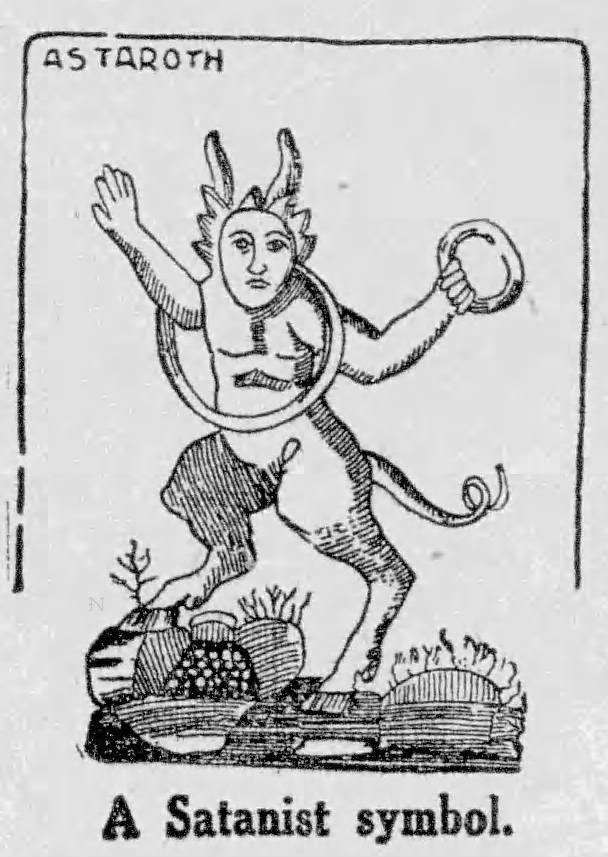
and his messenger, Astaroth. Devil worship reached its zenith during the reign of Louis XIV in France. Both Madame
de Maintenon and Madame de Montespan, who held high place at the court of that profligate monarch, have been
described as devout Satanists. Devil worship then was carried to indescribable bounds, and in her later years even
Madame de Montespan repented and entered a convent to expiate her sins. But her expiation did not break up the sect.
It was continued in Paris, though in milder form, and there today it has its followers, just as it now has them in New York.
Photos from the article: