All Articles from Anarchism.net
We don’t agree with all of what’s here but it’s useful to give some perspective on broader anarchist theory.
Anarchism, Capitalism, and Anarcho-Capitalism
ANARCHISM HAS NOTHING to do with the exploitative, rule-based and oppressive system of capitalism.
Yet there is a part of the anarchist movement calling themselves “anarcho-capitalists.” Some argue this
term is simply an attempt by conservative, big business forces to hijack the concept of anarchism, some
argue anarcho-capitalism is rather a state-minimalizing classical liberalism, and still some claim anarcho
-capitalism is truly anarchist. The Internet, as well as printed anarchist media, covers an extensive library
of argumentative essays on the oxymoron of anarcho-capitalism and why this political tradition needs to
be refuted. Anarchism is by necessity opposing the exploitative system of capitalism, in the same way
anarchism opposes the authoritative, exploitative, and coercive structures of the church and the government
or the State. This argumentation usually begins with the history of anarchism and its obvious socialist
heritage. The “father” of anarchism, Pierre-Joseph Proudhon, was in essence socialist and sought a society
based on equality and freedom. As for his and the anarchists opposition to capitalism he stated that “[w]e
do not admit the government of man by man any more than the exploitation of man by man.” The identification
of anarchism as a socialist movement is echoed by proponents of the later schools of anarchism, such as
anarcho-communist Peter Kropotkin and individualist anarchist Benjamin R. Tucker. The former defined
anarchism as “the no-government form of socialism” while the latter called for anarchism as “the abolition
of the State and the abolition of usury.” These quotes show the history of anarchism as a socialist movement.
It can therefore be claimed that anarcho-capitalism inevitably is an oxymoron–with no real ties to the general
anarchist tradition. Anarchism “has always challenged all forms of authority and exploitation, and has been equally
critical of capitalism and religion as it has been of the state.” [2] How can one from this historical heritage claim
to be both anarchist and advocate of the exploitative system of capitalism? The truth is that no one can, and no
one does. There are no anarchists approving of such a system, even anarcho-capitalists (for the most part) do not.
This unfortunate situation of fundamental misinterpretation of anarcho-capitalism (and other political movements)
originates from the confusion in definitions of terms and concepts. Anarchism as a term has two specific meanings
which have nothing in common: it is both a political movement seeking a free society without rule, and at the same
time a term describing chaos and disorder. In the anarchist political movement only the first definition of the concept
is used, while the general public usually refers to the second when using the term “anarchism.” Just as anarchism
is a confusing concept, so can other concepts have different meaning depending on the context and people using
the term. One may argue about which definition of a certain term is the correct and which should be abolished, but
this approach is rather misplaced. Instead of arguing that most people in the world should abandon the “chaos,
disorder” definition of anarchism one should advance the ideals of the anarchist political movement. This is the only
rational and effective approach to this confusion–the term is not what is important, but the ideals, ideas, and values
the anarchist movement associates with the term. Capitalism in the sense of wealth accumulation as a result of
oppressive and exploitative wage slavery must be abandoned. The enormous differences between the wealthy and
the poor do not only cause tensions in society or personal harm to those exploited, but is essentially unjust. Most,
if not all, property of today is generated and amassed through the use of force. This cannot be accepted, and no
anarchists accept this state of inequality and injustice. As a matter of fact, anarcho-capitalists share this view with
other anarchists. Murray N. Rothbard, one of the great philosophers of anarcho-capitalism, used a lot of time and
effort to define legitimate property and the generation of value, based upon a notion of “natural rights.” [3] The starting
point of Rothbard’s argumentation is every man’s sovereign and full right to himself and his labor. This is the position
of property creation shared by both socialists and classical liberals, and is also the shared position of anarchists of
different colors. Even the statist capitalist libertarian Robert Nozick claimed contemporary property was unjustly
accrued and that a free society, to him a “minimalist state,” needs to make up with this injustice.
Thus it seems anarcho-capitalists agree with Proudhon in that “property is theft,” where it is acquired in an illegitimate
manner. But they also agree with Proudhon in that “property is liberty” in the sense that without property, i.e. being
robbed of the fruits of one’s actions, one is a slave. Anarcho-capitalists thus advocate the freedom of a stateless society,
where each individual has the sovereign right to his body and labor and through this right can pursue his or her own
definition of happiness. As we can see, the exploitative, force- and rule-based system of capitalism is not championed
by any anarchists, not even the anarcho-capitalists. The critique directed from the leftist camps of anarchism towards
anarcho-capitalism is therefore misplaced, inaccurate and rather ignorant. To refute the ideas and values of a philosophical
movement one will have to use their definitions, or the critique will be virtually worthless. Anarcho-capitalism is thus not
the oxymoron many anarchists claim it to be. The term “capitalism” is here rather used in a way of emphasizing the
importance people of this movement put in the creation of value in the free market. This position of advocating the free
market without interference is shared by individualist anarchists such as Lysander Spooner and Benjamin R. Tucker,
of whom the latter demanded that interferences with the free market must be abolished. As Tucker claimed, “if a man
has labor to sell, he has a right to a free market in which to sell it.” It may seem as an unproductive and confusing way
of using such a widely discussed and refuted concept as “capitalism” in the anarchist movement–there must be other
terms more suitable for these ideals. Actually, anarcho-capitalists rather often refer to themselves as contractists or
voluntaryists to stress the fact that they disapprove of any coercive or force-based measures and champion a society
where every individual is free to arrange his or her life as seen fit. But on the other hand, there are a number of such
seemingly contradictory constructions of specific anarchist ideals. The anarchist position to oppose the powers of religion,
perhaps as opium of the people, and the church seems to be contested by anarcho-christians. And anarcho-socialists
use the term “socialism,” which originally was defined as a theory advocating state ownership and administration of the
means of production. [7] The combined terms seemingly create an inherent conflict, which in reality is nonexistent.
As we can see, anarcho-capitalism is not different from anarchisms in the refusal of exploitative capitalism. But there
are of course differences which need to be stressed and discussed, as is the case with every anarchist “branch” using
their own label. Anarcho-capitalism puts great value into the freedom of each individual to be involved in the free market
and take part in voluntary, mutual agreements for one’s own benefit. Anarcho-capitalists as most anarchists agree with
Tucker in that “[l]iberty insists … [on] the abolition of the State and the abolition of usury; on no more government of
man by man, and no more exploitation of man by man.”
The Structure of Anarchist Society – Unknown, 2004
A SOCIETY UNDER ANARCHISM is voluntary and free. Despite this fundamental characteristic of post-state society
many anarchist thinkers forward their idea of how the free society is constituted; from anarcho-communist Bakunin’s
“union of unions of unions” to anarcho-capitalist Rothbard’s free market society. Such structured views of anarchy
serve as inspirations for how to organize one’s neighborhood, but cannot be taken as mandatory blueprints to be
enforced under anarchy. Anarchists forward the idea of a society where man can shape his own life without being
subject to force by his equals. Equality is thus an important part of anarchism and freedom, since every man and
woman naturally is a free being; they are equally free though limited to their own ability and subject to the laws of
physics and nature. But within this framework of rules, such as bodily strength, gravity and the earth’s revolving
around the sun, only our minds set the limits for our achievements. Man is therefore the king of nature’s creations,
the very top creation of evolution. This creativity and richness possible is today limited by the evils of force-based
society. The history of man is a history of aggression. In old times tribes used violence to conquer the richness of
other tribes, simply because it was possible and seemed easier than to produce such richness using one’s own
energy and effort. City states, kingdoms and imperial powers followed in the same method of conduct: stealing
the richness of others through the use of force and aggression. Thousands of years of human history, i.e. human
lives, have been wasted to the pointless struggle man against man to steal the fruits of the others’ labor. The result
of this darkness is striking: a society where any action creates both winners and losers is a losing society on any
level. A society where creation is punished by the use of force of the non-creating is a barbarian society with only
limitations. The possibilities are constantly overshadowed by the limits of one man to stand tall against the aggression
of the multitude. Force feeds force in an ever increasing circle of pain, oppression, exploitation, and poverty.
The abandonment of such oppressive conduct is the solution for mankind to break the evil circle of force. It includes
the abandonment of all force-based structures of contemporary society in order to break the chains of man. This is
anarchism: breaking the man-made chains that hold our faces down in the mud; breaking down the castles of our
oppressors; freeing our fellow men to the life they have earned and will build for themselves through hard work and
fellowships; defeating the political class to establish the force-free society where men will live peacefully beside men
–where force is only a last resort and a means of defense. The goal is obvious to the anarchist and anyone wishing
to knock down the aggression of our age: the source of force, oppression,exploitation, aggression, and usury must
be abandoned and crushed. The state must go. Despite this correct identification of what must be, many anarchists
tend to make fixed plans for the structures of post-state society. Such plans or blueprints of post-state society are the
virus eating the anarchist movement from the inside. Anarchists forwarding such “free” blueprint societies as truths
or must-be’s are as dangerous adversaries as the state itself. Anarchism, the force-free society, does not allow for a
model or blueprint to be realized or enforced. There can be no compulsory structure of post-state society under anarchism
unless a new state, new government, is instituted. Under anarchism one man cannot force his will upon others, and
a multitude cannot force the one individual. The very essence of anarchism is voluntary conduct–the use of voluntary
means to reach agreements of societal change. Voluntary conduct and equality go hand in hand, if one is not respected
so is the other restricted. There can only be equality if everyman is respected for what he is, wants and chooses.
There is only voluntary conduct if every man’s actions and choices are equally respected and unhampered. From
this follows the core of anarchist thought: every man (i.e. man, woman, and child) is free to choose whatever he
sees fit as long as it does not involuntarily limit the choices of another. Contrary to this is the forceful blueprint society
of today and throughout history. The future under anarchy cannot be planned or controlled. The meaning of anarchy
is the absence of forceful structures through which one or many individuals can control others’ choices. There cannot
be a mandatory blueprint for anarchist society, since all individual choices have to be equally respected. There can
only be hopes, dreams, and plans to create one’s own Shangri-la, to create the future one wishes for oneself and
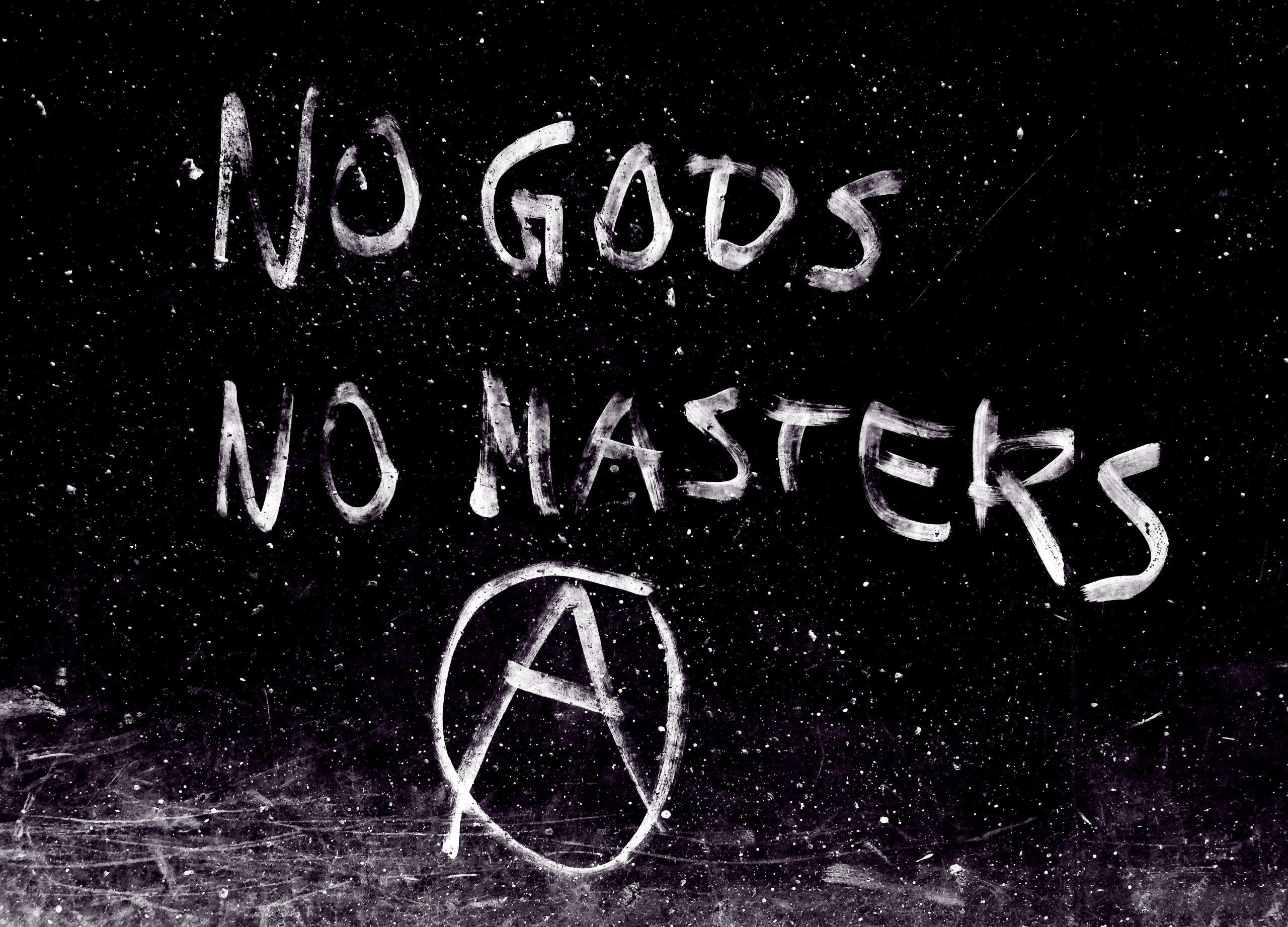
companions. In freedom and equality there can be no king, no minister, no master, and no god.
With no gods or masters, i.e. in anarchy, who will stop the hard-working, the intelligent, the lucky? If there is a structure
to stop them, it will not be anarchy. Effort, intelligence, and luck may upset equality through the choices of the achieving,
intelligent and lucky. Such “inequalities” are bound to come about in freedom, since people are differentand choose
differently. Any restrictions put on the hardworking, intelligent or lucky will mean the end of anarchy and freedom and
the birth of force, coercion, and through these oppression, exploitation, and usury. Forceful societal structures are not
compatible with anarchy, even if the results of voluntary choices and agreements by free men under anarchy to us are
seemingly unjust or inappropriate. If such inequalities effected by anarchists voluntarily working alone or cooperating
with equals are stopped “spontaneously” by the actions of other free men and women cooperating only to subdue the
successful, anarchy will inescapably lead to the formation of government. The very people seeking to strengthen
freedom and equality are the very end of freedom themselves. Turning to force to uphold freedom can only further
restrict what freedom is left. Force, aggression and coercion are incompatible with anarchy. The turning to violence as
means of conduct will start the circle of force yet again. If aggression and violence is used under anarchy, people will
eventually realize that “crime pays” and hence plunge into the use of violence for an easy profit. Thus, they elevate
themselves over others through the use of force against their fellow men–only to forfeit the products of free men’s labor.
Such a mafia society is not anarchy; it is chaos and fascism. Such a society is even worse than the oppressive monopoly
structures of the state. It is mob rule. And it is no doubt the end of freedom and anarchy. Anarchy offers many promises
and opportunities, of which all can be realized in a not too distant future. Such state of freedom or anarchy can serve as
the means and basis to fulfill our personal hopes and dreams, but a free society cannot be shaped, steered, governed
or ruled without losing what freedom there is.
Creating a blueprint for anarchist society, or demanding certain behavior of our fellow men, is a creation of government.
An anarchist making a blueprint for all people in anarchist society does not seek anarchy, but seeks the powers of the
state: to shape the wills and actions of free men and the structures of society. Under anarchy, a society under freedom
and equality, one has only the right to oneself and answers only to oneself. It is not a society without masters, but a
society with only masters. Under anarchy your plans are realizable in accordance to your efforts and skill, and cannot
be limited or restricted by other men. Your blueprint for anarchy is thus as true as any other: it is applicable to your
future only. Welcome to anarchy, where you are the master of your ability and labor and where no restrictions apply.
Any limitations are only in your own mind, yours to overcome.
What Is Anarchism? – Unknown, 2004
Many reply it is simply the abolishment of coercion in society, and thus the first thing to do is abolishing
the guns of government. But anarchists are infamous for having completely different ideas on how to go
forward. There is a seemingly unbridgeable gap between different factions of anarchism, usually putting
more energy into refuting each other than working towards the common goal: abolishing the state. Anarchists
seem to enjoy putting a lot of energy into refuting other anarchists of slightly different beliefs. Usually it
seems it is very important to them to show their distance to whomever is an anarchist but does not share
the exact beliefs. But wouldn’t the rational approach be to appreciate any time and effort put into forwarding
anarchist ideas? The anarchist movement is divided into many different factions that usually tend to wage
war upon each other: communist anarchists against socialist anarchists against syndicalist anarchists against
Christian anarchists against environmentalist anarchists against free-market, libertarian, and voluntaryist
anarchists. This flora of different anarchisms need not be a bad thing, but since it seems there is more energy
and effort used in fighting each other than the common enemy (the State), we are only creating problems
for ourselves. Of course, the two main groups of anarchist ideologies–individualist and collectivist–seem
incompatible. Anarchists see the free society in very different ways and may even have different methods
or preferences in how to abolish the state. But, most importantly, all anarchists agree on abolishing the state.
The main difference is how one sees the anarchist society. But while discussing the anarchist society, anarchists
often make the same mistake as statists: making up a plan for how an anarchist society would be like, and
aim to accomplish this society. But for an anarchist, this must be a strange way of thinking: The very reason
one is an anarchist is not wanting anyone to force a structure on society. So why do so many anarchists make
such statist-like plans in their heads, which are then preached to anybody willing to listen? There simply cannot
be a good answer to this question, but that this behavior in essence is not very anarchist.
Yes, this plan for society includes abolishing the state, so it must be anarchist by definition. But since these social
engineering anarchists “know” what society would look like, or how a free society should (or must) be structured,
they are really using both the statist vocabulary and, in reality, aim for statist methods. If the post-state society is
structured in a specific way, it means that we are not creating a free society but a new kind of state. I agree in that
creating an image of what could be in anarchy may have pedagogical benefits in discussing with statists, but the
image is nothing but a guess. Actually, how we may believe a free society would be spontaneously structured is not
and cannot be true; we can only guess what people would choose. This is the beauty of being anarchist: We leave
to everybody to form their own life and their own society the way they prefer and would like it. So there is a place
in anarchist society for everybody: statist or non-statist, collectivist or individualist, property owner or non-property
socialist, money users or non-money, and so on. The Common Goal. There is a common goal for all anarchists:
abolishing all coercive structures. It is the only way of reaching anarchy. Of course, collectivism-influenced anarchists
reckon capitalism, the market, money and such things as technology or contracts are “coercive structures” and thus
need to be abolished too. Libertarian or free-market anarchists say only direct force can be coercive, since capitalism,
money, etc. are all the results of people’s voluntary actions. But it should not really matter what we as anarchists
identify as coercive structures in this oppressive society. The collectivist, communist, no-property anarchists may
identify whatever they wish as coercive structures. The main point is that all anarchists identify the state as the
number one enemy. This is the common goal which makes us anarchists and which should allow us to work together.
We all believe–or should believe–that abolishing the state would create a free society, and then people would
voluntarily choose whatever structure they would like in their lives. An anarchist society would be structured,
but it would have a multitude of structures which all are the results of individual or collective voluntary action.
There would be a number of small societies corresponding to the values of whoever lives there. How can we,
as anarchists, say we wish to abolish such structures? We cannot. The very foundation of anarchism is the
belief in man having the full, sovereign right to self. Some identify this as only realizable in the higher value
of a collective or society, some believe this is possible only while alone and that collective action is a threat
to this right. But this does not really matter. The obvious problem for the anarchist movement is the leftist claim
that capitalism and property need to be abolished, otherwise there can be no freedom. Voluntaryist, free-market
anarchists usually consider capitalism and the right to property as “natural” rights which must be the foundation
of any society. Thus, they both have a plan or blueprint for the foundation of an anarchist society, just like the
statists do. There seems to be a conflict of ideas here, but I believe there is not. The main problem here is
anarchists turning to dogmas instead of working on the revolution. As a matter of fact, many leftist anarchists
claim the state is the only reason there exists such things as property, since they believe property and money
need a monopoly power in order to exist. Free-market anarchists on the other hand believe it is not possible
to abolish these things, since they will automatically arise when free people voluntarily choose to interact. So
in reality, there is no conflict; if the leftist anarchists are right, property and money will automatically disappear;
if free-market anarchists are right, people will automatically choose property and money. Of course, if either side
turns to the use of force to structure society the way they want it, we have a problem. (But on the other hand,
they would not be real anarchists, would they?) If collectivist anarchists believe they should abolish the state
and then abolish all property for everybody to “liberate them,” they will have to turn to force. Abolishing the
state means no one will have to use force in order to create a structure, since the abolishment of coercion
in itself cannot be coercive. But abolishing other people’s property sure includes force and coercion.
The problem here is of course that some anarchists usually do not identify any claims to property as just, and
they believe they are totally correct in this even though other people may not agree. Even to free-market anarchists
it is true that most property is to some extent unjustly acquired, but stealing or destroying it would not make
things better. As a matter of fact, in order to abolish property, all property owners need to voluntarily give up
any claims to property. Otherwise, we are not abolishing property, but stealing it (that is, forcefully taking it from
people) since they will take it back if we do not guard it. And if we do, it will be our property. Some anarchists
may claim property is in itself a theft from “community,” but these anarchists cannot force people into not having
the choice to produce wealth–it would not be anarchist to use such force. Abolishing the state may very well
mean all or most property as of today is abolished, but any wealth created in the post-state societies can be
identified as property by whoever produced it. So there may be property even though all unjust, state-based
property is abolished. This is the problem we have in the anarchist movement–can there be such a thing as property?
And how do we handle this issue? This is a philosophical question, which we should settle–but there is no need
right now. As most or all anarchists seem to believe, abolishing the state is number one on the anarchist wish list.
What comes thereafter we cannot know, and whatever it is, it will need to be voluntary and thus anarchist.
Barter Trade, Not Capitalism – Unknown, 2004
ARE ANARCHISTS PRO OR ANTI capitalism? Many anarchists dogmatically claim an anarchist cannot be
pro capitalism simply because capitalism is oppressive–and anarchism is based on socialist ideals. The
anarchist society necessarily needs to be “free from capitalist oppression.” Other anarchists claim an anarchist
society, based solely on voluntary action of free people (individually or collectively) cannot be anything but
capitalist. There seems to be an unbridgeable gap here. As anarchists often and correctly note, barter trade
is inoffensive and it is ethical. Someone believing in natural rights (or any other kind of rights too) would say
barter trade does not violate rights and is thus ethical. Some simply state that since barter trade is in full voluntary
and does not include any kind of coercive measures it is ethical and just. This is a fully anarchist point of view,
all anarchists should be able to support this. Now, why is barter trade not the same as a market? Imagine two
people, let’s say a baker and a fisherman, get together every now and then to voluntarily exchange things.
The baker obviously values fish higher than the bread he needs to give up to get it, and the fisherman obviously
values the bread higher than the fish he “pays” for it. It is very simple, if either one of them would believe it was
not just–and that they were not better (or as good) off as before–they would not voluntarily agree to the exchange.
This is how many libertarian or anarcho-capitalist anarchists define the market–voluntary exchanges for one’s
own benefit, which means every exchange is for all partaking actors’ benefit. Imagine there are more people in
this society, for instance a wagon maker. Now, this is going to get troublesome since one wagon takes a lot of
time and skill to produce, and the wagon maker cannot produce more than a few wagons each year. And, since
the baker and fisherman know they cannot make a wagon unless not baking or fishing for a long while, they
will agree to exchange a large quantity of bread or fish for a wagon (if they need it). Of course, working for a
couple of months making a wagon, and then getting perhaps one thousand loaves of bread or many hundreds
of fish is not an attractive exchange. Bread gets bad after a while, and fish will rot. Also, the wagon maker needs
something to eat while making the wagon he is about to sell.
It is the same the other way around too: bread and fish will go bad as the baker or fisherman is trying to save
enough bread or fish to buy a wagon. So the wagon-maker would have a wagon which he wishes to exchange
for fish or bread, and the baker and fisherman would have their bread and fish while being interested in trading
it for a wagon. But the exchange would never happen, since bread and fish easily goes bad when saved. So
what would happen in this little society? It is obvious the three people would come to an agreement since it is
in their mutual interest to make this exchange. Maybe they agree on paying the wagon maker a couple of loaves
of bread or some fish every day for a couple of months, and will in return get the wagon when it is finished.
This means they have avoided the problem with bread or fish getting bad, and they all benefit from this scheme
since nobody needs to keep a lot of bread/fish while awaiting the right quantity. There is nothing wrong with
this, right? They are still into barter trade, but have agreed on paying for the thing of greater value in smaller
portions. With this solution, they have through voluntary action invented the contract, since they have an
agreement for exchange even thought the exchange is not immediate. The agreement therefore causes an
ongoing interdependence throughout the time of the contract, but it is still barter and it is still 100 % voluntary.
Also, they have invented a financial instrument since there is value in the contract. The value arises simply
because the baker and fisherman offer their products before they get anything in return (which is the basis for
this contract), and will as time goes by have a bigger claim to the property (wagon) of the wagon maker. And,
of course, the wagon maker will be in debt as the baker and fisherman pays him bread and fish while he has
not yet given them anything. The difference is the current value of the contract, since–in this case–the baker
and fisherman relies on the contract to get value in the future. It is still barter, so there is no conflict and it is
not offensive; it is still as ethical as we agree barter is. We are still relying totally on voluntary exchange for
the mutual benefit of whomever is involved (in this case: the baker, the fisherman, and the wagon maker).
Now, maybe there is a storm and the fisherman’s boat is thrown ashore and sinks to the bottom of the sea.
The fisherman cannot get any more fish (or he cannot get the quantity he expected) and would need to get
a new boat. According to the contract he will have to continue paying a number of fish every day to the wagon
maker even though the wagon maker in real terms is in debt to the fisherman. What can he do? He can of course
go to the wagon maker and ask him to release him from his obligation stated in the contract through cancelling
it. Maybe the wagon maker will agree to this, but it would mean he has to pay the fisherman back the number
of fish he has already paid. But the wagon maker has probably already started working on the fisherman’s wagon,
which means he has really “paid” a part of the value of the contract even though it is not yet realized for the
fisherman. Maybe he cannot afford to let the fisherman get his fish back because he ate them all and cannot
trade for new ones. Now we have a problem. Either the wagon maker could give the fisherman whatever he has
achieved in making the wagon, perhaps a wheel and a blueprint (which are not really of value to the fisherman,
who cannot continue the work), or he can simply demand the fisherman continues giving him fish as was already
agreed. Or, he could offer to make yet another agreement saying perhaps that the contract is off and that the
fisherman will have a few fish back, but that he will keep 10 fish because he now cannot get food the following
days. Since he expected to get fish every day while working on the wagon he now demands some of his costs
are covered by the fisherman–this is not hard to imagine. As we can see, the contract is here a financial instrument
since there is value in the expected completion of whatever is stated in the contract. The agreement in itself
means a promise to make a future payment, thus the contract is simply an agreement to make such an exchange
as we have covered above–but it is not immediate. The contract is to some extent also to be considered as
speculation, since the fisherman promises to give the wagon maker a number of fish every day–but while
signing the contract he does not have the fish. He simply expects to have the fish when he is supposed to
deliver it to the wagon maker. He believes he will be able to catch fish every day to give to the wagon maker,
so he takes this chance. But there is, as we can see, a certain amount of risk involved.
The wagon maker and the fisherman most likely think this is quite troublesome, exchanging fish for wagons.
The difference in value is too great, thereby causing a lot of problems. Of course, the value they identify in
fish and wagons is totally subject to their wants and desires. There is no real (or rather: objective) value in
the wagon nor in the fish. To the wagon maker the wagon is worth approximately the time and effort it takes
him to produce the wagon, to the fisherman the wagon is worth as much as it lightens his burden or what
he expects to gain in whatever he would like to use it for. The same is true with the fish: the fisherman values
the fish to the time and effort he puts in catching the fish, while the wagon maker values the fish according
to his needs or desires. The values of the things is thus not objective, it is subjective and individual. What
happens when these two people get together to exchange a wagon for a number of fish is the establishment
of market value of both the fish and the wagon. The market value in this case is simply whatever is agreed
between seller and buyer, e.g. a wagon is worth 1,000 fish and a fish is worth 1/1,000 wagon. There is nothing
strange about this, it is simply a voluntary agreement to exchange products and the values of the products
are established by the parties involved in the exchange. Since the wagon maker also makes a deal with the
baker, there is also a market value of bread (relative to wagons) established. Perhaps the wagon is sold for
1,500 loaves of bread (the value of one wagon) meaning the bread is valued to 1/1,500 wagon. So we have
established the market value of wagons, fish and bread. This does not mean the value is always the same,
the market value is set only for the instance in which the single agreement is made. In this instance fish seems
to have the value of 1.5 loaves of bread, but we do not know this until the baker and fisherman agree to
exchange their products. (Simple Austrian economics, very rational and very intelligible.) The so-called
“market value” the State uses for taxation and the multitude of government programs with subsidies or
whatever is simply a scam. Competition The same is true if there are multiple actors in the marketplace
(the market is simply the abstraction of all voluntary exchanges).
If there are 1,000 bakers, 1,000 fisherman, and 1,000 wagon makers the market value is set in exactly the
same way–in each individual transaction or exchange. But what is now added is the choice of whom to make
the exchange with. If there are two fishermen in our example the value of fish would probably be lower since
there are more fish available in exchange for roughly the same number of loaves of bread or wagons. Competition
is introduced, which in this example increases the volume of fish available in exchange for bread or wagons.
This does not mean the fishermen will do anything to get as many fish as possible in order to buy all wagons
and bread on the market. No, every exchange is still the result of voluntary action from both the “seller” and
the “buyer,” thus the baker will exchange his bread for fish with the fisherman of his choice. Of course, the
number of fish he can get is an important factor, but so is how the baker feels about the fisherman and his
products, trust, friendship, politeness etc. Maybe the baker prefers fish caught using float and not nets, or
he wishes the fish to be killed painlessly and treated in a good way, or he feels sorry for a poorer fisherman,
or whatever. All these factors are of course important, since the choice to trade bread is only the baker’s.
As a matter of fact, since the baker has the option of with whom to exchange, the fishermen will have to
outbid each other–the one offering the best deal for the baker (on the baker’s terms) will probably get the
bread thus selling his fish. And of course, price is an important factor, but it is not at all the only one. The
baker chooses which factors he wishes to consider, and chooses freely with whom to trade. So competition
between the fishermen is for the trust of the baker, on the baker’s terms. In competition, the customer is king
and the sellers will have to accept his terms.
This is of course not true in today’s society, where the state has a large number of rules on how to make
exchanges, how to produce things, how to tell people about them (advertising), how to offer them, and a lot
of other things. Such rules of course upsets the “market,” since it is no longer up to the fishermen to agree
to the baker’s terms, and the baker’s terms are no longer important for the exchange–only the laws are.
This is what happens when coercive measures are introduced to an otherwise voluntary exchange. The
laws are of greater importance since they are backed by the guns of government, the baker’s preferences
are no longer a priority. All the baker can do is not to trade his bread while the government can fine, outlaw
or in other ways punish the fisherman. (Actually, many governments demands the baker to take part in the
exchange even if he does not like the terms.) Money Imagine another thing in our original example with one
baker, one fisherman and one wagon maker: one day the fisherman finds a couple of very beautiful pearls
in some of the clams he caught while fishing. He thinks they are very beautiful and puts them in his pockets,
anxious to show them to people. Everybody agrees that these pearls are really something special, and people
imagine a number of different uses for such beauties. Thus, there is a demand for the pearls. It is not created
in terms of producing a demand not before existing in the minds of people, but the new information (that such
pearls exist) brings new thoughts to people and lets them reconsider their priority hierarchies. Hence, some
people value the pearls very highly and some don’t. It is a newly identified demand, but it is based solely on
voluntary preferences. The value of pearls is exactly as with bread, fish, and wagons–it is subjective. (What
is objective is that there is an identified value in the pearls–all people seem to agree on this even though they
do not agree on what the value is.) The fisherman notices there are a lot of people wanting such pearls, and
thus that there is a market value. He does not know what the market value is (since it has to be established
in each individual exchange) but he is sure there is a value.
Thus, he tries offering the baker pearls instead of fish in exchange for bread. The baker accepts according to
what we established above–he places a higher value in these pearls than in the bread exchanged for them,
and the fisherman vice versa. So an exchange takes place and a market value is established for that single
exchange. Since the fisherman exchanged only half of his pearls for bread, now both the baker and the fisherman
have pearls. The fisherman makes the same offer to the wagon maker, offering pearls instead of fish as payment
for the wagon. The wagon maker accepts since he thinks these pearls are very rare and beautiful. His wife would
love them, and since he has heard the fisherman has already gotten bread for the pearls they surely have a
market value. The pearls have hence become a general medium of exchange, since people agree to trade
using pearls as bearers of value instead of the direct exchange of products. Any medium of exchange such
as this is money, so in our small society everybody is suddenly using money! Why? Because everybody wants
to own the pearls (they all place a certain value in owning the pearls), and they choose to use the pearls rather
than fish, bread, and wagons when exchanging value for products. Thus, the next time the wagon maker visits
the baker to make an exchange for bread he does not have to go through the trouble of trying to sell the baker
a wagon and settling a contract with part-payments. Instead, he brings the pearls he was paid by the fisherman,
and pays the number of pearls the baker and wagon maker agree the bread is worth. The reason they all start
using the pearls instead of direct barter is that they all consider them valuable and it is much easier for all of them
to trade products for pearls instead of products for products. They are easier to store and handle, and they are
scarce–one cannot find large numbers of pearls everywhere. Finding pearls takes time and energy, and thus
there is a cost for getting more pearls (money) into the marketplace.
Investment Now the fisherman can simply sell fish to the others and perhaps save the few pearls he does not
need to use directly to get bread and whatever he needs. So he starts leading a little cheaper life in order to
save; saving being the main prerequisite for investments. What is now spontaneously invented is a money
-based economy with profits–the fisherman is saving a little money from each exchange. The profits are not
coercive or violate the rights of anyone. Any exchanges are still the result of voluntary action between the buyer
and seller (they are both better off!), thus a new market price is established every time people agree to make
an exchange. And it is still the same as barter, even though it is indirect because everybody taking part in
exchanges believes it is easier and better to use pearls. If the fisherman can save a lot of money it means
simply that his costs are far less than what people are prepared to pay for his fish (meaning they place a
higher value in the fish than in the pearls they give up for it). And because of this others can easily start fishing
in order to get a piece of these profits. There is a rational incentive in catching fish if the fisherman is already
making profits–of course other people want to be better off just as the fisherman. So profits cause competition,
which in turn cuts profits. The result of this spontaneous balance-making is simply cheaper (and better)
products for the consumers. Anyway, when the fisherman has saved enough money (pearls) he goes to
another town to buy a new boat or a net in order to catch more fish so that he can save more money and
perhaps buy a house or a more comfortable bed for his wife. This way he can, through saving and investing
his profits, increase the supply of fish in the market and thereby supplying more food to hungry people.
Since there is more fish available (in the market) people are willing to pay less. If the fisherman tries to
charge the same price for the fish he will only find that people will not be able to buy all the fish and it will rot
while awaiting buyers. Also, the greater profits per sold fish will create an incentive for people to compete with
him. So his profits will not be stable no matter what he does (unless he goes to the government asking for “favors”).
Thus, the market price for fish goes down. The fisherman can probably still save a little money from his business,
since people are better off paying less for the fish and there is a small barrier for competitors to enter the market.
Buying a boat (or net) is costly, and this produces a possibility for modest profits. Of course, the fisherman can
set whatever price he wishes, but setting a too high price will only mean less people will be able to buy the fish.
Also, it creates a greater incentive for other people to get a boat/net and compete. As we have seen above
anyone would be able to make an equal deal with a boat maker as the baker and fisherman did before with the
wagon maker–i.e. making a contract for exchange of products in order to buy a boat. If there is a big profit in
catching and selling fish there is enough for a competitor to cover the costs of such an agreement with the boat
maker. So the price of fish will go down either through the fisherman recognizing this fact or through the “threat”
of a new actor (competitor) in the market. The threat is of course only directed to the “unnatural” profits of the
fisherman, all others are better off with such competition. Capitalism Another great thing with this is that there
may be people in such a society who have been successful fishermen for many years through which they could
have saved some money (pearls). Either they can use the money for covering daily expenses (food, clothes etc)
or they can boost the balance-making in the market, thus cutting profits, lowering consumer prices and stream
-lining production, through investing. This is what is called capitalism. Imagine the fisherman gets old and has
quite a few pearls in his possession. A new fisherman takes his place, so there are still three actors in the market:
a baker, a fisherman, and a wagon maker. The fisherman is very intelligent and finds ways of being very successful
in catching fish. He lowers the price of each fish a little bit, but is still able to make a lot of money from his business.
He somehow knows there is no one able to buy the boat needed to compete with him, except for the old fisherman
(who has no interest in going back to catching fish).
But since the fisherman is making profits there is an incentive for others to catch fish and get part of the profit.
The baker’s son sees the opportunity but has no pearls to invest in the boat necessary for such an enterprise.
But he knows the old fisherman has quite a few pearls, and one day goes to him offering him a very good deal.
He says he wants to buy a boat to earn pearls from catching fish, but does not have enough pearls to make the
purchase. So he offers the old fisherman the deal of buying (and owning) the boat, and the baker’s son will pay
him a number of pearls every month. This way he will in time pay for the boat, and gives the old fisherman an
extra pearl with every payment for the trouble and use of his property. The old fisherman thinks about it, and
finds the idea very attractive. So he agrees to pay for the boat and teaches the baker’s son a few secrets on
how to catch very big fish. The baker’s son enters the markets and sells his fish, of course to a slightly lower
price than the other fisherman. So the fisherman will have to lower his price not to lose the customers. Thus,
the price of fish goes down. The baker’s son sells the fish to a price covering the costs of the boat, the small profit
for the old fisherman, and his personal expenses. Probably the other fisherman sells his fish for about the same
price, since he wants to get as much as possible for his fish, but cannot charge a higher price than the competitor
(the baker’s son). So, spontaneously and voluntary there is capitalism created in the market. Also, the old fisherman
could agree to a slightly different deal. He could agree to buy the boat for the baker’s son in order to start the
enterprise, but with the condition that he gets part of the profits. Perhaps they agree that the old fisherman buys
the boat and the baker’s son does all the work, but they split any profits fifty-fifty. If so, they have started a
corporation and own 50 % each of the stock. The corporation may hire people to professionally do necessary
work, but the owners still require their money back–and maybe a little profit on top. Corporations, the stock
-market etc are all inventions of voluntary exchanges and agreements between individuals. But all these things
are today thoroughly corrupted by the state and its laws. Since all these things are directly derived from the
simple barter situation and no force is added it cannot be any less ethical or moral than the original situation.
If you find this development ethically offensive you are not considering the actions or behavior of the people
involved–you only take the results into account. If you want to guarantee a certain result or rules of conduct
in a society you will have to rely on the use of force. Relying on force simply cannot be anarchist.
What has really changed between the simple barter trade and this “advanced capitalist” society is that people get
cheaper fish while the baker’s son earns a living and the old fisherman gets a profit (this profit is nothing but a
small payment to make it worth his while to risk his justly achieved property). Also, the boat maker has sold two
more boats. I am not able to find anything offensive in this. There is no force added, and people are better off.
The reason this is possible is that prices and values are subjective, therefore each transaction means economic
growth–all parties involved are [subjectively] better off. State Capitalism What truly is offensive is the so-called
market of today, where all these voluntary actions leading to competition, productivity and capitalism have been
set aside by the state through coercion, force, and fraud. There is no such thing as a market like the one described
above existing today–the voluntary agreements of exchange between free people have been abolished by the
use of guns of government. The closest there is is what is usually called the “black” market, but the prices in the
black market are much higher than they should be because of the constant threat of state repression. And most
of the so-called market instruments causing balance and consumer-power through the voluntary actions of individuals
are set aside by the same threat of repression. Of course, the above example is a simplified abstraction of the
marketplace. It is much more advanced than this since there are many, many more actors involved. But the basis
is exactly the same. The creation of money, competition etc actually happened in about the same way as in the
example. With a little coercion added by the state, of course, which corrupted the results. So as you probably see,
the market is simply people coming together voluntarily to make exchanges, and what that eventually leads to.
So what is the difference between this voluntary market with capitalism and anarchism? The answer is so obvious
most anarchists do not find it: there is no difference. And there is no essential difference between the simple barter
trade and global corporations.
Speculation It is true that today’s “market” is somewhat oppressive and repressive, but it is not because of the market
instruments competition, money or capitalism–it is because they have been corrupted by the state. For example, in
such a free market as described here there could be no such thing as the speculation in currencies happening every
day these days–making money doing really nothing. The currencies of today have no real value (such as pearls or
gold, which are voluntarily accepted by everyone–and need to be voluntarily accepted as means of payment in each
single exchange), but are simply pieces of paper and ink backed by the guns of government. What makes people
think such “money” has a value is simply because the state forces people to use it. And because there is no identifiable
value, people can through simple transactions make more “money” from speculating if the value placed in the “dollar”
is really corresponding to the current exchange rate for the “euro.” With a market not intervened by the state there
would be no such fiat currencies. Instead people would trade in pearls, gold or whatever (and receipts of ownership
of such; or barter). With such currencies there is no way of making a profit in speculation, since the currencies are
simply products as anything else.
Anarchism, Capitalism, and Anarcho-Capitalism – Unknown, 2004
ANARCHISM HAS NOTHING to do with the exploitative, rule-based and oppressive system of capitalism.
Yet there is a part of the anarchist movement calling themselves “anarcho-capitalists.” Some argue this
term is simply an attempt by conservative, big business forces to hijack the concept of anarchism, some
argue anarcho-capitalism is rather a state-minimalizing classical liberalism, and still some claim anarcho
-capitalism is truly anarchist. The Internet, as well as printed anarchist media, covers an extensive library
of argumentative essays on the oxymoron of anarcho-capitalism and why this political tradition needs to
be refuted. Anarchism is by necessity opposing the exploitative system of capitalism, in the same way
anarchism opposes the authoritative, exploitative, and coercive structures of the church and the government
or the State. This argumentation usually begins with the history of anarchism and its obvious socialist
heritage. The “father” of anarchism, Pierre-Joseph Proudhon, was in essence socialist and sought a
society based on equality and freedom. As for his and the anarchists opposition to capitalism he stated
that “[w]e do not admit the government of man by man any more than the exploitation of man by man.”
The identification of anarchism as a socialist movement is echoed by proponents of the later schools of
anarchism, such as anarcho-communist Peter Kropotkin and individualist anarchist Benjamin R. Tucker.
The former defined anarchism as “the no-government form of socialism” while the latter called for anarchism
as “the abolition of the State and the abolition of usury.” These quotes show the history of anarchism as a
socialist movement. It can therefore be claimed that anarcho-capitalism inevitably is an oxymoron–with no
real ties to the general anarchist tradition. Anarchism “has always challenged all forms of authority and
exploitation, and has been equally critical of capitalism and religion as it has been of the state.” How can
one from this historical heritage claim to be both anarchist and advocate of the exploitative system of
capitalism? The truth is that no one can, and no one does.
There are no anarchists approving of such a system, even anarcho-capitalists (for the most part) do not.
This unfortunate situation of fundamental misinterpretation of anarcho-capitalism (and other political
movements) originates from the confusion in definitions of terms and concepts. Anarchism as a term has
two specific meanings which have nothing in common: it is both a political movement seeking a free society
without rule, and at the same time a term describing chaos and disorder. In the anarchist political movement
only the first definition of the concept is used, while the general public usually refers to the second when
using the term “anarchism.” Just as anarchism is a confusing concept, so can other concepts have different
meaning depending on the context and people using the term. One may argue about which definition of a
certain term is the correct and which should be abolished, but this approach is rather misplaced. Instead of
arguing that most people in the world should abandon the “chaos, disorder” definition of anarchism one
should advance the ideals of the anarchist political movement. This is the only rational and effective approach
to this confusion–the term is not what is important, but the ideals, ideas, and values the anarchist movement
associates with the term. Capitalism in the sense of wealth accumulation as a result of oppressive and
exploitative wage slavery must be abandoned. The enormous differences between the wealthy and the poor
do not only cause tensions in society or personal harm to those exploited, but is essentially unjust. Most, if
not all, property of today is generated and amassed through the use of force. This cannot be accepted, and
no anarchists accept this state of inequality and injustice. As a matter of fact, anarcho-capitalists share this
view with other anarchists. Murray N. Rothbard, one of the great philosophers of anarcho-capitalism, used a lot of
time and effort to define legitimate property and the generation of value, based upon a notion of “natural rights.”
The starting point of Rothbard’s argumentation is every man’s sovereign and full right to himself and his labor.
This is the position of property creation shared by both socialists and classical liberals, and is also the shared
position of anarchists of different colors. Even the statist capitalist libertarian Robert Nozick claimed contemporary
property was unjustly accrued and that a free society, to him a “minimalist state,” needs to make up with this injustice.
Thus it seems anarcho-capitalists agree with Proudhon in that “property is theft,” where it is acquired in an
illegitimate manner. But they also agree with Proudhon in that “property is liberty” [5] in the sense that without
property, i.e. being robbed of the fruits of one’s actions, one is a slave. Anarcho-capitalists thus advocate the
freedom of a stateless society, where each individual has the sovereign right to his body and labor and through
this right can pursue his or her own definition of happiness. As we can see, the exploitative, force- and rule
-based system of capitalism is not championed by any anarchists, not even the anarcho-capitalists. The critique
directed from the leftist camps of anarchism towards anarcho-capitalism is therefore misplaced, inaccurate and
rather ignorant. To refute the ideas and values of a philosophical movement one will have to use their definitions,
or the critique will be virtually worthless. Anarcho-capitalism is thus not the oxymoron many anarchists claim it
to be. The term “capitalism” is here rather used in a way of emphasizing the importance people of this movement
put in the creation of value in the free market. This position of advocating the free market without interference is
shared by individualist anarchists such as Lysander Spooner and Benjamin R. Tucker, of whom the latter demanded
that interferences with the free market must be abolished. As Tucker claimed, “if a man has labor to sell, he has
a right to a free market in which to sell it.”
It may seem as an unproductive and confusing way of using such a widely discussed and refuted concept as “capitalism”
in the anarchist movement–there must be other terms more suitable for these ideals. Actually, anarcho-capitalists rather
often refer to themselves as contractists or voluntaryists to stress the fact that they disapprove of any coercive or force
-based measures and champion a society where every individual is free to arrange his or her life as seen fit. But on the
other hand, there are a number of such seemingly contradictory constructions of specific anarchist ideals. The anarchist
position to oppose the powers of religion, perhaps as opium of the people, and the church seems to be contested by
anarcho-christians. And anarcho-socialists use the term “socialism,” which originally was defined as a theory advocating
state ownership and administration of the means of production. [7] The combined terms seemingly create an inherent
conflict, which in reality is nonexistent. As we can see, anarcho-capitalism is not different from anarchisms in the refusal
of exploitative capitalism. But there are of course differences which need to be stressed and discussed, as is the case
with every anarchist “branch” using their own label. Anarcho-capitalism puts great value into the freedom of each individual
to be involved in the free market and take part in voluntary, mutual agreements for one’s own benefit. Anarcho-capitalists
as most anarchists agree with Tucker in that “[l]iberty insists … [on] the abolition of the State and the abolition of usury;
on no more government of man by man, and no more exploitation of man by man.”
The Structure of Anarchist Society – Unknown 8/16/2004
A SOCIETY UNDER ANARCHISM is voluntary and free. Despite this fundamental characteristic of post-state
society many anarchist thinkers forward their idea of how the free society is constituted; from anarcho-communist
Bakunin’s “union of unions of unions” to anarcho-capitalist Rothbard’s free market society. Such structured
views of anarchy serve as inspirations for how to organize one’s neighborhood, but cannot be taken as
mandatory blueprints to be enforced under anarchy. Anarchists forward the idea of a society where man
can shape his own life without being subject to force by his equals. Equality is thus an important part of
anarchism and freedom, since every man and woman naturally is a free being; they are equally free though
limited to their own ability and subject to the laws of physics and nature. But within this framework of rules,
such as bodily strength, gravity and the earth’s revolving around the sun, only our minds set the limits for
our achievements. Man is therefore the king of nature’s creations,the very top creation of evolution. This
creativity and richness possible is today limited by the evils of force-based society. The history of man is
a history of aggression. In old times tribes used violence to conquer the richness of other tribes, simply
because it was possible and seemed easier than to produce such richness using one’s own energy and
effort. City states, kingdoms and imperial powers followed in the same method of conduct: stealing the
richness of others through the use of force and aggression. Thousands of years of human history, i.e. human
lives, have been wasted to the pointless struggle man against man to steal the fruits of the others’ labor.
The result of this darkness is striking: a society where any action creates both winners and losers is a losing
society on any level. A society where creation is punished by the use of force of the non-creating is a barbarian
society with only limitations.
The possibilities are constantly overshadowed by the limits of one man to stand tall against the aggression of the
multitude. Force feeds force in an ever increasing circle of pain, oppression, exploitation, and poverty. The abandonment
of such oppressive conduct is the solution for mankind to break the evil circle of force. It includes the abandonment
of all force-based structures of contemporary society in order to break the chains of man. This is anarchism:
breaking the man-made chains that hold our faces down in the mud; breaking down the castles of our oppressors;
freeing our fellow men to the life they have earned and will build for themselves through hard work and fellowships;
defeating the political class to establish the force-free society where men will live peacefully beside men–where
force is only a last resort and a means of defense. The goal is obvious to the anarchist and anyone wishing to
knock down the aggression of our age: the source of force, oppression,exploitation, aggression, and usury must
be abandoned and crushed. The state must go. Despite this correct identification of what must be, many anarchists
tend to make fixed plans for the structures of post-state society. Such plans or blueprints of post-state society are
the virus eating the anarchist movement from the inside. Anarchists forwarding such “free” blueprint societies as
truths or must-be’s are as dangerous adversaries as the state itself. Anarchism, the force-free society, does not
allow for a model or blueprint to be realized or enforced. There can be no compulsory structure of post-state society
under anarchism unless a new state, new government, is instituted. Under anarchism one man cannot force his
will upon others, and a multitude cannot force the one individual. The very essence of anarchism is voluntary
conduct–the use of voluntary means to reach agreements of societal change. Voluntary conduct and equality go
hand in hand, if one is not respected so is the other restricted.
There can only be equality if everyman is respected for what he is, wants and chooses. There is only voluntary
conduct if every man’s actions and choices are equally respected and unhampered. From this follows the core
of anarchist thought: every man (i.e. man, woman, and child) is free to choose whatever he sees fit as long as
it does not involuntarily limit the choices of another. Contrary to this is the forceful blueprint society of today and
throughout history. The future under anarchy cannot be planned or controlled. The meaning of anarchy is the
absence of forceful structures through which one or many individuals can control others’ choices. There cannot
be a mandatory blueprint for anarchist society, since all individual choices have to be equally respected. There
can only be hopes, dreams, and plans to create one’s own Shangri-la, to create the future one wishes for oneself
and companions. In freedom and equality there can be no king, no minister, no master, and no god. With no gods
or masters, i.e. in anarchy, who will stop the hard-working, the intelligent, the lucky? If there is a structure to stop
them, it will not be anarchy. Effort, intelligence, and luck may upset equality through the choices of the achieving,
intelligent and lucky. Such “inequalities” are bound to come about in freedom, since people are differentand choose
differently. Any restrictions put on the hardworking, intelligent or lucky will mean the end of anarchy and freedom
and the birth of force, coercion, and through these oppression, exploitation, and usury. Forceful societal structures
are not compatible with anarchy, even if the results of voluntary choices and agreements by free men under anarchy
to us are seemingly unjust or inappropriate. If such inequalities effected by anarchists voluntarily working alone or
cooperating with equals are stopped “spontaneously” by the actions of other free men and women cooperating
only to subdue the successful, anarchy will inescapably lead to the formation of government.
The very people seeking to strengthen freedom and equality are the very end of freedom themselves. Turning to
force to uphold freedom can only further restrict what freedom is left. Force, aggression and coercion are incompatible
with anarchy. The turning to violence as means of conduct will start the circle of force yet again. If aggression and
violence is used under anarchy, people will eventually realize that “crime pays” and hence plunge into the use of
violence for an easy profit. Thus, they elevate themselves over others through the use of force against their fellow
men–only to forfeit the products of free men’s labor. Such a mafia society is not anarchy; it is chaos and fascism.
Such a society is even worse than the oppressive monopoly structures of the state. It is mob rule. And it is no doubt
the end of freedom and anarchy. Anarchy offers many promises and opportunities, of which all can be realized in
a not too distant future. Such state of freedom or anarchy can serve as the means and basis to fulfill our personal
hopes and dreams, but a free society cannot be shaped, steered, governed or ruled without losing what freedom
there is. Creating a blueprint for anarchist society, or demanding certain behavior of our fellow men, is a creation
of government. An anarchist making a blueprint for all people in anarchist society does not seek anarchy, but seeks
the powers of the state: to shape the wills and actions of free men and the structures of society. Under anarchy, a
society under freedom and equality, one has only the right to oneself and answers only to oneself. It is not a society
without masters, but a society with only masters. Under anarchy your plans are realizable in accordance to your
efforts and skill, and cannot be limited or restricted by other men. Your blueprint for anarchy is thus as true as any
other: it is applicable to your future only. Welcome to anarchy, where you are the master of your ability and labor
and where no restrictions apply. Any limitations are only in your own mind, yours to overcome.
Three Arguments for Anarchism – Richard D. Fuerle, 2004
Some claim there would be no roads, hospitals, schools, or pollution control. All these activities, as well as
production of food, is sometimes claimed to be a result of government. But what is the government? There
are only people–individuals–acting everywhere, thus the government or the state is simply made up by the
yielding subjects–and the people acting as officers. What gave them this right of deciding what other people
can and cannot do? And what came first: man or the state? It seems to me that, from birth, a person’s thought
develops in stages. First, we learn the names of things–mommy, drink, sister, and so on. Then we learn the
properties of things–the stove is hot, the floor is hard, the teddy bear is soft. In the third stage we learn
relationships–if we’re bad, mommy spanks, if we heat water, it boils, etc. Since most of the people I meet
confine their conversation to people and things, that may be as far as they get or want to get. The last stage,
at least the last stage of what I am aware, is ideas–can morality be objective? Can there be bread without
freedom? Is free will consistent with an omniscient God? For me, ideas are the most interesting subjects for
conversation and I assume this is true for most (if not all) intelligent or educated people. In this essay I present
three arguments in defense of a hated and despised yet very powerful and liberating idea: anarchy. Those
arguments will proceed from the simple to the more convoluted. Being an anarchist, at least according to my
definition of the word, I believe that all three are valid. If you take ideas and arguments seriously I believe you
will be anarchist too after reading this essay. Realistically, however, since I have never been able to convince
a single person to become anarchist, the most I can hope for is to force you to think of flaws in my arguments.
First, let me define anarchy. The word literally means “no government.” That it also means “chaos” is to me the
greatest propaganda success ever, since there is no greater chaos than war, and all wars of any magnitude of
which I am aware were carried out by governments.
Even the economic chaos of depressions, inflation, shortages, massive waste, etc. are clearly the result of the
actions of government people, not of the actions of people who are not in the government. Indeed, only a great
natural disaster could exceed the chaos inflicted on us by government people. Not only do government people
cause chaos, but the assumption that there can be no order without government is simply false–all sorts of order
arise spontaneously without government. Cities, social customs, business customs, roads, law, money, all arise
spontaneously without government because, as Axelrod and others have shown, people benefit most in the long
run if they cooperate with other people, and cooperation requires order and rules. We may say, that anarchy
means “no ruler” or “no rules.” That is, that under anarchy no one is permitted to openly rule over another person,
though people will still create rules for the use of their property by others. By that definition alone, I would think
that every decent person would be an anarchist. After all, would a decent person endorse one person forcibly
bending another to his will, would he say that people are only “things” so that if they say “no” that “no” need not
be respected? No, he would say that people are ends in themselves, not means to the ends of another, that all
force must be defensive, not offensive, that one must not aggress against the person or property of another, and
that anything that is peaceful or consensual should be permitted. Remember, too, that to rule over another person
means to use force against him. How much force? Well, whatever force is needed to make him yield. If you are not
willing to apply enough force–then you no longer rule. This means that if you endorse anything but anarchy you
must endorse the killing of hose subjects who will not yield to any force but deadly force. Are you willing to kill
people, if necessary, to get things done by government instead of getting them done privately? If not, then
perhaps you should consider becoming an anarchist.
That may sound like an argument, but let’s call it a “passing remark” and proceed to the real first argument. This first
argument, by the way, is the argument that convinced me to give up statism and become an anarchist. First Argument
When I was much younger, and presumably, but not necessarily, less wise than I am today, I fancied myself to be a logical,
intelligent political conservative. Of course, I believe, there was a proper role for government, but government today
was too big, too powerful, too wasteful, too destructive. The “proper role” included all the “essential” functions–course,
police, national defense–as well as providing a decent and civilized environment–roads, schools, pollution control,
and elimination of drug sales and prostitution. The “proper role” did not include taking from one person to give to another,
preventing people from contracting on mutually acceptable terms, or controlling a man’s business or occupation. This
was a position I eagerly defended against all comers, confident in the correctness of my positions. One day I found
myself in a political argument with an intelligent, but more liberal, and thoroughly obnoxious person, and darn if he
didn’t catch me in a contradiction. I don’t even remember what it was any more, but there was no doubt that I was
trapped and that something had to give way. “No problem,” I informed him, “I’ll re-think my principles so that they are
internally consistent, then get back to you.” Of course, I expected that I would have to change some position–there
was no alternative given the contradiction I was caught in, but I figured some minor patchwork would take care of it.
So I began by trying to describe what I thought the permissible relationships between two ordinary people ought to be.
This was relatively easy, and took me all of ten minutes. Everyone was simply required to respect the right of others
to their persons and property; i.e., don’t alter the people’s bodies or property without their permission; don’t aggress;
don’t initiate force–use force only defensively. Of course, how the principle should be applied to particular situations
could still generate a lot of arguments, but there was no denying that the principle itself was clear, elegant, and had
the ring of truth about it. But what about the state?
There would have to be exceptions to the principle so that some people could tax, regulate, prohibit drug sales and
prostitution, etc. Surely, there was a second simple principle that would define the role of those people who acted for
the state. All I had to do was find it. Several problems arose immediately. Who could act for the state and who could
not? What rule would define the selection of those people? What if everyone or no one wanted to act for the state? I
worried that since a person acting for the state could seize the property of another person as his tax, this would be a
highly desirable job for a lot of unscrupulous people. Would a simple rule ensure that only the virtuous got the job?
What simple rules would define the limits to what “state people” could do to the rest of us? Even more basic, how was
the “state” to be defined–by the people who voluntarily joined it, so that a state was an organization of Mr. Jones, Mrs.
Smith, etc.? Or should it be defined geographically, by mountains, rivers, and oceans; linguistically, by the area where
particular languages are spoken; democratically, by the area in which some or all of the people want the government?
Would the state have land boundaries and, if so, would they shift as rivers moved, languages changed, or most of the
people voted for a different state? Who should decide the policies of the state–the majority of its members, its victims,
or both? Or should policy be decided as it is in the United States–by who can pay Congressmen the largest bribes?
Who would be subject to the state and who would not? Should people be free to join or secede at will? Then I pondered
another problem: A person acting for the state would be wearing that hat only part of the time–the rest of the time he
would be an ordinary person. How was one to know what he was? Suppose you thought he was ordinary, but he
turned out to be acting for the state–what should the consequences be? How could the two jobs be kept separate
so they did not intermix or contaminate each other? Another question: Suppose a citizen of one state got in trouble
with another state. What rules would tell what could happen to him? What of people who were citizens of more than
one state or of no state? Consider the problem from a different angle. If you argue that too much government (i.e.,
totalitarianism, fascism, or communism) is bad and that too little government (i.e., anarchy) is also bad. Then you
must take the position that there is an optimal amount of government, which can be defined by upper and lower
limits. But how can non-arbitrary, defendable limits be set? And, since all government involves the use of offensive
force against some individual, a lower limit can be justified only on the ground that the injuries suffered by the
victims of government force are outweighed by the benefits to the beneficiaries of that force. But again, how can
non-arbitrary, defendable rules on permissible injuries to achieve particular benefits be set when one cannot
even measure the sufferings of the victims or the pleasures of the beneficiaries? It was easy to think of questions
like this, and the more questions that occurred to me, the more obvious it became that there were no simple rules that
would define the state and its role in our lives. Try as I could, and I tried for many weeks, I could find no simple natural
rules for the state. This was puzzling because one simple rule did define relationships between ordinary people
–don’t aggress. Why, if the state was such a natural thing for mankind, was it so hard to find simple rules for it?
In the end I was faced with an alternative: Either spell out thousands of arbitrary and completely undefendable
rules about the state or get rid of the state. This came down to a very basic ontological question for me: Is there
an underlying order to the world? That is, is the world of politics like the world of the natural sciences? Natural
phenomena are extremely complex, but there is no doubt that they are governed by simple laws. Is the rest of
the world–psychology, economics, politics, even art–like that, too, or is it just a mish-mash, a jumble of faddish
pretty principles that arise for a few moments, then disappear? It took a leap of faith to answer that question,
but, with my background in science, I did not hesitate–the world does make sense, it does operate according
to simple, beautiful, elegant principles. It is not a randomized soup of momentary no-no’s. How could I think
otherwise when Einstein and other physicists even used that as a test for the validity of a theory–he new
Relativity had to be correct because it was elegant, simple, and beautiful. And, since the existence of the
state was inconsistent with such a world view, the state had to go. That is probably the most eccentric reason
anyone has ever given for becoming an anarchist, but it was mine. As the implications of this reasoning dawned
upon me, I felt as though a door had opened and I had been permitted to see a truth that others were not privy
to. It was almost a religious experience, closely reminiscent of the day, as a teenager, when I concluded that
there was no God. It even stirred the same anxiety I had felt then–then, that I would be ostracized and persecuted
by Christians, and now, that I would be followed and harassed by the FBI. So I became a reluctant anarchist.
I did not want to be an anarchist–the state was such a convenient way to get things done–but I could not
honestly say that this argument, and the other we will soon come to, were wrong.
The implications of this position seemed outrageously impractical–how would we get police, national defense,
roads, schools, etc. without taxes? What would happen to the poor, to pollution, to prostitution? It took several
years before I had read enough libertarian literature to satisfy myself that these problems could and would be
handled spontaneously and privately, and handled better than they were handled by state people. One final note
on this argument: Ideas have value only if the world operates according to underlying principles that can be
expressed as ideas. If you believe in the value of ideas, you must believe that there is such an underlying order.
But the state is not consistent with an underlying order. Therefore, you must, it seems to me, either dis-value
ideas where the state is concerned and leave a blind spot in your philosophies, or you must do as I did, and
get rid of the state. Second Argument Now my second argument also has a very powerful premise–that everyone
is equal. Equality is a drawing card that pulls us all together. It dissolves racial, religious, and ethnic differences.
You are no batter than I, and I am no better than you–we are both human beings, we are both equal. Very few
people would argue with that as a premise, yet very few people are anarchists. But, I claim that if you accept
equality, you must be an anarchist. Why? Well, when we say that all people are equal, in what respect are they
equal? Surely not in ability, talent, beauty, strength, wealth, health, or any other attribute. We mean that all people
are equal in rights. No one should have special rights that others do not have. No one should have a license to
kill or a license to steal. If you have the right to kill me, then I have the right to kill you. If you have the right to take
my property, then I have the right to take your property. If you have the right to tell me what I can eat, smoke, drink,
grow, say, who I can hire, what I can pay them, and so on, then I have the right to control you in the same way.
This second argument really has a second premise–that only people have rights, or at least that the state does not
have rights. If the state has rights, then someone can say that it is not he who takes your property, but the state–hew
is acting only as an agent for the state. And, of course, the state would have superior rights to any individual. To defeat
the argument that a state can have rights, I will argue that rights are not something that can be arbitrarily given out
to any object or idea that one wishes. Rather, rights arise naturally from the nature of the right-holder. This may be
somewhat complicated, but I will proceed slowly in steps. First, I contend that only beings having free will have rights.
Free will, to me, is not a vague notion, but has a precise meaning, which I will now explain. An event is a change in the
physical world. If one event causes another event according to physical law, there is a chain of causation. “Free will”
is the ability that certain beings have to initiate a chain of causation. I believe that such beings must necessarily be
conscious since the initiation of a chain of causation by a being having free will is necessarily purposeful. The purpose
is to change the physical world, or preserve it from change, in order to achieve a desired, and imagined, future
satisfaction, which I will call a “value.” Consciousness is required to “visualize” the future state that one believes may
result if one acts and the future state that one believes may result if one does not act and choose between them. If
a being having free will has a valid claim to the value he or she seeks to achieve from changing or preserving from
change a bit of the physical world it is his or her “right.” A right is a valid claim to a value achieved in the physical
world through changing it or preserving it from change. Thus, since states are organizations of people and are not
conscious and do not have free will, they cannot have values or rights. If someone claims that it is not he who has
rights superior to yours, but the state for which he acts as its agent, he is lying.
Since the state is not a being with a conscious mind it cannot authorize anyone to act as its agent. Moreover, even if
it did have a conscious mind, and rights, it would still have the burden of proving that its rights were superior to yours.
No, if anyone rules over you, he does so because he arrogantly and wrongly believes that he has rights that are
superior to yours, and that we cannot tolerate if we believe in equality. Thus, equality means equal rights, and rights
can be equal only if there is no ruler, which means anarchy. A similar argument can be based on truth, rather than
equality, as a noble goal for humans to strive for. I further contend that if you value truth then you must be an anarchist.
Why? Because the values that we try to achieve by our acts of free will are not physical things, but thoughts–ideas.
By the use of force or threat of force to prevent a person from acting, a ruler suppresses the idea his victim was trying
to actualize. If you believe that truth is not given by God to the ruling class but must be discovered through a free
expression of ideas, you must oppose the suppression of ideas inherent in any form of government, and be an
anarchist. Third Argument My last argument is based on the premise that man has free will. It is a complicated
argument that may be difficult to understand, so I will go slowly and hop that you will bear with me. The argument
takes the form that if A leads to B and A also leads to C, then B cannot contradict C. If B does contradict C then
either B is wrong or C is wrong. The “A” in the argument is free will, the “B” is a distribution of rights, and the “C”
is a personally-selected morality. I have already explained what I mean by “free will.” Now let us see how a distribution
of rights can be deduced from free will. If a value from a bit of the physical world is not claimed by anyone and a
first valuer changes or preserves it to serve his value, he makes a claim of ownership or right to that value. In the
absence of any later valuers making contrary claims, the claims of first valuers would automatically and naturally
result in an assignment of ownership in all bits of the physical world that serve values, which I will call “property.”
If a later value changes the property, or prevents its change by the first valuer, in a way that prevents the first valuer
from achieving his value, the later valuer is not only also asserting a claim of right to the property, but is impliedly
asserting that his claim is superior to the claim of the first valuer. Because he is claiming a superior right, the act of
the later valuer implies that he has weighed the importance of the value he hopes to achieve versus the importance
of the value achieved by the first valuer, and has found the former to be the more important value. To compare the
importance of the two values, however, he must measure the importance of his value to him and measure the
importance of the first valuer’s value to the first valuer. This is not possible because values are subjective and
therefore there can be no unit by which the importance of values can e measured. As a result, the later valuer’s
claim to a superior right must fail and we can conclude that no later valuer can ever make any valid argument that
he has a superior right to the dimension of the physical thing serving the first valuer’s value. This means that the
first valuer’s claim of right cannot be challenged, and the assignment of rights in accord with the claims of first
valuers must be left standing An assignment of ownership or rights is therefore deduced from the premise of free
will. Now let us explicitly deal with personally-selected morality. First, I will argue that free will is in the sine qua non
of morality. If there is no free will, there is no morality, for it is only free will that creates morality. If there is no free
will, then choices are determined by prior physical facts and there is no good or evil, only the inexorable march of
physical law. It is only when one is metaphysically free to choose the questions of right or wrong, good or bad, arise.
Second, and many persons find this assertion more tenuous, no one in his own mind chooses evil. That is, one
defines what is “good” by the choices one makes.
This does not mean that what is good to you is necessarily what someone else chooses, only that what is good to him
is what he chooses. Nor does it mean that he will later agree that what he chose was good. It means only that at the
moment of action, he believed his action was morally justified. Even if he commits murder, he says to himself at the
moment of action that it is justified because of the wrong done to him, because of his uncontrollable anger, because
his goal was so noble and unselfish, or because eggs must be broken to make an omelet. If one takes the position
that “good” can be defined other than by an act of free will, then one necessarily asserts that morality is exogenous
to free will. But morality cannot be exogenous to free will if one agrees that it is the act of free will itself, and only that
act, that creates morality. Thus, one’s acts define one’s code of morality. Thus, out of free will arose an assignment of
rights and out of free will also arose an individual’s chosen code of morality. Suppose that the chosen code of morality
contradicts the assignment of rights. Is that possible without something being amiss? No, I maintain that if B is deduced
from A and C is deduced from A, then B cannot contradict C. If it does, then either B or C must be wrong. And, of course,
I maintain that the assignment of rights, being general, is not wrong. Therefore, the conclusion is that any moral code
that contradicts the assignments of rights cannot be correct moral code. Furthermore, it follows readily that only anarchy
is consistent with that assignment of rights, and therefore that only anarchy can be morally consistent with rights. Note
carefully that the conclusion contains no ought statement; no “ought” was deduced from an “is.” Yet if one accepts the
premise of free will, the other premises used, and the logic of the arguments, one is left with an anarchist morality.
Which concludes my three arguments for anarchy.
Anarchism and Politics in History – Carl Watner, 2004
ANARCHISTS STRONGLY REJECT the institution of government, and the political struggle for power.
Nevertheless some anarchists are attracted to the promises the oppressive structures of government
make: as a means of creating change, of creating peace, liberty, freedom. But the true anarchist does
not get involved in politics: he does not vote, compete for a position of power, or support the players of
the game in any other way. This idea of non-partaking in the state has a long history, and has been learned
the hard way. This essay deals primarily with the expression of the voluntaryist doctrine that the State
should be abolished through peaceful, non-electoral means, which has been advocated by anarchists in
Europe (as well as in America). The picture presented here is not an exaggerated view of the anti-political
nature of European anarchism, but it is one seen through a single lens. There are many other aspects and
elements of European anarchism, which, although not examined here, are still important. Nevertheless,
any historical judgment will credit anti-parliamentarianism as one of the most important and long-lasting
aspects of the anarchist tradition, both in Europe and North America. Although Emma Goldman was a
naturalized U.S. citizen, her roots were European and many of the activities and debates she engaged in
involved European affairs. Her appearance in this essay also epitomizes the difference in emphasis between
individualist-anarchists and collectivist-anarchists. The former have approached libertarian history from
the perspective of the self-ownership principle; that is, anarchists and libertarians were usually defined
by their adherence to the axiom that each person is a self-owner and should control his own person and
justly owned property. Within the context of English and American history this primarily meant dealing
with the radical individualists and radical abolitionists from the 18th, 19th, and 20th Centuries. However,
the European anarchist tradition never fully developed this principle of self-ownership in the same manner
as the individualist-anarchists in the English-speaking world. It was always anti-authoritarian and had a
more collectivist orientation towards property ownership than did the individualist tradition.
Anarchists of whatever persuasion always have and always will view the State as a criminal institution, as a
band of thieves and robbers who violate the person and property rights of their victims. It is this anarchist
insight into the nature of the State–that the State is inherently and necessarily an invasive institution–which
distinctly identifies the anarchist, whether individualist or collectivist. What unites them is their commonly
shared view of the State as a criminal gang and as the chief enemy and most dangerous enemy of all people
in society. Where they differ is in their expectations regarding the form a future anarchist society will take.
Since anarchism is the doctrine that all the affairs of the people should be conducted on a voluntary basis,
it is up to the people who compose such a society to arrange their affairs as suits them. Many European
anarchists anticipated a communal, or collectivist organization of society, once the State was abolished.
However, as much as their future expectations differed from those of the individualists, their approach to
social change was voluntaryist and anti-political. Although the European anarchist tradition was often looked
upon as fraught with the violence of terrorists and war, it included many nonviolent revolutionaries among its
ranks. As we shall see, the European experiences offer a rich buffet of historical lessons for all voluntaryist
anarchists today. Proudhon Although one of the earliest popularizers of the term “anarchism” was Pierre-Joseph
Proudhon (1809-1865), another Frenchman, Anselme Bellegarrigue, his contemporary, was the first to publish
a periodical with an explicitly anarchist title. His L’Anarchie: Journal De L’Ordre, first appeared in April, 1850.
Bellegarrigue was even more anti-electoral than Proudhon and was explicitly nonviolent. According to him, the
task of abolishing governments “must be carried out neither by political parties, which will always seek to dominate,
nor by violent revolution, which needs leaders like any other military operation. The people once enlightened will
act for itself.” The people will make its own revolution, by the sole strength of right, the force of inertia, “the refusal
to co-operate.”
From the refusal to co-operate stems the abrogation of the laws that legalize murder and the proclamation of equity.
Both Bellegarrigue and Proudhon stressed the basic freedom and spontaneity of anarchism and saw that these
elements precluded the use of rigid organizations, particularly anything like a political party, which sought to seize
and hold power, for creating the future society. “All parties without exception, in so far as they seek for power, are
varieties of absolutism,” said Proudhon, and none of his followers have departed from this position. From his own
personal experiences in parliamentary affairs, Proudhon came to reject parliamentary institutions because “they
mean that the individual abdicates his sovereignty by handing it over to a representative; once he has done this,
decisions may be reached in his name over which he no longer has any control.” Proudhon opposed democratic
parliaments as well as monarchs, such as Emperor Napoleon III, when he proudly declared: “Whoever puts his
hand on me to govern me is an usurper and a tyrant; I declare him my enemy.” Proudhon did not begin his “political”
career with a rejection of electoral activity, however. In April 1848, he narrowly missed being elected to the Constituent
Assembly, and in June of that same year he actually was elected. There is some speculation that he ran for office
with the idea of gathering support for his People’s Bank, since he had already approached a government cabinet
minister for assistance in promoting the project. His experience was disillusioning: “As soon as I set foot in the
Parliamentary Sinai, … I ceased to be in touch with the masses; because I was absorbed by my legislative work.
I entirely lost sight of the current of events.” It was soon clear that, he was completely out of place in the Assembly.
As he recalled his election of 1848, a year afterwards Proudhon remarked with some justification: When I think of
all I have written and published for ten years on the role of the state in society, on the subordination of power and
the revolutionary incapacity of government, I am tempted to believe that my election was the effect of a misunderstanding
on the part of the people.
His biographer, George Woodcock, adds, “it seems to have been the effect of a misunderstanding on his own part
as well.” While still in Parliament, Proudhon was charged with sedition when he denounced Louis-Napoleon. His
parliamentary immunity was waived by his colleagues, and he was sentenced to three years in prison and a fine of
3,000 francs. Thus ended his first involvement in real politics. Years later, in 1863, when the Bonapartist government
held elections, Proudhon became the center of an anti-voting movement. Committees of Abstention were set up in
Paris and Bourdeaux and Proudhon penned a detailed exposition of his abstentionist arguments, which appeared
in April 1863, under the title Les Democrates Assermentes et les Refractaires (Oath-Taking Democrats and Non
-Jurors). Despite some little success, the Committee of Abstention disbanded after the election. “Yet it bequeathed
to the movements that followed it, and particularly to anarchism and syndicalism, at least two important elements
–the rejection of expediency as a dominant element in political behaviour, and the rejection of the democratic myth
of the vote as a universal political panacea.” Although Proudhon may not have totally rejected all forms of parliamentarism
and voting, he believed that political parties were designed to serve the ruling classes. It is certain that his own political
experiences “hardened his distrust of political methods and helped to create the anti-parliamentartianism that marked
his last years and was inherited by the anarchist movement in general.” Besides Proudhon, there were several other
European anarchists with similar electoral experiences. Karl Grun, one of the most ardent German converts of Proudhon,
served “a short disillusioning period as a parliamentarian–in the Prussian National Assembly in 1849, …” Another
anarchist with similar experience was the Dutchman, Ferdinand Domela Nieuwenhuis, who was also an extreme anti
-militarist. He was elected to parliament in 1888, as a Socialist and he remained there for three years. Like Proudhon
and Grun, he found it a saddening experience, and emerged a convinced anti-parliamentarian and began turning towards
anarchism. (This also recalls to mind the British member of Parliament, Auberon Herbert, who evolved into a voluntaryist.)
The anarchist dissatisfaction with electoral politics was not totally a one way street. There were prominent anarchists
who turned towards parliamentary socialism, as they became disillusioned with the possibilities of achieving the
“anarchist revolution.” Paul Brousse (1844-1912) was one such personality. He had fallen under the influence of
Bakunin in the early 1870’s and became one of the leading exponents of the anarchist “propaganda by deed” (acts
of violent terrorism). After 1877, he became mainly concerned with the revival of the French socialist movement.
“This revival, combined with the growing isolation and ineffectiveness of the anarchists, led Brousse to change
his ideas on political tactics, and when he returned to France in 1880, he had abandoned the central tenet of anarchism,
abstention from the use of the vote, although he continued to believe in the ideal of anarcho-communist society.”
In Brousse’s own case, he became disillusioned with the possibility of terror tactics winning a majority of the
masses over to anarchism and thus became willing to experiment with electoral tactics instead. However previous
to his “political” conversion, in 1875, he had written a pamphlet critical of universal suffrage, attacking it both
on the basis of the French experience, as well as criticizing its theoretical shortcomings. In the words of his
biographer, Brousse illustrated “how universal suffrage had been used throughout the century as an instrument
of the bourgeoisie, while posturing as an expression of the will of the people.” Brousse concluded that electoral
agitation would only confirm the bourgeoisie in power. Despite his anti-electoral outpourings, Brousse swallowed
his pride and turned to electoral action, when his anarchist strategies failed to bring about any immediate results.
He joined with the socialists and became founder of a political party identified with the term “possibilism.” The
“possibilists” had as their aim “to achieve as soon as possible the organization of public services for the immediate
needs of the working class. One of the ways this could be achieved was through municipal action” and politics.
The choice he made was a way out of the dilemma faced by anarchists in the late 1870’s and 1880’s. For many saw
the dogma of electoral abstention only as a tactic and when it proved ineffective they were ready to resort to electoral
efforts or trade unionism. Syndicalism The failure of terror tactics during the 1880’s and early 1890’s created a
disillusionment in anarchist ranks, as we have seen. This resulted in large numbers of French anarchists becoming
syndicalists and entering workers unions. Revolutionary trade unionism, or syndicalism as it became known, was
premised upon the class struggle between wage earners (the proletariat) and the State, represented by property
owners and the bourgeoisie. The outcome of the class struggle would result in a social revolution and the
establishment of a socialist society, in which autonomous syndicates would control each industry. The syndicates
in turn would be controlled by the workers of that particular branch of industry and would unite in general national
federations. Syndicalists thus combined the Marxian elements of class struggle and distribution according to need
with the collectivist concept of property and the anarchist idea of statelessness. Syndicates were unique in that they
placed a distinctive emphasis on the role of the labor union in the struggle against the State and opposed parliamentary
democracy and political weapons in the class struggle. It was from the two makers of the anarchist tradition,
Proudhon and Michael Bakunin (1814-1876), that the French syndicalists inherited their “over-powering hatred of
the centralized state, a sharp distrust of politicians, and a rudimentary conception of workers’ control in industry.”
Imbued with strong anarchist tendencies, many of these unions came to regard the State with hostile eyes and
to reject the conquest of political power. The general strike, comprising workers in all trade unions, rather than
political parties, was to be the primary means of achieving the social revolution.
Many anarchists participated in syndicalist unions, and in fact it was their participation which largely prevented these
unions from becoming subsidiary to the political parties in their respective countries. There was a clear distinction
between parliamentary socialism and anarcho-syndicalism. The anarchists believed that the State could never become
an instrument of emancipation even in the hands of a socialist government. These anarchists denounced parliamentary
action as a “pellmell of compromise, of corruption, of charlatanism and of absurdities, which does no constructive
work.” On the other hand, most European socialists called for the working man to participate in parliamentary life.
They didn’t think that political abstention was helpful or possible. The anarcho-syndicalists responded that “Politics
can never be the way of emancipation for the workers. … You can change the form of political state, …, but it will still
be coercive.” There was always a danger of these anarchist unions being co-opted by political parties, socialist or
Marxist. In 1907, a leading Italian anarchist, Errico Malatesta (whose life and ideas will be examined in greater detail
below), cautioned anarchists “against entering unions infested with socialist politicians, lest they lose sight of the
ultimate goal of a classless society. Fearful that syndicalism would sink into the morass of trade-unionist reformism
and ‘bureaucratism’, Malatesta warned his anarchist comrades not to become union officials.” The distrust of
parliamentary methods, particularly by the French syndicalists, was reinforced by the sell-outs performed by their
top leaders. Many French anarcho-syndicalists felt that they were sold out when in 1899, Alexander Millerand
accepted the post of Minister of Commerce. This anti-political bias was the confirmed policy of nearly all the syndicalist
unions all over Europe. Syndicalism was best known for its advocacy of direct action and the general strike. Workmen
were warned against even accepting beneficial labor legislation since they would be reinforcing a power they wanted
to destroy. Labor reform could only be obtained independently of parliamentarism. The Italian Debate From their very
beginning, anarchists had argued that parliamentary activity by socialists would corrupt their principles, and that socialists
in bourgeoisie legislatures could not sincerely and effectively work for the abolition of the State. In Italy, where Bakunin
had spawned an active anarchist movement, there were echoes of this dispute for many decades. Much of the Italian
working class was reluctant to participate in any kind of disciplined party activity and was against any kind of parliamentary
life, for the very reasons cited by the anarchists. Workers elected to office soon became renegades to their cause.
These ideas and the defense of the anarchist abstentionist position were promoted by all of the prominent Italian
anarchists during the last decade of the 19th Century. One of them, Luigi Galleani, in his recently translated The
End of Anarchism?, wrote: The anarchists’ electoral abstentionism implies not only a conception that is opposed
to the principle of representation (which is totally rejected by anarchism), it implies above all an absolute lack of
confidence in the State. And this distrust, which is instinctive … is for the anarchists the result of their historical
experience with the State and its function. … Furthermore, abstentionism has consequences which are much less
superficial than the inert apathy ascribed to it. It strips the State of the constitutional fraud with which it presents
itself to the gullible as the true representative of the whole nation, and in so doing, exposes its essential character
as representative, procurer, and policeman of the ruling classes. Galleani’s book was written as a rebuttal to
Saverio Merlino. At one time a very prominent Italian anarchist and lawyer, Merlino became dissatisfied with
anarchism in the late 1890’s, and moved closer and closer to parliamentary socialism. He eventually became a
politician himself. Merlino’s defection was a source of concern to those remaining within the Italian anarchist
movement and some of its leading theoreticians, like Galleani and Errico Malatesta, engaged in long polemical
discussions in order to counter the effect of Merlino’s defection. Merlino had been living outside Italy until 1894,
and when he returned to Naples he was arrested and imprisoned there to serve out an old sentence. He was f
reed in late 1896 or early 1897, and soon thereafter informed the conservative newspaper, Il Messaggero, that
his political opinions had changed. This provoked a debate with Errico Malatesta, which continued until 1898,
when Malatesta was arrested. Merlino concluded that he no longer considered himself an anarchist, and would
rather define himself as a ‘libertarian socialist’. Furthermore, he now approved of parliamentary action, so much
so, that, in agreement with other friends, he proposed to present Galleani (who was then also confined as a
political prisoner) as a candidate for Parliament on the Socialist Party ticket as a protest against political detention
and as a means to set him free by popular request. Galleani refused the offer. He and other anarchist prisoners
published a special newspaper, in which they rejected the use of electoral means, even as a way of freeing themselves.
As anarchists they wished to assert, “once and for all their firm refusal to compromise, or in any way distort their
opposition to the State–a fundamental tenet of their convictions.” The front page of their paper carried an editorial,
signed by Galleani, titled, “The faith remains unshaken.” The hostages were determined to save the dignity of their
principles and would rather remain in the squalor of their jails or their islands of confinement, at peace with themselves,
“than return to the so-called free world by bowing down to their jailers–whom they despised with concessions they
knew to be false and shameful.” The debate between Merlino and Malatesta received wide-spread attention both
in Italy and abroad. Emma Goldman summarized it years later when she stated her position that anarchists should
not cooperate with communists in elections. She wrote to Alexander Berkman, that You probably remember the
controversy between Malatesta and Merlino. Of course fascism wasn’t known then. But black reaction was. And
it was Merlino who argued that anarchists by joining the socialists during elections would help defeat the reactionary
gang. I don’t know whether you remember Malatesta’s reply. It was to the effect that the anarchists would, as they
had always done, merely get the chestnuts out of the fire for the socialists and liberals. And they would injure their
ideas beyond repair. Merlino’s basic thesis was that the struggle for liberty must be fought on all fronts, including
electoral politics. Although he recognized that anarchists do not aspire to political power, he did not consider it
contrary to their principles to participate in electoral struggles against reactionary regimes. It was better to support
a republican or socialist candidate than a conservative one who was likely to impose martial law. Merlino looked
with disfavor on the anarchist abstentionist position because he thought it had brought about two negative results:
1) the separation of the abstentionist anarchists from the most active and militant part of the populace; and 2) their
abstention served to weaken them in front of the government.
In practice, Merlino saw nothing contrary to anarchist principles in the electoral struggle. He did refuse,
however, to condone anarchists serving as ministers in the government. This did not preclude the election
of deputies to parliament, who would probably always remain in the minority. Their election would be a method
of popular agitation against a reactionary government; it would be their duty to speak out against the existing
government, denouncing its arbitrariness. Finally Merlino conceded, that although parliamentary methods, as
all things of this world, had their draw-backs, it was a perfectly valid method of agitation and propaganda,
suitable to be used by anarchists. Malatesta bitterly opposed Merlino’s ideas. One of his main themes was
that by getting people accustomed to voting and delegating authority they are made powerless in handling
their own communal affairs. Since anarchists don’t aspire to power, there was no motive for them to assist
those who do. Both Galleani and Malatesta rejected the use of protest candidates because they took away
the unity of the struggle which constituted the characteristic opposition of anarchism to politics. For Malatesta,
the essence of parliamentarism was that parliaments can make and impose laws. Contrary to Merlino, Malatesta
thought that all anarchists had to fight this idea, as anarchists do not grant to others the ability to bind them.
As Malatesta stated, “Parliamentarism is a form of government and government means legislative power,
judicial and executive powers; it means violence and coercion, and the imposition of force and the will of the
governors on the governed.” Thus it must always and firmly be rejected by anarchists. Malatesta also argued
that even if anarchists could win at electoral politics they would still not want to hold positions of power. “We are
against the principle of government and we do not believe that participating in it is the way to renounce power.”
Furthermore, he recognized that abstentionism, although a question of tactics, was integrally related to the question
of anarchist principles. “When one renounces it [abstentionism] one ends with renouncing also the principles
involved. And that happens because of the natural connection between means and ends.”
Finally he argued that instead of legitimizing parliamentary government, anarchists should stand for its abolition.
He wrote: Our mission, as anarchists, instead is showing to the people that parliamentary government, although it
is the least bad of the types of government, is still a government. The remedy will not be in changing the form of
government but in abolishing it. The Merlino-Malatesta debate foreshadowed the problems that 20th Century anarchists
were to encounter in their efforts at political collaboration. We will find this true both in the case of the Russian and
Spanish anarchists which will now be examined. Anarchists And The Russian Revolution The historian, Paul Avrich
has noted that the anarchists in Russia had always set themselves apart from other radical groups by their “implacable
opposition to the state in any form. Faithfully they cleaved to Bakunin’s dictum that every government, no matter who
controls it, is an instrument of oppression. Nor did they exclude the ‘dictatorship of the proletariat’ from this indictment…”
Years before Bakunin had predicted the anarchists’ differences with Marx, when he had written in Statehood and
Anarchy that the dictatorship of the proletariat would be “the most autocratic, the most despotic, the most arrogant,
and the most contemptuous of all regimes.” Though the anarchists desired, along with Lenin, to destroy the Provisional
Government, Bakunin’s warnings about the power hungry communists lingered in their minds. When the Czar
abdicated in mid-March, 1917, a Provisional Government was set up under Prince Lvov, who was superseded by
Alexander Kerensky in July. When Kropotkin returned to Russia that summer, he was well received by the masses
and the government. Kerensky offered the well-known libertarian a cabinet post as Minister of Education as well
as a state pension, both of which Kropotkin declined. Kerensky certainly had had in mind capitalizing on the popularity
of Kropotkin if he could. Much to the dismay of the anarchists, the downfall of the Czar fell far short of their principal
objective, which was the social revolution and abolition of the Russian government.
Although the February revolution had overthrown the monarchy, it failed to eliminate the State. Some anarchists
compared the February rising to a game of musical chairs, in which one ruler took the seat of another. Thus the
immediate aims of both the Bolsheviks and the anarchists came to coincide since both desired the elimination of
the Provisional Government. As the noted historian of this era, Paul Avrich, has written, this “was all they shared
in common, however. Collaboration on this end, ultimately resulted in the destruction of anarchism in Russia.”
Kerensky’s Provisional Government had elections scheduled for October, and as the time drew near for the
Constituent Assembly to be selected, “anarchist spokesmen poured forth a veritable torrent of invective on the
subject of representative government.” Alexander Shapiro, whom we shall meet again in Spain, wrote that “no
parliament can break the path toward liberty, that the good society can be realized only through ‘the abolition of
all power’ … Bill Shatov, another Russian émigré anarchist, declared that political power in any shape … was
not worth a rotten egg” and that “political power can give us nothing.” When Lenin seized power in the November
1917 coup, he was readily assisted by the anarchists. The latter blindly hoped that no new government would
take the place of the Provisional one. “Disregarding the preachments of Bakunin and Kropotkin against political
‘coups’, they had taken part in a seizure of power in the belief that power, once captured, could somehow be
diffused and eliminated.” With the establishment of the Bolshevik government, they found that it was impossible
to eliminate political power by capturing it. This “marriage of convenience,” as Paul Avrich termed it, between
the anarchists and Lenin, lasted only as long as Lenin wanted it to. Lenin had used the anarchists to his own
advantage and when he was finished with them, there was nothing more to do than to eliminate them, since
they were truly a threat to the Communist Party.
The antagonism between the Soviets and the anarchists was further heightened when Lenin opened peace talks
at Brest-Litovsk in the Spring of 1918. Many anarchists had become so disillusioned with Lenin, that they sought
a complete break with him. The Bolsheviks, for their part, began to contemplate the suppression of their former
allies, who had outlived their usefulness. A contemporary anarchist critique of Bolshevik power argued that it had
offered abundant proof that “state power possessed inalienable characteristics; it can change its label, its theory,
and its servitors, but in essence it merely remains power and despotism in new forms.” Finally in April 1918, armed
violence broke out between the Bolsheviks and anarchists when the government conducted a raid against 26
anarchist centers in Moscow. A dozen Cheka agents were slaughtered, about 40 anarchists were killed or wounded,
and more than 500 were taken prisoner. Practically all the anarchist presses and periodicals were closed down
and shortly afterwards, the Cheka conducted similar raids in Petrograd and the provinces. The anarchists reacted
by accusing the Bolsheviks of having acted as “Judases” and betrayers. They also turned to violence to defend
themselves and counter-attack. Anarchist groups bombed the office of the Moscow Committee of the Communist
Party while it was in session during 1919. Shortly before the bombing they had described the Bolshevik dictatorship
as the worst tyranny in human history. The violence was denounced by most prominent anarchist leaders, but
nevertheless the Soviet government used this violence as an excuse to make massive new arrests from anarchist
ranks. “Bolshevik spokesmen maintained that with the survival of the revolution at stake, it was imperative to snuff
out violent opposition from every quarter. No anarchists, they insisted, were being arrested for their beliefs, but
only for their criminal deeds.” Paul Avrich has written that, “The deepening of the Civil War of 1918-1921 threw the
anarchists into a quandary over whether to assist the Bolsheviks in their internecine with the Whites. Ardent libertarians,
the anarchists found the repressive policies of the Soviet government utterly reprehensible; yet the prospect of
a White victory seemed even worse.” The anarchists realized that by refusing to come to the assistance of the
Bolsheviks, they might help tip the scales in favor of the Whites. The anarchists were split apart by this issue
opinions ranged all across the spectrum; from eager collaboration with the Communist Party to active, violent
resistance against them. Some anarchists even became Communist Party members.
In the end, a great many gave varying degrees of support to the regime. Nevertheless there were a few anarchist
stalwarts and die-hards who had utmost contempt for their renegade colleagues. They contemptuously labeled them
“Soviet anarchists” and claimed they had succumbed to the blandishments of politics. “Again and again, they warned
that political power is evil, that it corrupts all who wield it, that government of any kind stifles the revolutionary spirit
of the people and robs them of their freedom.” Lenin was impressed with the support provided by some of his “Soviet
anarchists” and in 1919, he commented that many anarchists were becoming dedicated supporters of Soviet power.
Bill Shatov was an outstanding example. Shatov, whose comments against political power we read earlier, served
Lenin’s government as a military officer during 1919 (he took on a significant part of organizing the defense of
Petrograd) and then as Minister of Transport in the Far Eastern Republic in 1920. Several years later he was sent
to the East to supervise the construction of the Turk-Sib Railroad. (Perhaps it was poetic justice that Shatov was
exiled to Siberia and was believed to have been shot during the purges of the late 1930’s.) Shatov justified his
participation in the government by citing the danger of a reactionary takeover. Nevertheless, he admitted to Emma
Goldman and Alexander Berkman, after their arrival in Russia in January 1920, that “the Communist State in action
is exactly what we anarchists have always claimed it would be–a tightly centralized power still more strengthened
by the dangers of Revolution.” When Kropotkin died in February 1921, his funeral represented the last great anarchist
gathering in Russia. Certain important anarchist political prisoners were released from Cheka prisons for the day
and public support for the deceased “anarchist prince” was overwhelming. However, the following month, March
1921 witnessed the climax of the Soviet atrocities against the anarchists. The sailors and civilian population of
Kronstadt, an island base in the Gulf of Finland, revolted against the Soviets. The rebels were suppressed by the
Red Army, under the direction of Trotsky. Following the climax of the revolt, new raids against the anarchists swept
the country. Few anarchists were left at large, their book stores were closed, and even the followers of the pacifist
Tolstoy were imprisoned or banished. A number of pacifists had already been shot during the Civil War for refusing
to serve in the Red Army.
It was at this time that Emma Goldman, Alexander Berkman and other foreign-born anarchists were in Russia, hoping
to witness the revolution in practice. Their expectations were sorely disappointed. Emma Goldman threatened to stage
a personal protest in order to call to Lenin’s attention the persecution of the anarchists in Russia. Many of them were
already in jail (where they had participated in at least one prolonged hunger strike) and many others had been shot.
Finally the Soviets granted amnesty to many of the better known anarchist prisoners who had no record of violent
opposition to the Soviet government. These freed prisoners had to leave the country at once. Meanwhile, “Emma
Goldman, Alexander Berkman, and Sanya [Alexander] Schapiro, profoundly disheartened by the turn the revolution
had taken, had made up their minds to emigrate also.” Emma Goldman: On Revolution And Elections Goldman and
Berkman had been in Russia for nearly two years (January 1920 to December 1921) and had seen the revolution in
action. Emma Goldman’s reaction to that experience was recorded in her two books, My Disillusionment in Russia
and in My Further Disillusionment in Russia. By the time of her departure from Russia she had become highly critical
of Lenin and his regime. She knew that power corrupts anarchists and communists, just as it corrupted their opponents.
Her outlook on social revolution had been refined as a result of her experiences. No longer did she look upon the violent
destruction of an existing regime and the social revolution as synonymous. The failure of the Russian Revolution was
that it took superficial political changes (the replacement of the Czar by Lenin) for an indication of systemic change.
Nothing could have been further from the truth. As Emma Goldman wrote, [In] its mad passion for power, the
Communist State even sought to strengthen and deepen the very ideas and conceptions which the Revolution
had come to destroy. … With the concept that the Revolution was only a means of securing political power, it
was inevitable that all revolutionary values should be subordinated to the needs of the Socialist State; indeed
exploited to further the security of the newly acquired governmental power.
The perversion of the revolution was crystallized for Emma Goldman by the “all-dominating slogan” of the
Communist Party: “THE END JUSTIFIES ALL MEANS.” In a brilliant analysis of means and ends, Goldman
asserted that, There is no greater fallacy than the belief that aims and purposes are one thing, while methods
and tactics are another. This conception is a potent menace to social regeneration. All human experience
teaches that means cannot be separated from the ultimate aims. The means employed become, through
individual habit and social practice, part and parcel of the final purpose; they modify it, and presently the
aims and means, become identical. From the day of my arrival in Russia I felt it, at first vaguely, then ever
more consciously and clearly. … The whole history of man is continuous proof of the maxim that to divest
one’s methods of ethical concepts means to sink into the depths of utter demoralization. In that lies the
tragedy of the Bolshevik philosophy as applied to the Russian Revolution. One of her final comments on her
Russian experience was summed up in 1936, at the time of the Stalinist purges, when she claimed that the
anarchist criticism of Russia had been vindicated. “Our position,” she wrote, “as regards power and dictatorship
has been strengthened by the events in Russia.” All the people being purged began their lives with an ideal for
which they suffered prison and exile. “No sooner did they ascend to power than their past was wiped out and
they became as savage in their persecution of their opponents as the enemies they came to destroy.” She
concluded, “For nothing so corrupts and disintegrates as power itself.” The whole essence of the question
about Russia was for her the fact that “you cannot educate men for liberty by making them slaves,” and this
is what the Bolsheviks had tried to do.
During the mid-1930’s Emma Goldman was concerned not only with the direction of events in Stalinist Russia
but also with the direction taken by the anarchist movement in Spain. She was to some extent intimately connected
with the events in Spain, because of her contacts in the international anarchist movement, as well as her two
visits to Spain during the Civil War. Evidence of her concern is found in her correspondence and published
articles, particularly in her discussion of “anarchists and elections.” In an article by this title appearing in the
June-July 1936 Vanguard, she proposed and answered the following questions: 1. [The] question as to whether
the abstention from participation in elections is for Anarchists a matter of principle? I certainly think it is, and
should be for all anarchists. 2. … [It] is but logical for Anarchists not to consider political participation as a “simple
question of tactics.” Such tactics are not only incompatible with Anarchist thought and principles, but they also
injure the stand of Anarchism as the one and only true revolutionary philosophy. 3. Can Anarchists, without scruple,
and in the face of certain circumstances exercise power during a transition period? … I cannot understand how they
can possibly aspire to power. For Emma Goldman, it was “not the abuse of power” which corrupted everybody, but
rather “the thing itself, namely power which is evil and which takes the very spirit and revolutionary fighting strength
out of everybody who wields it.” Collaboration and cooperation in elections and with the Communists (as the anarchists
were doing in Spain) did not meet with her approval. I cannot agree with the suggestion that anarchists should in
grave times co-operate with communists in elections. … I myself consider it not only inconsistent with our views of
vesting power to politicians by means of voting for them. I also consider it highly dangerous. We insist, do we not, …
that the means must harmonize as far as possible with the end. And our end being anarchism, I do not see how we
can very well unite with any political party. … (With our past experience with socialists and communists, it seems folly
to join them. But more important is my firm belief that we would be spitting ourselves in the face, if we approved
participation in elections. Fighting all power and all government as we do, how can we help by putting anyone
into positions of power? … we simply cannot and should not make the plunge.
We can only state our own position towards the fundamentals of anarchism. And that has always been opposition to the
slick political machine that has ever corrupted the best of people or has paralyzed their efforts. Anarchists and the Spanish
Civil War (1936-1939) Though Emma Goldman aided the Spanish anarchist movement during the Spanish Civil War,
as her statements make clear, she disagreed with their participation in the Republican government. However, she stood
behind them because they were fighting with their backs to the wall against the whole world. Their struggle was her
second chance to see the revolution at last. She was in Spain from September 1936 until January 1937, at which time
she went to London to help publicize the republican cause. She was continually embroiled in disputes over anarchist
principles and their collaboration in Spain. Her appointment as a collector of relief funds for the Catalan government
somehow seemed to show her complicity, however much she denied it. She was sickened by the farcical comedy of
anarchist leaders defending government property, which occurred in the aftermath of the May crisis in Barcelona. She
agreed with her former companion in Russia, Alexander Shapiro, who complained that “Anarchists in government will
and ‘must’ act like all government officials and ministers.” The important point about the Spanish Civil War is that for the
first and only time in modern political history there were anarchist ministers serving in both provincial and federal cabinets.
Nothing like this had ever transpired in anarchist history. The Spanish anarchists had caused a terrible breach among
both their international comrades and their principles. It is important to understand what motivated the Spaniards into
holding office and participating in governments, and what, if any lessons, are to be learned from their experiences. The
anarchist tradition in Spain has a long and rich history, mostly embroidered with violence and terrorism. By the first two
decades of the 20th Century, the anarchist presence in Spain was a significant element, particularly among the working
classes and their syndical trade unions. The CNT (Confederacion Nacional del Trabajo or National Confederation of
Labor) had been founded in 1910 and was a national trade union. The influence of the anarchists saved it on various
occasions from falling into the hands of other political organizations. In 1927, the anarchists founded their own trade union,
the FAI (Federacion Anarquista Iberica or Anarchist Federation of Iberia) in an effort to radicalize their own movement.
It was hoped that the FAI would act as a “radical” watchdog to correct the deviationist tendencies present within the
CNT. The CNT and FAI shunned parliamentary activity and in contrast to other labor parties, held no seats in the central
or local government and refrained from nominating candidates for parliament. They followed a syndicalist line, believing
that direct action and strikes were necessary to accomplish the social revolution. The FAI, the more radical organization
of the two, made no distinction between governments of the right or the left, just as they made no distinction between
individual politicians. For them, all politicians were equally bad. Post-World War I Spain had suffered a series of military
coups and rebellions and experienced continual struggle against the monarchy. In December 1931, a new constitution was
adopted after the dissolution of the royal throne. The Republican government of Azana was hard pressed by discontent,
especially in the autonomous province of Catalan, which was granted home rule in late 1932. In early 1933, there was
a large uprising in Barcelona, sparked by anarchist and syndicalist unrest with the progress of social reform. In November
of that year the first regular elections for the Cortes were held. The anarcho-syndicalists generally took a hard line,
abstentionist approach to this election. Both the CNT and FAI had urged their members not to vote. Tierra y Libertad
(Land and Liberty) declared a month before the elections in November: “Our revolution is not made in Parliament, but
in the streets.” “We are not interested in changing governments,” Isaac Puente, an influential anarcho-syndicalist, had
written at the same time: “What we want is to suppress them. … Whatever side wins, whether the right or the left will
be our enemy, … and will have at its disposal the truncheons of the assault guards.” A few days before the election,
Tierra y Libertad editorialized: Workers! Do not vote! The vote is a negation of your personality. Turn your backs on
those who ask you to vote for them. They are your enemies. … As far as we are concerned they are all the same;
all politicians are our enemies whether they be Republicans, monarchists, Communists, or Socialists… Parliament
is a filthy house of prostitution toying with the interests of the country and the people.
The November 1933 election for the Cortes resulted in giving the Parties of the Right 44% of the seats. Throughout
1934 and 1935, social and political unrest continued to plague Spain. Catalan sovereignty was proclaimed and its
independence suppressed by military efforts. Finally in January 1936, the Cortes was dissolved and new elections
were called for February. These elections were lukewarmly endorsed by many Spanish anarchists, after the Popular
Front coalition promised to free all political prisoners. It was largely the support of the anarchists and syndicalists which
enabled the Popular Front to come to power. This combination of Republicans, Socialists, Syndicalists, Communists
and anarchists won a decisive victory over their political opponents. The new Popular Front government which took
power proclaimed an amnesty as it had promised, but soon faced the Civil War, which broke out on July 18, 1936, as
the result of a rebellion by military chiefs in Morocco. The Popular Front government held its own in Madrid and Barcelona
but the nationalist forces made advances in other parts of the country. Catalan, which had already previously regained
autonomous status, immediately sought anarchist participation in the existing provincial government, the Generalitat.
The CNT had its largest following in Catalan and it was logical that the existing provincial government would want to
take advantage of its presence. Luis Companys, President of the Generalitat, summoned representatives of the CNT
-FAI to his office as soon as the uprising had been defeated (July 20, 1936) in order to obtain anarchist and syndicalist
legitimization of his rule. Garcia Oliver and Diego Abad de Santillan became ministers in the government of the Catalan
Generalitat. Santillan saw no other choice than for anarchists to share the administrative power with the Companys
government in Catalan. Paralysis of the federal government in Madrid and continued advances by the nationalist forces
threatened to envelop Spain in fascism. It was up to the anarchists to transform the militia committee of Catalan into
a truly revolutionary body. Regarding his experience as a minister in the Catalan government, Santillan, in 1938, wrote:
“Simply as governors we [the anarchists] were no better than anyone else, and we have already proved that our
intervention in governments served only to reinforce governmentalism.”
Meanwhile, the rebel, nationalist forces had made further advances into Republican Spain and on September 4, 1936,
the Popular Front formed a new government under the leadership of Largo Caballero, a former socialist minister. If the
Caballero government was to be more than a government in name, it would have to “assume control of all the elements
of state power. … The work of reconstructing state power could not be achieved or at least would be extremely difficult
to achieve without the participation in the government of the extreme wing of the libertarian movement, …” This part of
the movement was represented by the anarchist-oriented CNT and FAI. Although views differed, most of Caballero’s
colleagues advised his seeking the participation of the libertarians in the government. The advantages of having them
share the responsibility for its measures would be indubitable. “The entry of representatives of the CNT into the present
Council of Ministers would certainly endow the directive organ of the nation with fresh energy and authority,” wrote
Claridad, one of Largo Caballero’s journals on October 25, 1936, especially “in view of the fact that a considerable
segment of the working class, now absent from its deliberations, would feel bound by its measures and authority.”
What Caballero’s advisers could not guess was whether or not the anarcho-syndicalists would wish to become ministers
in the government and share in the reconstruction of the State. This was questionable even though quite recently they
had violated their principles by joining the Catalan regional government. Furthermore, Largo Caballero had tried, when
forming his cabinet in September 1936, to secure the participation of the anarcho-syndicalists by offering them a single
ministerial seat without portfolio. Burnett Bolloten has noted that, Caballero “needed their participation in the belief that
they would feel themselves bound by his government measures and authority.” However, at that time they rejected his
offer, based on their traditional anti-governmental stand and their personal distrust. (Caballero had been responsible
for persecution of anarchists earlier in his political career.) The CNT had not been ready to enter the Madrid government
in September but in October 1936 a plenary session of the regional federations of the CNT was held for the purpose
of discussing the matter further.
The result was that the CNT authorized its representatives to “conduct negotiations for bringing the CNT into the
government.” The CNT justified its position by stating: “… in order to win the war and to save our people and the
world, it is ready to collaborate with any one in a directive organ, whether this organ be called a council or a government.”
In their negotiations with Caballero, the CNT representatives asked for five ministries including war and finance, but
he rejected their demand. Finally, on November 3, 1936, they accepted four: justice, industry, commerce, and health,
none of which, however, was vital. Furthermore, the portfolios of industry and commerce had previously been held
by one minister. The four CNT members named to the government were: Juan Garcia Oliver (justice), Juan Lopez
(commerce), Federica Montseny (health and public assistance), and Juan Peiro (industry). As we have seen, Caballero
was partly motivated by his desire to invest his government with greater authority. President Azana, who had to sign
the decrees appointing the anarchist ministers, was hesitant to do so. Caballero claimed that Azana did not see the
significance of getting the anarchists into office. “From terrorism and direct action, it [Spanish anarchism] had moved
to collaboration and to sharing the responsibilities of power. … It was a unique event in the world and would not be
sterile. I [Caballero] told him [Azana] that if he did not sign the decrees, I would resign.” The Communists also had a
similar, ulterior motive in drawing the anarchists into the government. They hoped to bolster their own power. The
Communists were concerned with world opinion, particularly in France, Britain, and America. They wished to give an
appearance of legality to the Spanish Republic. Thus they hoped that the participation of the anarcho-syndicalists in
the government would placate foreign opinion and enhance their prospects of receiving military assistance from these
Western powers. Furthermore, after the war, it was revealed that the Communists hoped to create a breach in the
ranks of the anarchists and syndicalists by drawing the CNT into government collaboration.
In fact, there was a discord in the ranks of the anarchists and syndicalists because nearly everyone was unhappy
with what they recognized to be a compromise. Their justification was simply that if the anarchists did not take a
role in the Republican government, a dictatorship worse than Russia would result and that trip prospects of a fascist
regime were more unacceptable to them than the act of collaboration with the existing government. Reluctant criticism,
both within Spain and outside Spain, was immediately forthcoming from anarchists. Emma Goldman, who had argued
with Federica Montseny for hours against collaboration, “believed that the anarchists had abandoned political principle
to save Spain from further foreign intervention. Such a course was not surprising in the context of Spanish history, but
the real tragedy of the anarchists was that they were pulled further and further into the mire of compromise.” The
December 1936 Vanguard carried remarks on the Spanish situation, translated from a French anarchist journal.
The author, Luigi Bertoni, wrote, partly in justification and partly in recognition of the anarchists departure from principle.
The present Spanish government does, indeed, differ considerably from any ordinary government; that is especially
evident from the hostility shown towards it on the part of governments all over the world. But it is still essentially and
practically a government, and must therefore contain to a considerable extent the faults inherent in it. Thus it is not
without apprehension that I view the discharging of ministerial functions on the part of our four comrades, despite
the complete confidence we have in them. … Rather than ‘governmental anarchists’, I should call them ‘revolutionary
anarchists’. Another outspoken critic of anarchist collaboration was Camillo Berneri, an Italian anarchist living in Barcelona.
Robert Kern, a historian of this era, has noted that beginning October 1936, Berneri wrote “vitriolic articles in his Guerra
Di Classes demanding, among other things, development of an international revolutionary campaign as the prime
defense of the republic. He also attacked the mood of anarchist collaboration. Difficulties in Aragon did not necessitate
a total capitulation to the Communists. Membership in the Popular Front cabinet, far from solving anything, would only
put anarchists under extreme coercion to maintain unanimity in Madrid. All differences of ideology would eventually be
extinguished and Stalinist statism imposed–a tragic end to a long anarchist tradition.” Before Berneri was assassinated
in 1937 (for his anticommunist attacks), he wrote an “Open Letter to Federica Montseny” in which he claimed that the
acceptance of the ministerial posts had no direct bearing on the war effort or upon the problems that the anarchists
hoped to solve by joining the cabinet. In his open letter Berneri asked, “The hour has come to enquire whether the
Anarchists are in the Government for the purpose of being the vestals to serve as a Phrygian Cap for some of the
politicians flirting with the enemy or with the forces anxious to restore ‘The Republic of all Classes’.”
Federica Montseny, one of the four who had accepted ministerial positions in the Madrid government of Caballero,
was one of their most outspoken defenders. She and her family represented several generations of radical anarchist
activism in Spain. Federica was born in 1905, the daughter of Federico Urales, who was one of the most well-respected
anarchist theoreticians and journalists in Spain during the first two decades of the century. In the early 1920’s, she
and her father renewed publication of a famous anarchist journal, La Revista Blanca. Federica was editor of the journal
and an author of many novels. By the Fall of 1936, she was one of the most popular anarchist leaders and theoreticians
in Spain. At the age of 31, she accepted the ministerial post for health and public assistance, becoming the first woman
ever to hold a ministerial office in a Spanish national government. There is little doubt that Montseny was a purist, at
least in principle. In a 1934 article in La Revista Blanca, she wrote that all governments are evil: “It became obvious
that no theory justified the existence of any state. Be it socialist, communistic, democratic, or fascistic, they were all
the same–they were states. Each kind of state possessed the same purpose: the promotion of friends, the suppression
of the workers by keeping them submissive, and the exploitation of the many by the few.” A state in all places and at
all times represented “oppression and the annihilation of man. … [A state was] incarnated in armed organisms which
sustain through the method of terror and force, the Power which dominates, robs, and which kills.” As her biographer
adds, “Montseny insisted” that her view of the State applied not only to traditional governments, but to revolutionary
ones as well. So it is clear that Montseny understood that all governments were evil even though she became a
minister in one. The underlying justification for her action was that she saw the Nationalists as a greater threat to
anarchist ideals than any liberal republican government.
She felt it foolish to allow oneself to be drowned by the tide of fascism. The retrograde nature of fascism demanded a
new approach. Anarchists were among the first to realize that the struggle against fascism was of utmost importance.
In a 1937 talk, she said, “We think [by cooperating with Caballero] we will avoid a repetition of the fate of the anarchist
movements in other countries where Communists assumed direction of the revolution.” It was not without trepidation
that she entered the government in November 1936. In a speech she made in France in 1945, she reportedly said of
her doubts about becoming a governmental minister: “I asked for twenty-four hours to think over the matter. I consulted
my father who, thoughtfully, said, ‘You know what this means. In fact it is the liquidation of anarchism and of the CNT.
Once in power you will not rid yourselves of power’ …” After she resigned from the cabinet in mid-1937, she declared:
“As a daughter of veteran anarchists, … I regarded my entry into the government, my acceptance of the post to which
the CNT had assigned me, as having more significance than the mere appointment of a minister. … What inhibitions,
what doubts, what anguish I had personally to overcome in order to accept the post! … [For] me it implied a break with
my life’s work, with a whole past linked to the ideals of my parents. It meant a tremendous effort, an effort made at the
cost of many tears.” She also noted that the complicity of anarchists in government would, as she put it, “ruin many of
us morally.” It’s safe to conclude that ultimately she regretted her departure from principle and her involvement in the
government. She had not accomplished anything lasting by her efforts. The Caballero government managed to sustain
itself in power until May 1937, at which time it was succeeded by that of Negrin which excluded the anarcho-syndicalists
from participation. The four anarchist ministers had done little to strengthen the position of the anarchist movement during
their time in office and had irreparably injured anarchist ideas. This realization burst upon the libertarian movement in
1938, as Franco came nearer and nearer to total victory.
During the last two weeks of October 1938, national plenary meetings of the regional federations of the libertarian
movement were held in Barcelona. Three major divisions of opinion were to be found among those present. A majority
held that the libertarian movement should participate in politics, as they had already done. Two minority views existed:
1) that the FAI should be converted into a political party of the CNT and attempt to represent the libertarian movement
in the government once again, and 2) the view, represented rather feebly by the Young Libertarians of Catalan, “that all
participation in government should be renounced.” During one of the sessions of the Young Libertarians, their views came
across rather picturesquely. “To try to join the State in order to destroy it is like taking your wives and sisters to brothels
in order to abolish prostitution.” The result of the plenary meetings were resolutions in favor of political participation.
One resolution read: “Our direct participation in the administrative bodies of political, economic, and military life…was
motivated by our high sense of responsibility and the need for co-operation in the fight against fascism … in order to
facilitate a victory. … [This participation] has not been a correction of our tactics but rather an intelligent addition to
our methods in accord with the circumstances and in response to an abnormal situation in the life of the people.”
However, in an effort to purify their intentions, another resolution read: “The Libertarian Movement, having taken part
in politics in violation of its tradition, declares: the political Power, the State, will always be the antithesis of Anarchism,
and [our] circumstancial participation in Power has been … for the purpose of opposing to the greatest possible extent,
from a position in Power and from everywhere else, the strangulation of the revolution.” Many historians agree that the
collaboration of the CNT and FAI in the republican government failed to improve the military situation during the their time
in power. Vernon Richards, another historian of this era, concluded that “it certainly added prestige to the Government.”
In his opinion, there is little question that the anarchists were “out-witted and outmaneuvered by the politicians on every
issue. Equally significant is that their contact with politicians had no ideological influence on the politicians whereas a
number of leading members of the CNT were in the end won over to the very principles of government and centralize
authority, …” They became victims of the false belief that “power was only evil when in the ‘wrong hands’, and for a ‘wrong
cause’, and not that ‘power tends to corrupt and absolute power corrupts absolutely’, …” If we had measured the number
of anarchists in Spain by their refusal to collaborate in electoral politics, then we would probably have found very few
of them there. Moreover, it seems that few of them understood the implications of their philosophy, which was not only
anti-electoral but anti-war. One of the most basic contradictions faced by the Spanish anarchists was the fact, as John
Brademas put it, that they “sought to make war and social revolution at the same time.” This was impossible in theory
and contradictory in practice. The choice between fighting the forces of Franco, on the one hand, and fighting for the
revolution, on the other hand, seemed to be answered by violence, no matter which way they turned. Before the Civil
War broke out, there had been interest (by some Spanish anarchists) in the ideas of the French anarchist, Sebastien
Faure, who was strongly anti-nationalist and anti-militaristic. Faure’s non-violence … attracted Spaniards fighting a
military dictatorship. Faure believed that organizing masses of everyday people into a Gandhi-like campaign of public
non-violence would render military power useless.” However, Faure’s ideas were not followed up and here lies at least
part of the real tragedy of Spanish anarchism. The Spaniards did not see the incongruity of trying to wage war on the
basis of anarchist principles. War and anarchism are simply repugnant; one is destruction and extermination, and the
other is mutualistic voluntaryism. The anarcho-militias, manned by anarchists during the Civil War, were full of problems,
for the simple reason that the individual anarchist soldier refused to recognize any authority. He took a dim outlook on
rank, military titles, and regimentation. As one anarchist commentator on the Civil War noted, “War has always been
a tomb, never a means of revolution.”
The ultimate problem of violence and social revolution facing the Spanish anarchists was that an anarchist society could
not be established and maintained on the basis of coercion. Recourse to violence was always an indication of weakness
not strength. The revolution with the greatest possibility of success would be the one which was brought about peacefully.
Only then would there be any valid sign of unanimity among the population on the objectives of the revolution. One of the
chief justifications of the Spanish anarchist participation in government and war was that they were choosing the lesser
of two evils. During the events leading up to the elections of February 1936, Diego Abad de Santillan observed this very
thing, that: “participation in the elections was advisable. We gave power to the leftists, convinced that under the circumstances
they were the lesser evil.” In an astute analysis of this justification, Murray Bookchin observed: This could be construed
as a reasonable and honest statement if action based on the “lesser evil” was seen for what it really was–a distinct
departure from principle, openly admitted to be such, a bitter pill to be swallowed to deal with an acute illness. … But
after this has been said, one must emphasize that it would have been preposterous to expect a “lesser evil” to behave
with a noble virtue. … The best the CNT and FAI could have hoped for from the newly elected state would have been
neutrality; to base one iota of their policy on active state support was not only absurd, but marked the initial steps
toward the “politicalization” of the Spanish anarchist movement and its eventual conversion into a political party. …
The Anarchists … were slowly becoming clients of the creature they most professed to oppose: the state power itself. …
Having taken to the vote, they began to take to politics. Concluding Remarks As we can see, there are many reasons
for the rejection of electoral participation and political power. These reasons lie at the very core of the anarchist doctrine,
and have been thoroughly supported and practiced in the European anarchist tradition.
Malatesta was probably the best spokesman for the non-electoral anarchists, having defended that position against
Merlino, as early as 1897. Malatesta saw not only the dangers of electoral politics, but he foresaw the dangers of war
and revolutionary violence years before they developed in Spain. In 1930, regarding anarchism and revolutions, he
wrote: I incline to the view that the complete triumph of anarchy will come by evolution, gradually rather than by violent
revolution. … In any case, if we take into account our sparse numbers and the prevalent attitudes among the masses,
and if we do not wish to confuse our wishes with the reality, we must expect that the next revolution will not be an
anarchist one, and therefore what is more pressing, is to think of what we can and must do in a revolution in which
we will be a relatively small and badly armed minority. … But we must, however, beware of ourselves becoming less
anarchist because the masses are not ready for anarchy. If they want a government, it is unlikely that we will be able
to prevent a new government being formed, but this is no reason for our not trying to persuade people that government
is useless and harmful or of preventing the government from also imposing on us and others like us who don’t want it.
… If we are unable to prevent the constitution of a new government, if we are unable to destroy it immediately, we should
in either case refuse to support it in any shape or form. Disobedience on principle, resistance to the bitter end against
every imposition by the authorities, and an absolute refusal to accept any position of command. … In this way we shall
not achieve anarchy, which cannot be imposed against the wishes of the people, but at least we shall be preparing the
way for it. And again in 1932, he wrote: The primary concern of every government is to ensure its continuance in power,
irrespective of the men who form it. If they are bad, they want to remain in power in order to enrich themselves and to
satisfy their lust for authority; and if they are honest and sincere they believe that it is their duty to remain in power for
the people. … The anarchists … could never, even if they were strong enough, form a government without contradicting
themselves and repudiating their entire doctrine; and, should they do so, it would be no different from any other
government; perhaps it would even be worse. Wherever and whenever anarchists have engaged in war and/or
electoral politics they have inevitably failed both militarily and politically. One cannot remain an anarchist and take
part in war or government. By compromising one’s anarchism this way, one does not make failure less certain;
only more humiliating. That is the lesson of anarchist history.