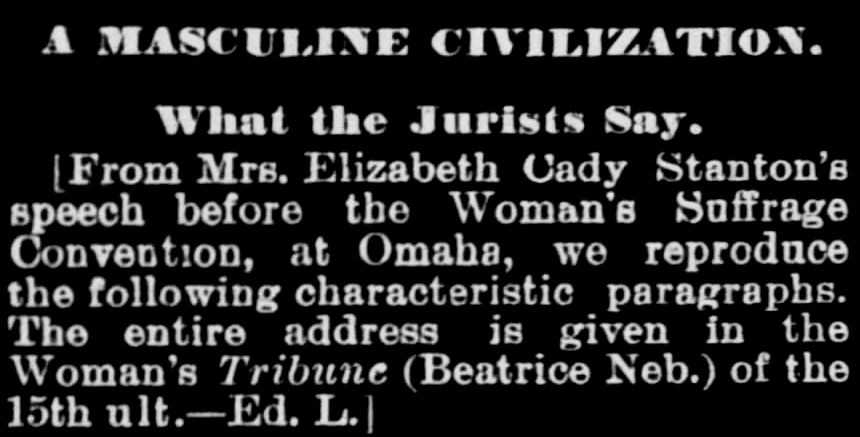
A Masculine Civilization – Elizabeth Stanton, 1/11/1889
Republished from our predecessor publication Lucifer the Light Bearer
I propose to talk this evening to women on their duty to vote; to take an active part in government;
to cultivate the virtue of patriotism, and thus stimulate their fathers, husbands, brothers, and sons
to a conscientious discharge of their public duties. The majority of men are so absorbed in the daily
struggle for wealth that the most important interests of the masses are left to the management of a
small minority of politicians. We need every influence we can summon today to rouse men to their
duty. If women would use as much persuasion to get men to the polls and primary meetings as they
do to get them to the church, the opera, or evening parties, we should have better government. But
women use no influence in this direction because they have no appreciation of the importance of
suffrage for themselves. Many men never go to the polls, many more never attend a primary meeting,
and many, right or wrong, simply vote with their parties, quite regardless of platforms or candidates.
The consequence is corruption and imbecility in every department of government. Our journals, like
faithful watchmen on the towers, are continually warning the people of the danger of this apathy and
indifference of good men to their public duties, but few heed the warning. An editorial in The Bee (the
best journal this side of Chicago) of November 27, urging good men to attend the primary meetings
and reconstruct your city council, shows the pressing need of rousing men to their public duties: “It
is the duty of every citizen, whether he be Republican or Democrat, to attend his respective primary.
He should see to it that only reputable and trustworthy men receive the nomination of his ward. This
ought to be no idle appeal. The welfare, the prosperity, the future greatness of Omaha hang in the
balance. Nine honest councilmen can infuse vigor and honesty into the city government.
But nine boodlers can sink the city into corruption and hurry it into bankruptcy. It remains in the
taxpayers’ hands which of the two he will take. The exertions of a few hours at the primaries and
the polls on the part of our citizens for the selection of men of character to the council will be
worth more to the city of Omaha than all the endeavors made by our business men to attract
capital and immigration.” This appeal from one who understands the situation is an admission
of the fact that those who constitute the governing power of this city are not faithful to their trusts.
Now one reason for this is the ignorance of women in regard to questions of government and their
indifference to all interests outside the home. To my mind, the sphere of man and woman is the
same, only with different duties in that sphere. Their life work is side by side. Men should take
more interest in their homes and women more in the state. If woman’s desires and ambitions
are limited to personal adornment and family aggrandizement, we need not look for much public
spirit or lofty patriotism in the men of their families. If we would cultivate a higher political virtue in
the men of this nation, women must be made to feel their responsibility in the success of the grand
experiment of republican government. What should we think of a woman who, having inherited a
splendid estate, should, through the inefficiency of a husband, allow everything to run to waste and
ruin—house dilapidated, leaks in the roof, water in the cellar, lawn and garden overgrown with
weeds, grapery and conservatory dismantled, fences down, orchards and woodland plundered,
children playing in the streets and highways in rags, ignorance and vice?
Sensible people would consider her as great a failure as the man by her side, and far more guilty if
possessed of ordinary common sense and executive ability. It would clearly be her duty to supplement,
if possible, her husband’s incapacity with her superior ability and to take the helm of domestic government.
The religion of women is too often a sickly sentimentality, born of apathy and superstition, leading them
to accept with patience their present condition rather than meet the necessary friction in getting out of
the old grooves of thought and action to conscientiously assume the new duties that, in this transition
period, woman is called on to discharge. The family is but the nation in miniature, and the duty of the wise
wife and mother in the supposed care is the duty of the wise women of this republic in the present hour.
There is a large department of legislation that belongs specifically to women: questions of education and
religion; the sanitary conditions of our homes, schoolhouses, jails, and prisons; temperance; charities;
the treatment of criminals; marriage; divorce; prostitution; the rights of children; and the protection of
our domestic animals that cannot protect themselves. Our daily papers are filled with crimes of every
variety and degree that thousands of women weep and pray over in their homes, without a thought that
they are in a measure responsible for their existence. The question is often asked why it is that the moral
and spiritual progress of the race does not keep pace with its intellectual and material achievements. I
would answer: the moral and spiritual world belongs specifically to women, and she is not yet awake to her
duty in this realm of thought and action. The world of trade and commerce, of material wealth, discovery,
exploration, and invention, belongs specifically to man, and we can look with pride and thankfulness on
the wonders he has achieved in the last half century. In fact, man has accomplished all he ever proposed,
with two exceptions: he has failed to find out the nature of women, and the latitude of the North Pole.
Now, I do not think I could throw any new light on the voyage to the North Pole, but I could help him in his
researches as to the idiosyncrasies of Eve’s daughters. The key to the whole situation is found in the Golden
Rule. If man will simply accord women precisely what he would desire for himself under similar circumstances,
he will understand her nature as well as his own. Had woman fulfilled her duties in the world of morals as well as
man has in the material realm, we should now welcome as marvelous changes in social ethics, in the progress
of the race toward a true manhood and womanhood, in that inner life seen by the eye of Omnipotence alone.
As citizens of this great republic, we have an inheritance unsurpassed in the history of nations: boundless
acres, majestic forests, lakes and rivers, inexhaustible mines of wealth, and the institutions of a continent to
make and mold to our will. In our federal Constitution, Declaration of Independence, and republican theory
of government, we have a Magna Charta of rights such as the daughters of kings and emperors were never
pledged. Andrew Carnegie, in his Triumphant Democracy, has painted in glowing colors the grandeur of
our present outlook as a nation and the infinite possibilities of our future. Russia and America are the only
nations still in the act of growth. The rest have reached the zenith of their power and are looking toward
the setting sun. We are the only nation that has proclaimed the true idea of government. In the Old World
they have governments and people; here we have, in theory at least, a government of the people, by the
people, for the people, to be fully realized as soon as women—one-half the people—are enfranchised and
the laboring masses know how to use the power they possess. In the Old World, the palace on the hill is the
home of nobility; here it is the public school or university, where the children of rich and poor, side by side,
contest for prizes for scholarship.
Thus the value of character above all artificial distinctions—the great lesson of democracy—is early learned by
our children. There is no excuse for ignorance here; the circulation of our journals and magazines is fabulous
and so cheap as to be available to all. The Czar of Russia and the Tories of England might learn from our experience
that self-government and “home rule” are safe and possible, proved so by a nation of 65,000,000 people. Lord
Salisbury says: “The Americans have a Senate; I wish we could institute it here—marvelous in its strength and
efficiency. Their Supreme Court gives a stability to their institutions which, under the vague and mysterious
promises here, we look for in vain.” Such writers and historians as Sir Henry Maine, Froude, and Matthew
Arnold have all commented on our democratic institutions in most complimentary terms. Indeed, the whole
tone of English writers and travelers has entirely changed since they amused the world with ridicule of our
people fifty years ago. It is the duty of the republic, as viewed from this standpoint, that I urge the women of
this nation to defend and maintain. You have an equal share in this rich inheritance, and it is your duty to
vindicate your rights. Would that I could awaken in the minds of my countrywomen the dignity of this demand
for the right of suffrage—what it is to be queens in their own right, entrusted with the power of self-government,
possessed of all the privileges and immunities of American citizens. The ballot is the crown of honor and the
scepter of power in a republic; by it our social, religious, and political relations are all regulated. Are not the
educated women of America as capable of wielding this power as Victoria of England? And is not individual
sovereignty in a republic as exalted as in a monarchy? What American woman would scorn the position of
Britain’s queen? And yet the position of an American citizen is prouder far, if the duties of self-government are
fully discharged. Whoever heard of an heir apparent to a throne in the Old World abdicating his rights because
some conservative politician or austere bishop doubted women’s capacity to govern?
When I hear American women, descendants of Jefferson, Hancock, and Adams, say they do not want to vote,
I feel that the blood of the Revolutionary heroes must have long since ceased to flow in their veins. When I
heard that a body of Massachusetts women had actually been before their legislature to beg that the women
of the state might not be enfranchised, I blushed for my sex. In the year 1776, when our fathers sent forth
their Declaration of Rights, booming at the mouth of the cannon, it was heard round the world, electrifying
the lovers of liberty everywhere and making every crowned head tremble on his throne. And when later they
issued our national Constitution, reasserting the broad principles of justice, liberty, and equality, it was the
coronation day of our virgin republic. Then government and religion clasped hands. Luther’s inspiring motto
in the Reformation—individual rights, individual conscience, and judgment—was reasserted and has been
echoed and re-echoed through the last two centuries. Thus was humanity dignified, all caste and class, all
bills of attainder, all royal prerogatives abolished, and the oath administered in old Independence Hall
pledged the right of self-government to every man and woman under our flag. The time has fully come when
the principles of our government must be vindicated. The moral necessities of the hour demand the direct
influence of the educated women of this nation in government. The recent presidential canvass shows that
men are quite ready to avail themselves of woman’s help in emergencies, and she is equally ready to give it.
There were women speaking on different platforms for different parties throughout the campaign; women
marching in the processions, carrying flags and banners; some adding enthusiasm to public meetings by
playing musical instruments and singing quartets. Their pens have been busy, too, discussing the merits
of different parties and questions under consideration. There has never been a time in the history of our
nation when women manifested so much interest in an election.
If all this interest could have been represented in votes, the Republicans and Prohibitionists would have had
larger majorities, and a far greater number of women would have been aroused to their duties as citizens. I
do not say that the possession of the ballot will revolutionize the nation and transfigure womanhood instantly, but
it is the first step in that direction; it is the outpost to the temple of learning and power. To abolish all invidious
distinctions of sex will inspire woman with greater self-respect and give her opinions new weight in public affairs.
To dignify woman is to give our sons new lessons of reverence for the mothers of the race—for those who
have gone to the very gates of death to give them life and immortality. Thus far we have had a distinctively
masculine civilization based on the idea that society is constructed for the best interests of man alone. As he has
been the dominant power thus far during the reign of physical force, he has naturally, in all his arrangements,
consulted his own tastes and inclinations. Our best legal authorities, from Blackstone down to Kent and Story,
all take the ground that man and woman are not to be judged by the same moral code. This idea runs through
all our laws and judicial decisions in all cases in which man and woman, as plaintiff and defendant, appear in
our courts, and popular sentiment in social life reflects these decisions. Such are the sentiments and opinions
of men who are quoted as authority on this subject; and yet these “high priestesses of humanity,” while their
profession is considered a necessity, have no protection in church or state, under canon or civil law. Though
the victims of men, they are hounded like wild beasts from one shelter to another, dragged into the courts,
taxed by the state, robbed of their property, shunned by society at large, and left to perish on the highway.
While the women of wealth and position who shed tears over George Eliot’s portrayal of such wrongs in Adam
Bede, and in Hawthorne’s The Scarlet Letter, shun the hapless victims of our social system, they welcome the
destroyer to their domestic altars.
Alas! the cheapest article of commerce today is womanhood. A vast organized company, circumnavigating the
globe, has a profitable business buying and selling young girls in every market of the world; and like cattle, the
prices rise and fall according to demand—now east, now west, now north, now south—according as the tide of
emigration tends or as new sources of wealth are discovered. They form a recognized fraction of the army and navy
alike, in peace and war. When the terrible revelations were made in London three years ago, the world was startled
by the iniquities in high places. That was but a rift in the dark clouds that surround all womanhood, giving casual
observers only a hasty glance into a world of misery and crime. Speaking from woman’s standpoint of this dark
problem, one remedy I see is thorough education of our daughters for self-support and financial independence.
Open to them all the higher advantages and opportunities of life: free access to the universities of learning, the
trades and professions, the positions of profit, honor, and distinction. Let us reverence the woman who honestly
earns her own bread rather than her who lives in luxurious ease on the toils of another. Virtue and independence
go hand in hand. Alexander Hamilton said long ago, “Give a man a right over my subsistence and he has a right
over my whole moral being.” And while planting woman’s feet on the divine heights of purity and peace, we must
sedulously educate our sons into higher sentiments of chivalry and reverence for the whole sex. It is the duty of
every man to treat all women as he would wish his own mother, wife, sister, or daughter to be treated. Surely, if
honor is demanded anywhere, it is in the relations of men and women. If a gentleman in a game of billiards finds his
friend cheating, he lays down his cue and plays with him no more. If in business he finds him guilty of questionable
honesty, he avoids all relations thereafter. But if a man enters home after home and despoils the daughters of the
people, it does not close the doors of good society to him nor lessen his chance of holding the highest position
under government. Ah, my friends, so long as this is our moral code, we shall have the social chaos we now suffer
—yea, worse still; for in woman’s transition from slavery to freedom she will more surely, year by year, avenge her
own wrongs, feeling that she has no protection elsewhere.
The antagonism between the sexes is daily increasing and will continue until justice, liberality, and equality
are vouchsafed to women. And yet, in natural confinement, they are bound to each other by every law of
attraction. It is this fine, almost invisible cobweb of faith that men and women have in each other that binds
society together—a faith, though often disappointed and betrayed, that makes for the few a love and friendship
that may endure through time and eternity. Whether for weal or for woe, women must be equal actors in civilization;
hence, she has a right to a voice in the laws that affect her welfare. From our standpoint we say: one code of
morals for man and woman; and nature, by the terrible penalties she has inflicted on the race for the violation
of this law, has set the seal of condemnation on the present system and verified the warning given amid the
thunders of Sinai: “The sins of the fathers shall be visited upon the children to the third and fourth generations.”
This whole social problem is too vast for man to adjust alone. The interests of both parties must be equally
regarded in any valid contract—and surely in the one on which rests our whole social fabric. Galton says the
brain of man is already overweighted with the requirements of this intense civilization, and to meet the still
more complicated problems awaiting his solution, the race must, by some means, be lifted a few degrees
higher. Where can we look for this new force but in the education, elevation, and enfranchisement of woman?