Sabbatarianism and Morality – Secular Thought, 7/20/1889
Republished from Lucifer’s sister publication Fair Play
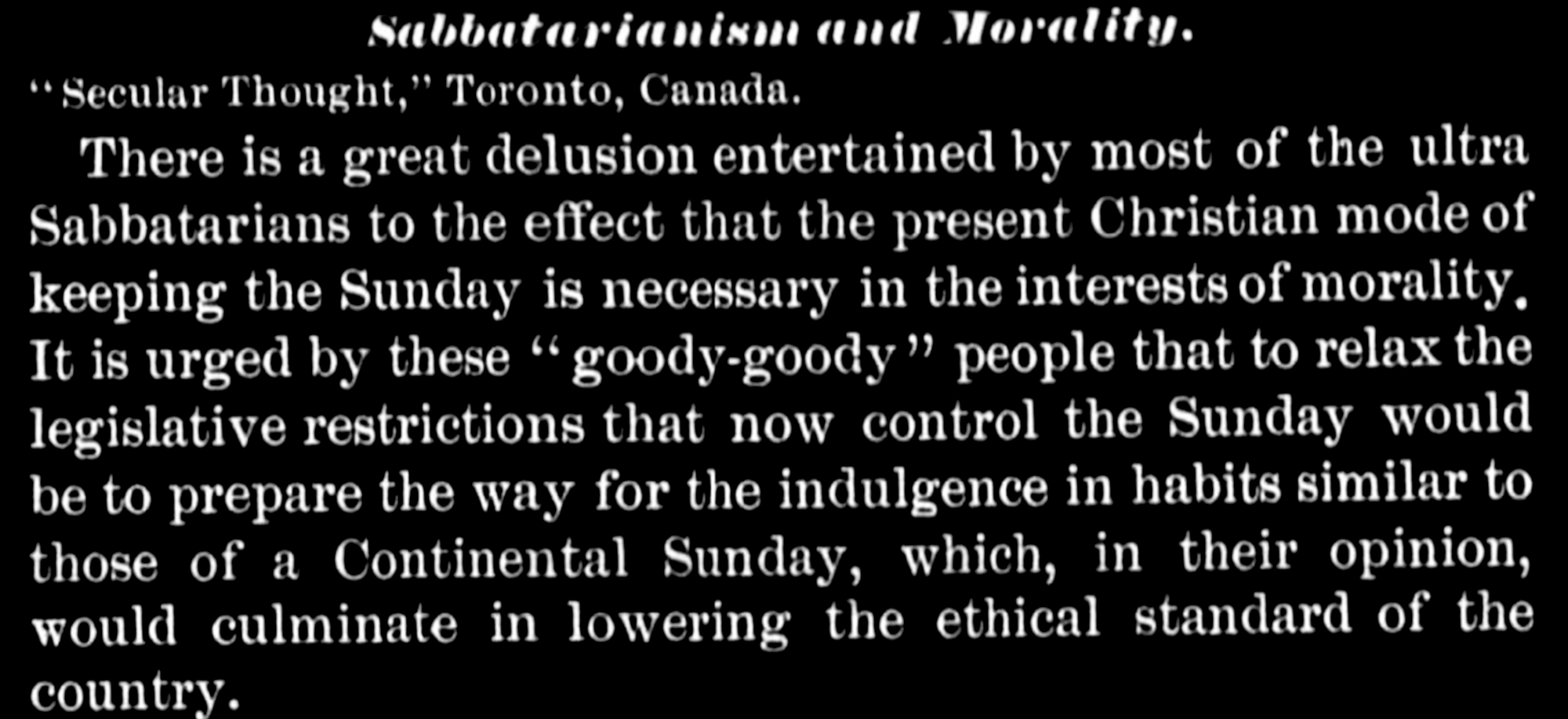
There is a great delusion entertained by most of the ultra-Sabbatarians to the effect that the present Christian mode
of keeping the Sunday is necessary in the interests of morality. It is urged by these “goody-goody” people that to relax
the legislative restrictions that now control the Sunday would be to prepare the way for the indulgence in habits similar
to those of a Continental Sunday, which, in their opinion, would culminate in lowering the ethical standard of the country.
So far from the above prognostication being justified by facts, the lesson from personal experience and general history
is that strict Sabbatarian countries have not been very remarkable for their high moral tone, and that in many respects
some Continental nations have actually been in advance of their Sabbatarian neighbors in moral culture and intellectual
refinement. For instance, take Scotland, where the Sabbath has been kept with severe rigor. In his evidence before the
British House of Commons a few years ago, Sheriff Alison, of Glasgow, a gentleman who may fairly be presumed to
know something practical on the subject, said: “I am sure there are eighty thousand people in Glasgow who are just
as completely heathens to all intents and purposes as the Hottentots of Africa. Of course, they have all heard there is
a God; but as to any practical operation of the influence of religion upon their minds, they never go to church, or to any
place where moral and religious instruction is carried on. I should think there are ten thousand men in Glasgow who get
drunk on Saturday night—who are drunk all Sunday, and are in a state of intoxication, or half-intoxication, all Monday,
and go to work on Tuesday….I am decidedly of opinion that the overstrained observance of Sunday in Scotland has
perhaps a more prejudicial than beneficial effect in manufacturing towns. I think that the observance of the Sunday in
Catholic countries on the Continent is much more conducive to benefit than the strict observance of it in Scotland.”
Prof. Tyndall also quotes the following testimony: “Puritanism with its uncompromising demands has had a sway of
three centuries in Scotland; and yet at this moment, in proportion to the population, the amount of crime, vice and
intemperance is as great, if not in some details greater, than it is in England.
But the most frightful feature of Scotland is the loathsome squalor and heathenism of its large towns. The combination
of brutal iniquity, filth, absence of self-respect, and intemperance visible daily in the meaner class of streets of Edinburgh
and Glasgow fills every traveler with surprise and horror.” It is only fair to say that since the above was written Scotland
has greatly improved, and it is significant to note that the improvement has followed the relaxation of Sunday laws
in that, in many respects, great and heroic country. Prof. Tyndall further states his own experience of a Continental
Sunday thus: “I have spent many a Sunday afternoon in the public gardens of the little university town of Marburg,
in the company of intellectual men and cultivated women, without observing a single occurrence which, as regards
morality, might not be permitted in the Bishops’ drawing-room.” (Pres. Address, pp. 42-43.) England maintains the
“sacredness of the Sabbath,” and yet the historian Froude could write of her as follows: “From the great house in
the city of London to the village grocer, the commercial life of England has been saturated with fraud. So deep has
it gone that a strictly honest tradesman can hardly hold his ground against competition. You can no longer trust
that any article you buy is the thing which it pretends to be. We have false weights, false measures, cheating and
shoddy everywhere. And yet the clergy have seen all this grow up in absolute indifference.” Toronto is pre-eminently
a Sabbatarian city, where the Puritanical observance of the Sunday is carried out with the strictest assumed solemnity.
All business is suspended, street cars are not allowed to run, newspapers are not permitted to be sold, and the
pulpits have a complete monopoly of public attention. Toronto has been fitly termed the “city of churches,” where
during Sunday a dogmatic gloom overshadows life’s sunshine, and the nightmare of theology reigns supreme.
Notwithstanding all this mock piety, and her many natural advantages and beauties, who can truthfully aver
that Toronto is remarkable for sobriety, virtue, and a high moral standing?
Has it not been deplored again and again by writers in the press that there is an air of insincerity pervading her churches,
and a lack of integrity lurking in her official circles? Within her theological domain hypocritical cant abounds in lieu of
practical earnest action, and instead of a bright and elevating freedom we have the tyranny of priestcraft and the gloom
of a despotic faith. Truly may Dr. Norman McLeod say that “in proportion to the strict enforcement of Sabbatarianism,
there would be multiplied those practical inconsistencies, dishonesties, and Pharisaic sophistries, which prove in all
ages supremely detrimental to morality and religion.” The horror professed by some modern Pharisees as to a free
Sunday is purely groundless. W. C. Gannett observes in his excellent Essay on “The Workingman’s Sunday”: “The
Continental Sabbath is by no means the abomination of desolation and profligacy described by those who fear it.
As the late Dr. Guthrie, of Edinburgh, was a true Scotch Presbyterian on the subject his testimony is noteworthy.
We ‘counted on one occasion,’ said the Doctor, ‘in Paris, thirty-three theatres and places of amusement open on
the Sabbath day. Coming home, in one hour we saw in London and Edinburgh, with all her churches and schools
and piety, more drunkenness than we saw in five long months in guilty Paris.'” From the same writer we quote the
following evidence in favor of opening the public library and art institutions on Sundays: “There is the Public Library
reading-room. In Boston it took ten separate struggles, during a seventeen years’ campaign, beginning with a
hardly-listened-to proposal in 1856, and embracing long discussions in the city councils and the papers, repeated
hearings of petitioners and remonstrants, two mayors’ vetoes and two appeals to the Legislature,—to open the
doors to him [the working man]. Feb. 9, 1873, saw him at last allowed to enter. He has scanty time for papers
or magazines through the week and there he finds a feast of them. If you go there, you will see him any
Sunday afternoon or evening.
According to the last report of the Boston Library, at its central reading-room, it takes on the average, that day, four
hundred and seventy-six periodicals to feed him and his fellows,—the winter average, apart from the summer, much
exceeding this, and on full Sundays the congregation overflows into the next room. A very considerable portion are
persons who do not, or cannot, visit the Library on week-days,—reporters, mechanics, and those who work early
and late. The Milwaukee Library ventured to do the same in 1868 or 1870. In Philadelphia the Mercantile Library
also followed suit in 1879. Before the second year was out, the attendance averaged seven hundred, ‘nearly all
young men,’ and it reports gradually increasing numbers ever since. The Cincinnati Public Library, opening its doors
on a March Sunday of 1871, has, the past year, averaged over eleven hundred in its Sunday reading-rooms. In
Philadelphia the new Academy of Arts is open on that day at the week-day price; the attendance is larger than on
week-days, and of about the same character; ‘many in humble life, who could not come through the week, enjoying
the exhibition to their heart’s content, some even carrying babies rather than not come.’ The Zoological Gardens
there are also open; and, at the usual price, the attendance on Sundays is ‘at least three times greater than
on week-days; the class of visitors averages about the same, and it is always orderly.’ Abroad the thing is past
experiment. In the German city Sunday is the people’s free day at the Galleries. In Berlin it is Monday that sees
them closed and their custodians resting. In Paris it is said that the book most applied for at the lending libraries, on
Saturdays, is the guide-book to the Museum for the next day’s treat. That next day the Louvre opens its departments
exceptionally wide. Going there, you find the rooms possessed by working men and peasants, whole families down
to the awed children, each one dressed and mannered at his best, enjoying it together. In English Birmingham they
dared the experiment three or four years ago with good success. In Dublin, both the Botanical and the Zoological
Gardens are opened Sundays, and have three times as many visitors as on all the other six together.” The facts here
given are of more importance in the calm consideration of this question than all the rash statements and fanatical
denunciation of theologians, who are, of course, interested in perpetuating the superstition of the Christian Sunday.