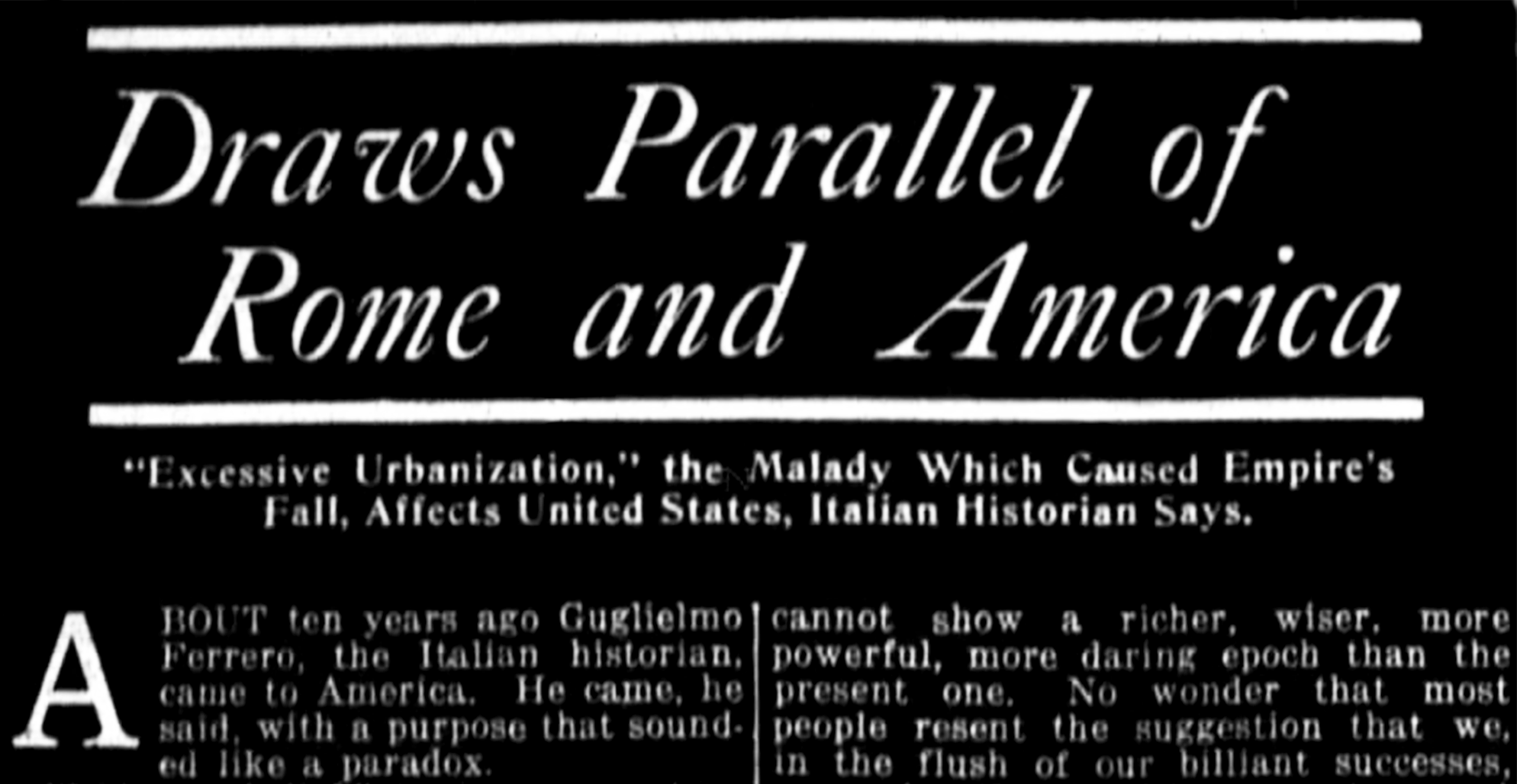
Parallel of Rome & America – Guglielmo Perrero, 6/10/1920
About ten years ago, Guglielmo Ferrero, the Italian historian, came to America. He came, he said, with a purpose
that sounded like a paradox. “It is my belief,” he told his lecture audiences, “that a journey in the New World is of
supreme intellectual benefit to a historian of the ancient world, and that, in order to understand the life and history
of Greek and Roman society, it is just as important to visit the countries of America as Asia Minor or Northern Africa.
Many of you Americans go to European universities to study ancient history. It seems to me that you might well invite
many European professors to come and go through a finishing course in America, studying not only in libraries but
in the live world and observing what is happening in American society. Nobody is in a better position than you are
to understand ancient society.” Ferrero was a refreshing variant of the usual type of foreign student of our manners,
morals, and institutions. The tall buildings, the pride of the cities, the colossal fortunes, the fetish of progress, the
fever of speculation, the orgies of luxury, and the clashing of classes impressed him not as things for supercilious
criticism or humorous comment, but as phenomena for the profound consideration of the historian and the socio-
logist. Before coming here, he had completed a monumental work, “The Greatness and Decline of Rome,” in which
he proved that the true history of Rome had never been written, and in which he demonstrated that the decline and
fall of that ancient civilization was brought about not by military or political causes, but by the slow growth of a
cancerous disease that infected the body politic and gradually undermined its vitality.
Urbanization: A Disease
The malady from which the greatest empire of the world died was excessive urbanization — the growth of the
cities at the expense of the productive areas of the country. Little by little, through the centuries, the great lode
-stones of the Roman cities, with their advancing prices and swelling luxuries, overbalancing the producing
power of the country, had sapped the vital energies of the nation and precipitated into chaos the most brilliant
and prosperous civilization the ancient world had known. Leaving our shores after a close and sympathetic
study of American institutions, culture, progress, art, social expression and exploitation, and the sociological
and economic undercurrents of American life — and with the statistical facts of a newly made United States
census at hand — he was deeply impressed with two great outstanding facts that contained elements of alarm:
the rise in the cost of living and the luxury and growing allurements of the big cities. Comparing, in accordance
with his new philosophic method of studying history, the ancient Roman civilization (from the study of which he
had just emerged) with the modern American civilization whose phenomena had been under his observation,
he reached the conclusion that history was again repeating itself, and that the germs of the disease of urbanism
that killed Rome were rapidly increasing and multiplying in the American commonwealth. The reign of extrava
-gance, the increased cost of living, and the growing preference for city rather than country life — even ten
years ago Ferrero saw the menace of these symptoms of the hidden disease. On his return to Europe, he
wrote a book — “Ancient Rome and Modern America” (Putnam’s Sons) — to prove that America is fast
entering into the maelstrom of urbanization and is in imminent peril of treading the same paths that led
to the downfall of the ancient empire.
Theory Being Proved?
Ten years ago Ferrero’s theory was regarded as rather fanciful. But today, with prices soaring far beyond the basis
from which he theorized, and with another census daily flashing forth alarming confirmations of his urbanization
deductions in the enormous growth of the cities and the decline of the rural populations, the warnings of the Italian
historian are beginning to command more sober attention. Are we really riding to a Roman fall? Ferrero says we
are, but he is no pessimistic philosopher. He does not say that the fate of ancient Rome is to be ours. There are
resemblances, but there are also differences — there are leavens that may save us whole. He makes no prophecies;
he merely states the facts as he sees them and sounds a friendly warning. Here is the way he makes out his case:
“Is it permissible to talk of decadence at the very moment when man has made himself lord of the whole earth and
is even learning to fly? History cannot show a richer, wiser, more powerful, more daring epoch than the present one.
No wonder that most people resent the suggestion that we, in the flush of our brilliant successes, are seeing the
repetition of that ancient and terrible history of the last centuries of the Roman empire, which was one of the saddest
and deadliest episodes in the world’s history. “And yet that history is repeating itself, to a certain extent at least.
The showy wealth and the noisy triumphs of modern civilization veil, but do not hide, this recommencement de
l’histoire from him who studies, in a spirit of philosophy, our times and the decadence of the Roman empire. “The
disease which killed the Roman empire was in fact excessive urbanization. Neither the attacks of barbarism from
outside, nor those of Christianity from within, would have prevailed against its might and its massive weight if the
strength of the colossus had not been already undermined by this internal cancer.
Era of Increased Wealth
“After two centuries of war, an epoch of rapid increase of wealth, of lucky enterprises, of frequent, close and varied
commercial and intellectual intercourse between the most distant peoples began. In every part of the empire new
industries and agricultural enterprises gave rise to a prosperous middle class and to provincial aristocracies —
nouveaux riches families — which gradually came to form the governing classes of the empire, migrated to the
cities, strove to enlarge them, to embellish them, and to make them more comfortable, reproducing in every part
of the empire the splendors of the urban civilization as perfected by the practical Roman spirit of organization.
“The empire covered itself with cities, great and small, rivaling each other in splendor and wealth; and into these
cities, at the expense of depopulating the countryside where nobody was willing any longer to live, it attracted the
peasantry, the village artisans and the yeomanry. In these cities schools were opened in which the youth of the
middle class were taught eloquence, literature and philosophy, and trained for official posts, the number of which
increased from generation to generation, and for the liberal professions. “With each succeeding generation, the
impulse towards the cities became stronger. The numbers and the requirements of the urban population increased.
“In order to feed, amuse and clothe the crowded city populations; to carry through the construction of magnificent
monuments whose ruins we still admire; to provide work for the industries and arts of the cities, agriculture was,
little by little, ground down by everlasting burdens. The position of the peasant, in the solitude of the depopulated
countryside, became ever more sad and gloomy, just as the cities became fairer, bigger, fuller of amusements
and festivals.
A City of Idlers
“And one day the empire awoke to find that its cities were swarming with beggars, idlers, vagabonds, masons,
plasterers, sculptors, painters, dancers, actors, singers — in short, the whole tribe of the artisans of pleasure
and luxury. But in the fields, which were expected to feed all these men who had crowded into the cities to
work or to idle, there was a dearth of peasants to cultivate the land. While the cities tricked themselves out with
magnificent monuments, the empire was threatened with a dearth of bread — and of soldiers. The agriculture
of the empire, and with it the empire itself, received its death blow. “Today, Europe and America resound from
one end to another with a chorus of complaints from men and women who have to live in the cities. Rent, bre-
ad, milk, meat, vegetables, eggs, clothes — everything, in short, is rising in price. Governments are besieged
with entreaties, threats and prayers to provide supplies, but they do not know how to do so. What is the cause,
what the remedy, of this strange phenomenon? Some lay the blame on the taxes, some on Providence, some
on the merchants and speculators. And, indeed, at first sight, the phenomenon seems inexplicable. “At no
period of history was there such a determined rush to make money as at the present time. No age had at its
disposal so many and such effective means of making it. The men of today are obsessed to such an extent by
the frenzy for work that they no longer have time to live. How comes it, then, that men everywhere complain,
and most loudly in the richest countries, of the intolerable dearness of everything?
Phenomenon in America
“In no country is this phenomenon more apparent and interesting than in the United States. In no country of
Europe are complaints of the expense of living more generally and loudly raised than in the United States.
Why? Because in America the disproportion between the progress of the country and that of the cities, bet
-ween industrial progress and agricultural progress, is even greater than in Europe, the home of populations
which for centuries have been accustomed to a country life. Consequently the scarcity is greater and more
vexatious in the United States, because the wealth of that country is greater than that of Europe. “This scarcity
is a graver and more complex phenomenon than those who most complain of it suppose, and it is not the
fault of government or traders. It is a veritable recommencement de l’histoire, and the study of the Roman
empire can be of the greatest service in helping us to understand it. It is the first serious, universally felt
symptom of that excessive urbanization which was the ruin of ancient Rome. “This modern society arises
from the over-development of the cities, from the too rapid increase in the needs and luxuries of the multi-
tudes who live in the cities. Men and women concentrate in the cities and swell the urban industries and
luxury, public and private, intent on putting into operation all the marvels which the fertile modern genius is
continually inventing. The countryside, on the other hand, in the last half century has been left too much to
itself, and agriculture has been too much neglected, exactly as began to be the case in the Roman empire
at the beginning of the second century of the Christian era. It is easy to guess what must be the natural
consequences of this lop-sided arrangement.
Bankrupting Agriculture
“The cities grow bigger; industries increase in number; the luxury and needs of the masses, crowded together
in the cities, augment. On the other hand, there is no proportionate increase in the productiveness of the land.
And so the increase in wealth is accompanied by an increasing scarcity of the fruits of the earth, and the things
which serve to clothe and feed us — cotton, linen, hemp, wool, cereals, meat, vegetables — nearly all rise in
price much more than do manufactured goods. “And can we honestly declare that our epoch is untainted by the
mania for grandeur and display which caused the ancient Roman empire to squander such vast treasures and
cloaked its fatal decadence with a vesture of splendor? I cannot suppose that our freedom from such taint wo-
uld be maintained by anyone who remarked the headlong growth of public and private luxury, the ever-swelling
vanity of nations, professions and classes, the tendency to mistake in everything the grandeur of colossal pro
-portions for the grandeur of intrinsic virtue. “Whoever casts his eye around him, in America as in Europe, sees
this impression gaining ground on all sides and acquiring force. “The history of Rome admonishes us to distrust
this illusion and to sound the spirit of our civilization to its deepest depths — that spirit which to us seems a limpid
mirror of perfection while it is really very much the opposite. The vices, the faults, the depraved inclinations of
twenty centuries ago remain the same today, and modern civilization would be guilty of the gravest of errors if,
deaf to the great lesson preached by the ruins of Rome, she boasted of those very defects which destroyed in
the ancient world one of the greatest works of human brain and energy that history has to offer.”