Theory & Practice – Unknown, 8/18/1888
Republished from Lucifer’s sister publication Fair Play
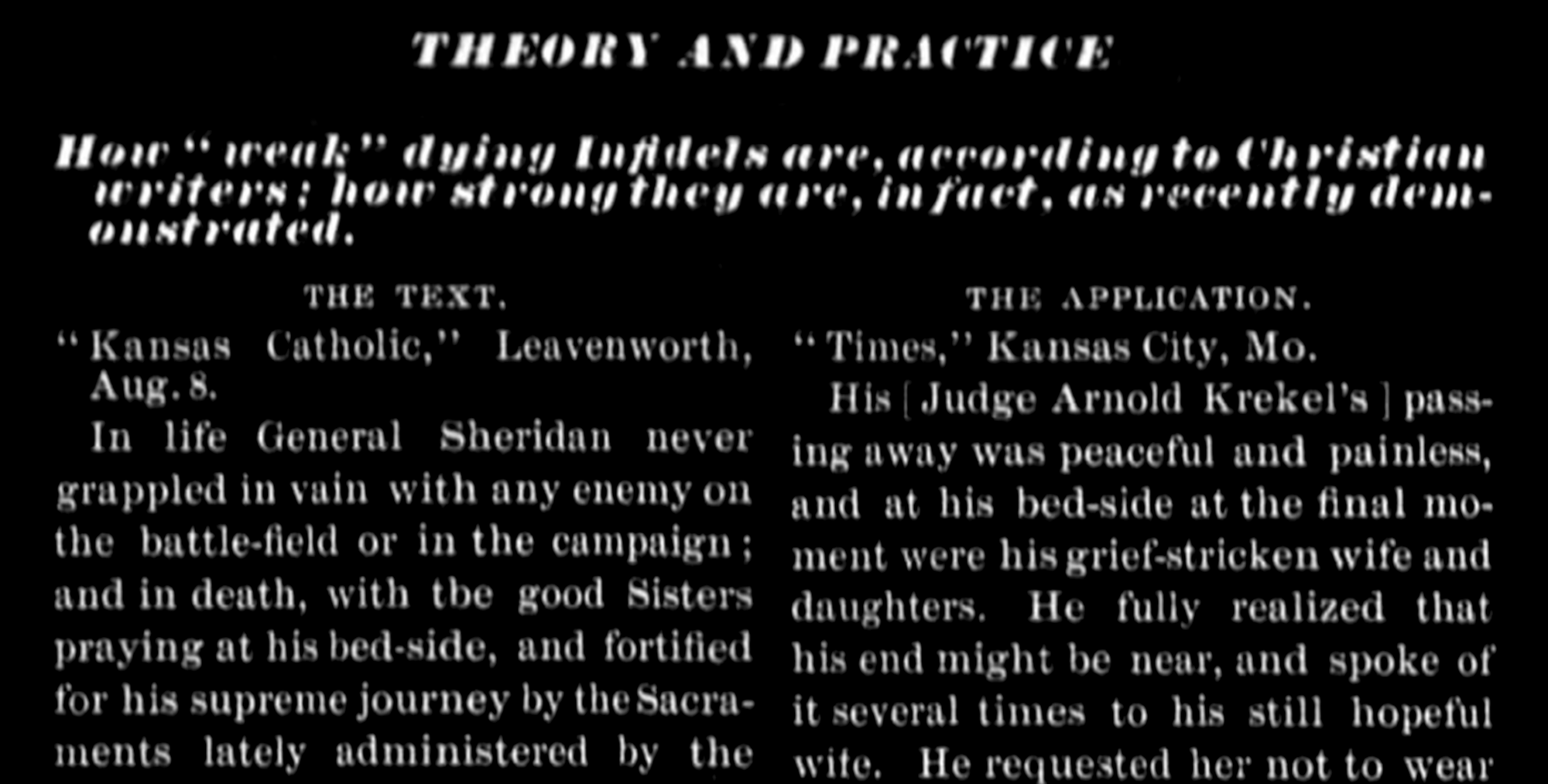
How “weak” dying Infidels are, according to Christian writers:
how strong they are, in fact, as recently demonstrated.
“Kansas Catholic,” Leavenworth, Aug. 8.
In life General Sheridan never grappled in vain with any enemy on the battlefield or in the campaign;
and in death, with the good Sisters praying at his bedside, and fortified for his supreme journey by the
Sacraments lately administered by the priest of the Catholic Church, he fought an infinitely greater battle
with an infinitely more dreadful enemy—his spiritual enemy—and our great hope is that in that supreme
moment the Immaculate Mother helped him to victory. How powerless are all the powers of the world
in that supreme moment, the moment of death; how dark is that battlefield to the man who has not the
light of Faith; how hopelessly weak is the man who does not possess the arms of the Sacraments of
the Church in that supreme and final fight with his eternal foe.
The Application.
“Times,” Kansas City, Mo.
His [Judge Arnold Krekel’s] passing away was peaceful and painless, and at his bedside at the final moment were
his grief-stricken wife and daughters. He fully realized that his end might be near, and spoke of it several times to
his still hopeful wife. He requested her not to wear mourning, saying that death was as natural as birth, and that
the emblems of mourning were unnecessary and useless. He was very much averse to ceremony, and requested
that the last rites be as simple as possible. It was his wish that he might be laid to rest at St. Charles, where his
first wife and two children are buried, and thither the remains will be taken. Although of Catholic antecedents,
Judge Krekel was a pronounced Agnostic, and his children and immediate relatives hold liberal religious views.
“Sun,” New York.
The death of Courtlandt Palmer is another of the refutations of the assertions that the death-bed of the unbeliever
is an agonizing one. Mr. Palmer seems to have entered the dark valley with serenity and composure fully equal to
the many graphic pictures of the last hours of saints which are to be found in religious literature. Here was a man,
still young, blessed with every material source of happiness, who has never had a proper desire ungratified, who
rejoiced in a delightful home, who had resources for the keenest intellectual enjoyments—approaching death, not
nonchalantly nor with flippant affectation of indifference, but like a philosopher about to put his philosophy to the
supremest test. He seemed to rejoice in the sense of victory, and to be anxious that the world should know of his
experience. These two instances of the peaceful deaths of Freethinkers should be enough to convince Mr. O’Flanagan
of the Catholic that his premises are unsound. Here are two more which I respectfully request him to remember
when next writing upon the supposed weakness of Freethinkers in the hour of dissolution. Both the following
extracts are taken from the New York Sun of July 29th, ’88.
Dr. Beard
Beard lay down in his bed in an uptown hotel to die. Pneumonia had fastened upon his delicate lungs, and he
knew that his illness was mortal. Did he then bewail his fate—cut off in his prime, and when his life-plans were
far-reaching and aimed for the benefit of mankind? Instead, he dictated to his wife his experiences as a sufferer.
He jotted down with feeble hand what Beard intellectual made of Beard moribund, and when his breath came
fast and short and with the agony of pain from each inhalation he still made effort to preserve his experience
with the hope that physicians might thereby learn something of this disease which would help them to master
it when others were afflicted. Once when he returned from the realms of unconsciousness he made a feeble
effort to tell its story, and the only agony he seemed to suffer during his illness arose from his failure more fully
and satisfactorily to preserve the record of his illness.
Senator Matt Carpenter
One morning after examining a test which plainly indicated that dissolution was not far away, he spoke of
it calmly to his partner, discussed it as he would a piece of testimony that he intended to introduce in a law
case, and then quietly made some notes of a speech he intended to make in the Senate. He entered the
Senate chamber, his face whiter than his hair, bantered and perplexed a fellow-Senator on the subject of
establishing a consular court in China. With one hand in his pocket and all his exquisite melody of voice
and charm of diction, he delivered a speech on this unusually dry subject that entranced the Senate, and
then as unconcernedly as though going to the restaurant for lunch, put on his heavy fur-lined overcoat,
stood at the door of the Senate a moment, looking around for what he knew was his last glance, and
quitted the chamber forever. And while he was making the speech, with his hand in his pocket, he held
in it the vial which contained the test that told the story of his speedy death.